
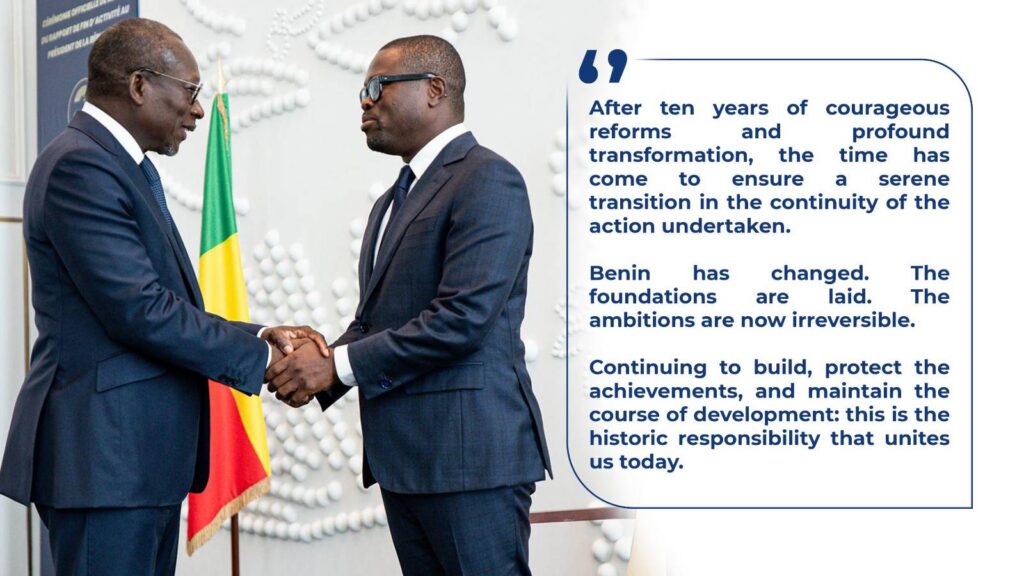
The political landscape of Bénin is undergoing a historic transition. As the nation prepares to welcome its incoming president, Romuald Wadagni, outgoing leader Patrice Talon delivered a solemn farewell address to the country—a moment that closes a transformative decade defined by his signature policy of the “Break with the Past.”
The outgoing president’s reflective assessment
In a televised address broadcast nationwide, President Talon presented a detailed account of his tenure, which began in 2016. He emphasized the depth of structural reforms, fiscal discipline, and accelerated infrastructure development that reshaped the nation’s economic and social fabric.
Yet, the president did not shy away from acknowledging the sacrifices demanded of the Bénin population. His candid remarks underscored the necessity of unpopular but critical decisions to propel the country forward and restore its standing on the global stage.
« Progress has come at a cost, » he stated, « but these sacrifices were essential to breaking free from underdevelopment and securing long-term prosperity. »
A seamless transition of governance
At the heart of the address was a deliberate endorsement of continuity. By publicly endorsing Romuald Wadagni—his former Minister of Economy and Finance, and the architect of the administration’s economic strategy—Patrice Talon signaled a seamless handover that prioritizes stability and institutional continuity.
The president emphasized that Wadagni’s leadership would ensure the sustainability of national recovery efforts while paving the way for a new phase of governance centered on consolidation rather than upheaval.
The legacy of a decade of reform
President Talon’s tenure was marked by decisive economic and structural transformations:
- Economic stabilization: A rigorous overhaul of public finances and improved sovereign credit ratings.
- Urban renewal: A sweeping road infrastructure program that transformed cities across the country.
- Industrial growth: The establishment and expansion of the Glo-Djigbé Industrial Zone (GDIZ), a cornerstone of industrialization.
The challenges ahead for the new administration
While the nation stands transformed, President-elect Wadagni faces pressing challenges that demand immediate attention. The priorities are clear and urgent:
- Economic equity: Restoring purchasing power and ensuring equitable distribution of growth benefits.
- National cohesion: Easing political tensions and fostering dialogue with opposition groups.
- Security imperatives: Strengthening border protection and countering terrorism in the northern regions.
A democratic milestone
Patrice Talon’s decision to step down after two terms marks a rare moment of democratic fidelity in West Africa. Unlike regional peers who have altered constitutions to extend their rule, Talon adhered strictly to constitutional limits—sending a powerful message about the strength of Bénin’s institutions.
As the capital, Cotonou, gears up for the official inauguration, the nation stands at the threshold of a new chapter. The era of “Break with the Past” is concluding, making way for a future built on pragmatism, continuity, and democratic resilience.



More Stories
Niger: Tiani faces fallout from special forces anger after Russian intervention
Crisis in Niger, IMF agreement in Sénégal, and Moroccan elections: Five essential stories
RDC-Israël : un rapprochement aux enjeux multiples