
Bénin marks peaceful political transition with new president
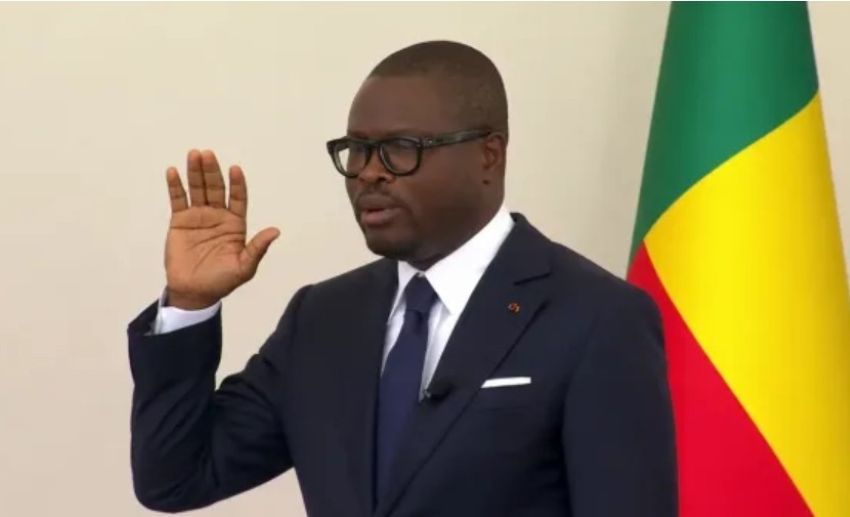
Cotonou, Sunday, May 24, 2026 — Bénin has delivered one of Africa’s most compelling political moments this year. In an atmosphere of rare solemnity on the continent, Romuald Wadagni was sworn in as the new President of the Republic, succeeding Patrice Talon after two constitutionally compliant terms. This peaceful transition sent a powerful message across West Africa and beyond.
The ceremony underscored a major political statement: a smooth, institutionalized handover of power. At 49, the former Finance Minister assumes leadership in a continent where political transitions often face fragility, contestation, or military intervention. The sight of Patrice Talon calmly witnessing his successor’s installation—surrounded by former Béninese heads of state—carried deep symbolic weight, illustrating a rare commitment to institutional integrity over personal power.
A democratic milestone for West Africa
The inauguration in Cotonou transcended national boundaries. Diplomats, African political leaders, institutional representatives, and international observers recognized this transition as a strong political signal amid regional turbulence. West Africa has faced recurring institutional crises, military coups, and presidential succession disputes. In this unstable climate, Bénin’s handover from Patrice Talon to Romuald Wadagni stands as a rare exception.
Talon’s voluntary departure after two terms marks a significant departure from regional trends. While some African leaders have altered constitutions to extend their rule, Bénin’s outgoing president honored the constitutional framework, reinforcing the country’s reputation as one of Francophone Africa’s most stable democracies.
In Cotonou’s streets and across African social media, images of this transition sparked widespread praise, with many calling it a “democratic lesson” during a period of profound political reshaping on the continent.
Romuald Wadagni’s leadership challenge
Romuald Wadagni’s presidency ushers in a new political phase for Bénin. A respected technocrat and former Finance Minister instrumental in economic reforms under Patrice Talon, the new leader inherits a nation undergoing deep economic transformation but facing significant social challenges.
In his inaugural address, Wadagni emphasized continuity in structural reforms while pledging to accelerate policies aimed at improving living conditions. His background resonates in African and international economic circles, where he is seen as part of a new generation of leaders prioritizing economic management, administrative modernization, and public efficiency over traditional political maneuvering.
Yet this technocratic image also presents challenges. Beyond macroeconomic performance, social expectations remain high: youth employment, cost of living, infrastructure development, access to public services, and inequality reduction will test the new administration. Wadagni must also delicately balance preserving institutional stability inherited from Talon’s presidency while gradually establishing his own political identity.
A continental call for democratic renewal
The inauguration of Romuald Wadagni resonates far beyond Bénin’s borders, arriving at a moment when Africa grapples with profound questions about democratic models, institutional credibility, and the capacity of states to facilitate peaceful transitions.
The most powerful symbol of the day may not have been the oath itself, but Patrice Talon’s calm and unequivocal presence, witnessing the power transfer without tension or ambiguity. In many African nations, this image has been interpreted as proof that alternative political pathways remain possible—where institutions prevail over individuals, and stability is rooted in rule adherence rather than power personalization.
Bénin has reaffirmed its political uniqueness, demonstrating its ability to orchestrate a presidential succession within republican continuity, free of major crisis or institutional rupture. In an Africa seeking new democratic benchmarks, this moment could leave a lasting imprint on the continent’s political imagination.


More Stories
Niger: Tiani faces fallout from special forces anger after Russian intervention
Mali : 17 morts dans les rangs des dozos, le JNIM accentue sa pression
Sahel : le pari des juntes tourne-t-il à l’échec sécuritaire ?