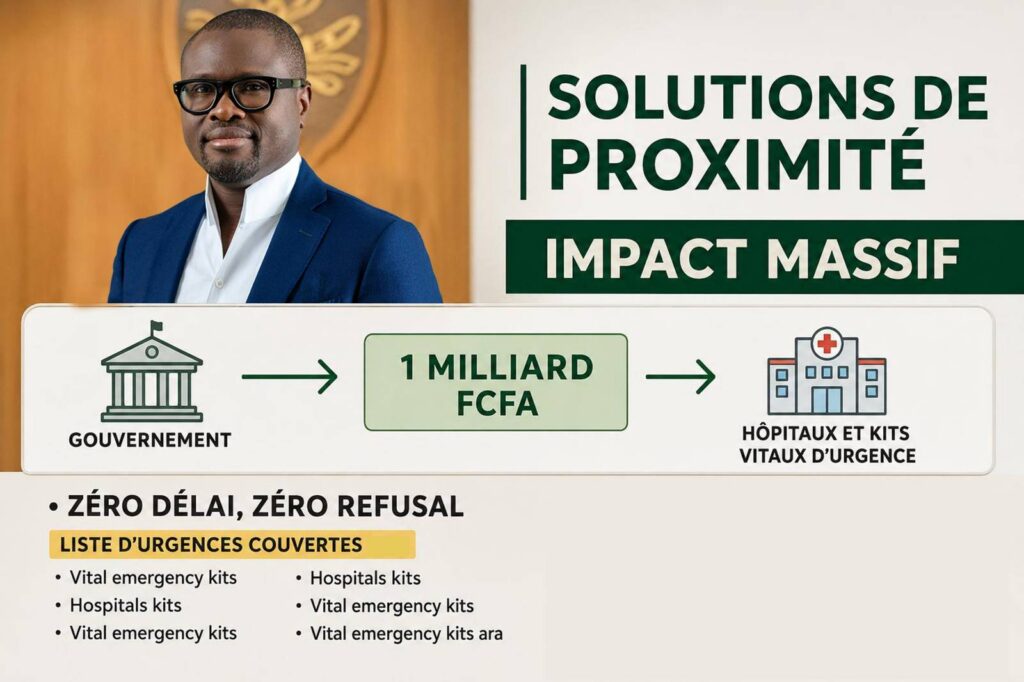
On Wednesday, June 3, 2026, President Romuald Wadagni announced a landmark financial allocation of one billion West African CFA francs. Earmarked exclusively for public health facilities, this unprecedented funding initiative is designed to ensure the systematic provision of free vital emergency care. Behind this substantial investment lies the potential to transform the lives of tens of thousands of vulnerable families across the nation.
“First, we heal. The financial discussion comes later.” With these resolute words, the Head of State underscored a pivotal shift in the nation’s healthcare policy. By securing a permanent one-billion-franc guarantee for public hospitals, President Wadagni is directly confronting one of the health system’s most insidious challenges: preventable deaths caused by immediate financial inability to access critical medical care.
The newly implemented mechanism guarantees automatic coverage for all life-threatening emergencies, including road accidents, severe obstetric complications, respiratory distress, and cardiac arrests. From this point forward, the absence of immediate funds or family support will no longer delay the delivery of life-saving interventions.
Estimated Reach: How Many Families Will Benefit?
While official records do not quantify the exact number of beneficiaries—given the inherently unpredictable nature of medical emergencies—an assessment of standard emergency care costs in public hospitals provides insight into the initiative’s profound impact.
Based on average expenditures for emergency kits, consumables, and stabilizing procedures—ranging from 25,000 FCFA for moderate cases to 100,000 FCFA for severe trauma or major surgical emergencies—this one-billion-franc allocation is projected to support between 10,000 and 40,000 patients in life-threatening situations.
In Benin, hospitalization frequently triggers severe financial strain for entire households. By shielding these patients from the burden of emergency fees, the initiative indirectly safeguards up to 200,000 citizens from catastrophic debt, asset liquidation, or sudden loss. This financial buffer serves as a protective measure for the nation’s most economically vulnerable populations.
Empowering Healthcare Professionals
Beyond its financial scope, this decision liberates medical staff from an ethical dilemma they have long faced: the necessity to delay treatment until payments are secured. Doctors and nurses in public hospitals will now be able to prioritize their primary duty—saving lives—without the ethical burden of financial constraints.
“No life should be lost because immediate funds are unavailable when urgent care is required. A human life is invaluable,” affirmed the President, reaffirming his commitment to building a more humane and protective healthcare system.
A Broader Vision for Accessible Healthcare
This one-billion-franc emergency care initiative is part of a comprehensive health strategy spearheaded by President Wadagni. To ensure optimal functioning of public health facilities, an additional 10 billion FCFA has been allocated to provide universal access to clean water and reliable electricity in all underserved medical centers nationwide.
Together, these measures mark a decisive step toward achieving universal healthcare access by 2030. The initiative demonstrates that medical efficacy cannot be separated from social justice. All attention is now focused on the Ministry of Health to ensure the seamless implementation and meticulous management of this emergency care fund, guaranteeing that every franc allocated translates into lives saved on the ground.