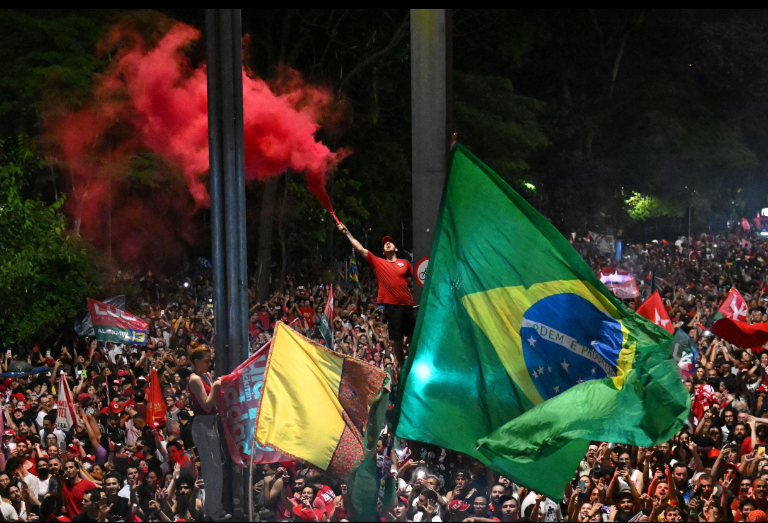
Lula secures fourth term while Bolsonaro’s camp escalates legal fight over ballot delays
Luiz Inácio Lula da Silva has claimed a historic fourth presidential term with 51.79% of the vote, defeating Flávio Bolsonaro by over four million ballots. However, the right-wing senator has refused to concede, launching a legal challenge to overturn the election results—a move that threatens to deepen political fractures across Brazil.
The Tribunal Superior Eleitoral (TSE) confirmed Lula’s victory with 64,256,232 votes, while Bolsonaro received 59,826,041 votes. Despite the clear numerical gap, Bolsonaro’s team has seized on last-minute procedural changes as grounds to contest the election’s legitimacy, raising concerns about institutional stability.
Controversial late-hour polling extension sparks legal battle
The heart of the dispute lies in a late decision by Supreme Court Justice Cristiano Zanin to extend voting until 7 p.m. in certain polling stations in Bahia and São Paulo, where transportation disruptions were reported. While the measure aimed to ensure electoral access, critics argue it disrupted the principle of equal treatment for all voters.
Flávio Bolsonaro’s campaign has condemned the decision as a violation of electoral integrity, alleging that the extension favored Lula’s base. In a statement to the press, he declared, “It is impossible to accept these election results under these conditions.” His legal team is now preparing a formal appeal to challenge the outcome, though no evidence of fraud has been presented.
Notably, both campaigns had previously requested extensions to address logistical issues—Bolsonaro’s campaign citing heavy rainfall in southern regions, while Lula’s team emphasized voter accessibility in urban peripheries. This adds another layer of complexity to the dispute, as neither side can claim unilateral unfairness.
Brazil’s political divide amplifies post-election uncertainty
The election has exposed stark contrasts in Brazil’s ideological landscape. Lula’s victory—cemented by his legacy of social welfare programs under the Workers’ Party (PT)—represents a triumph for left-wing policies aimed at reducing poverty and inequality. Meanwhile, Flávio Bolsonaro, son of the former far-right president Jair Bolsonaro, embodies a conservative movement prioritizing traditional values, security, and economic liberalism.
Jair Bolsonaro himself remains a polarizing figure, serving a 27-year prison sentence for his role in a plot to overturn the 2022 election. His continued influence, despite his incarceration, underscores the deep distrust in Brazil’s democratic institutions—a distrust further exacerbated by his son’s refusal to accept defeat.
The legal challenge now moves to the courts, where Bolsonaro’s team will seek to prove that the election’s irregularities warrant annulment. Yet even if the appeal fails, the damage may already be done: the contest has widened societal divisions, leaving the country at risk of prolonged political instability.
Lula’s challenges ahead: uniting a fractured nation
With over 48% of voters backing Bolsonaro, Lula faces an uphill battle in consolidating his mandate. A fragmented Congress, where conservative factions hold significant influence, could hinder his ability to implement sweeping reforms on healthcare, education, and economic recovery.
In his first remarks after the results, Lula struck a unifying tone, acknowledging that while not all Brazilians supported him, his responsibility now is to govern for the entire nation. Yet the specter of judicial challenges and lingering discontent threatens to overshadow his presidency from day one.
The question now is whether Flávio Bolsonaro’s legal fight will remain confined to the courts or spiral into a broader political crisis. One reality, however, is certain: Brazil’s democracy will be tested in the months ahead, as institutions scramble to reconcile a deeply polarized electorate.