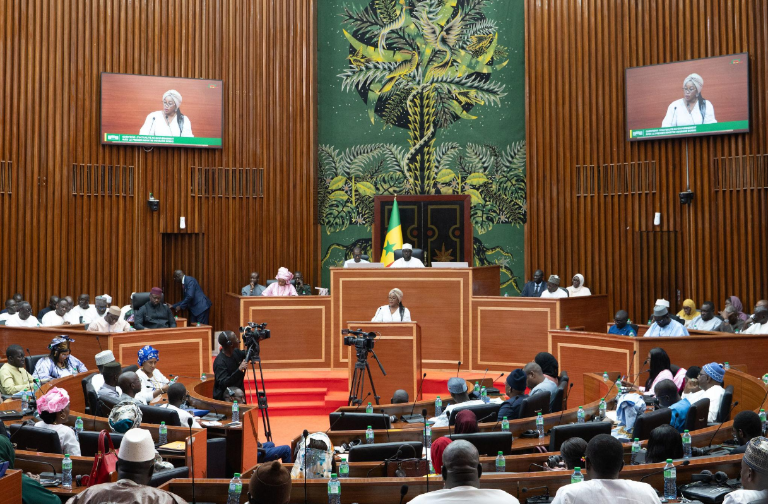
Consequences of a parliamentary rebellion on public finances
The Senegalese government is scrambling to secure support for its revised budget ahead of a critical parliamentary vote, after lawmakers from the ruling Pastef party rejected the draft in committee. This unexpected resistance threatens not only the adoption of the loi de finances rectificative, but also the broader economic stability of the country, leaving citizens and businesses facing uncertain conditions.
Why did the ruling party’s own MPs reject the budget proposal?
Despite belonging to the same political camp as the executive, several Pastef deputies opted to block the revised budget in committee on October 23, days before its scheduled plenary vote. The rejection signals deep internal divisions over fiscal priorities and spending choices, especially as the government seeks to balance economic constraints with public spending demands. While the exact reasons for the opposition remain unclear, the episode highlights growing parliamentary assertiveness even within ruling majorities.
Potential fallout for businesses and households
A prolonged standoff could have direct consequences for Senegal’s economy:
- Delayed fiscal adjustments: Vital budget corrections—such as revised tax measures, public investment cuts, or social spending reallocations—may be postponed, prolonging financial uncertainty.
- Public service disruptions: Delayed funding approvals might affect the rollout of essential services, including healthcare, education, and infrastructure projects.
- Investor confidence at risk: Economic instability and political friction could deter foreign and domestic investment, slowing growth and job creation.
Prime Minister Lô’s last-ditch negotiations
Prime Minister Ahmadou Al Aminou Lô is now focused on one objective: securing a compromise that salvages the budget while avoiding a full-blown institutional crisis. His strategy centers on direct talks with dissident deputies to clarify the government’s rationale and explore viable adjustments. The aim? To transform opposition into negotiation and prevent a legislative deadlock that could paralyze state finances.
Yet, the challenge is steep. The government must defend its economic strategy without appearing coercive, while the deputies must weigh their principles against the risk of destabilizing the country’s fiscal framework. With the plenary vote looming, the clock is ticking on both sides.
What’s next? Three possible outcomes
- A last-minute compromise: Parliament adopts a revised version of the budget, incorporating limited changes to satisfy dissenting voices without compromising core fiscal objectives.
- A legislative deadlock: The bill is rejected in plenary, forcing the government to either renegotiate the draft entirely or seek alternative financing measures.
- A constitutional impasse: Prolonged gridlock could escalate into broader institutional friction, raising questions about the effectiveness of Senegal’s governance model and the balance of power between the executive and legislature.
Beyond the budget: the deeper crisis of political coordination
This episode exposes a critical challenge for Senegal’s political system: reconciling majority discipline with parliamentary autonomy. While ruling parties traditionally toe the government line, this rebellion shows that lawmakers are increasingly willing to challenge executive decisions—even those they ostensibly support. The ultimate test will be whether this event sparks a new era of constructive debate or fuels further institutional friction.
As October 27 approaches, all eyes are on the dialogue. Will the government find the right balance between fiscal responsibility and political compromise? Or will this budget showdown deepen divisions and leave Senegal navigating uncharted economic waters?