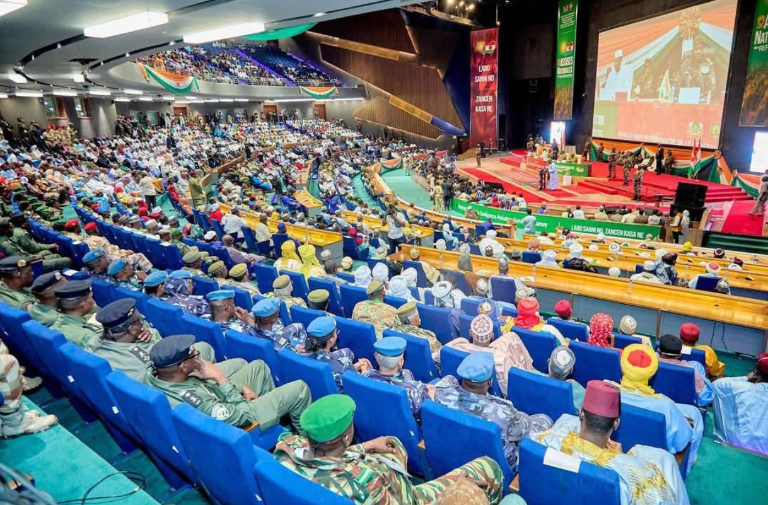
Niamey faces mounting questions over whether its government complied with national law before allowing foreign military presence. The proposed deployment of Algerian forces, approved just weeks ago by Algeria’s parliament, has thrusts Niger’s recently adopted Charter of Refoundation into the spotlight.
Legal loophole or democratic safeguard? The charter’s referendum requirement
The Charter of Refoundation, enacted on March 26, 2025 to guide Niger’s post-crisis transition, sets strict conditions for foreign military presence. Article 45 mandates that any temporary or permanent deployment must first be ratified by a national referendum unless urgent circumstances compel the president to act by decree, pending a non-binding advisory opinion from the Refoundation Consultative Council.
The timing of Algeria’s October 25, 2026 parliamentary vote and Niamey’s subsequent authorization raise a critical question: did authorities follow the charter’s referendum route or invoke the emergency clause—without which any foreign troop presence on Nigerien soil would lack legal foundation?
Between rapid deployment and democratic accountability
According to official announcements, the Algerian units are slated for operations near Madama in northern Niger, a strategic zone near Libya’s porous border. While Algeria’s adherence to its own parliamentary procedures is clear, the same cannot be said for Niger’s compliance with its own constitutional framework.
No public record confirms the holding of a referendum explicitly endorsing Algerian troop presence. Equally elusive is documentation of an emergency decree signed by President Abdourahamane Tiani, accompanied by a Council opinion. Without either mechanism—referendum or properly justified decree—the legitimacy of the military cooperation remains formally unresolved.
Sovereignty redefined: security cooperation vs. constitutional duty
Niger’s recent history has been shaped by political upheaval and persistent security threats across the Sahel. Facing attacks by armed groups and transnational criminal networks, cooperation with neighboring states can bolster border security and protect vital infrastructure—including energy projects that fuel the national economy.
Yet the Charter frames sovereignty not simply as territorial control but as institutional integrity. It requires that any decision placing foreign forces on Nigerien soil be anchored either in a popular vote or in narrowly defined emergency conditions. Circumventing this safeguard risks undermining public trust in both the transition government and the legal order it claims to restore.
What are the risks of skipping the public vote?
Bypassing the referendum requirement without transparent justification could expose Niger to several hazards:
- Undermined public confidence: Citizens may question whether military agreements serve national interests or foreign agendas, fueling political dissent.
- Dependence on external security: Over-reliance on foreign troops could erode Niger’s long-term capacity to protect its own borders and population.
- Mission creep: A narrowly defined mandate—such as securing a single energy facility—can expand into broader, unannounced operations without public oversight.
- Diverging priorities: While Algeria may prioritize energy security or regional stability, Niger’s citizens deserve clarity on whether their protection or economic stability takes precedence.
The government must now clarify its legal basis for authorizing foreign troops. Lacking either a referendum outcome or a documented emergency decree, the decision risks being perceived as an institutional misstep—one that could have lasting consequences for Niger’s democratic transition and national cohesion.
Time to clarify, before consequences deepen
The Charter does not exist merely as a bureaucratic formality. It embodies the will of the Nigerien people, expressed through a framework that balances urgent security needs with democratic legitimacy. Failure to disclose the exact procedure used—referendum or emergency decree—leaves a vacuum that speculation and skepticism will continue to fill.
Civil society, political representatives, and constitutional bodies now have a duty to demand transparency. The government, for its part, must either publish the referendum results or provide full documentation of an emergency authorization, including the Council’s opinion and a clear end date for the mission.
For a nation rebuilding its institutions, sovereignty is not only about choosing partners—it is about honoring the rules that define who gets to decide. And in Niger, that decision-making power is meant to reside with the people.