
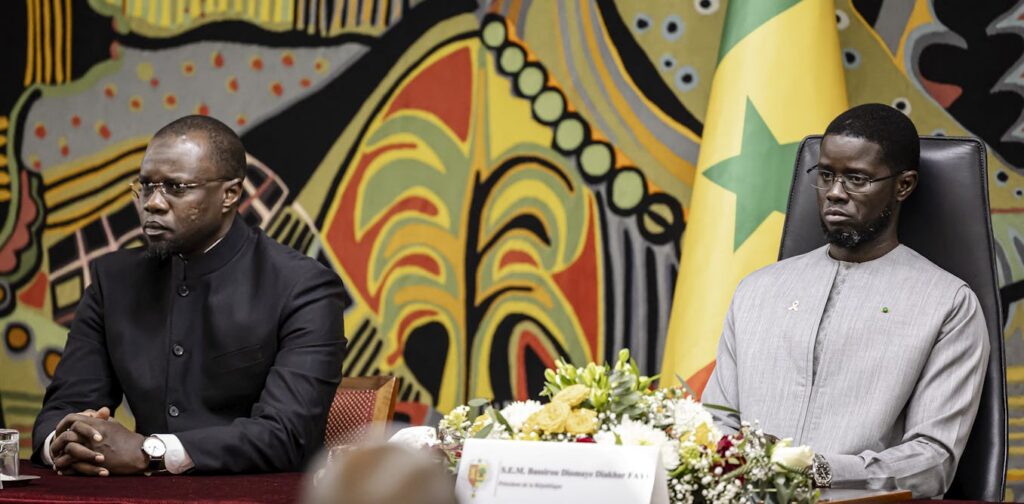
Political landscapes thrive on shifting alliances, where yesterday’s allies may become today’s adversaries—or vice versa. This age-old dynamic has once again played out in Senegal, where the once-unified leadership of President Bassirou Diomaye Faye and Prime Minister Ousmane Sonko has fractured under the weight of diverging ambitions.
What began as a strategic partnership to challenge the established order has evolved into a high-stakes power struggle, culminating in the abrupt dismissal of the prime minister and the dissolution of the government on May 22. The first cracks emerged during the November 2025 rally, but the May 2 meeting between the two leaders removed any lingering ambiguity—President Faye openly criticized Sonko’s “excessive personalization of power,” signaling the end of their collaborative front.
From shared vision to institutional rivalry
The Sonko-Diomaye tandem was forged in crisis, when Sonko endorsed Diomaye’s candidacy after his own was disqualified. Initially, their roles complemented each other: Sonko provided the political firepower, while Diomaye embodied institutional authority. The slogan “Sonko mooy Diomaye” (Sonko is Diomaye) became a unifying battle cry against the previous administration.
Yet the November 2025 gathering exposed the fragility of this alliance. What was once a seamless fusion of identities has splintered into competing narratives. Sonko’s rallying cry now emphasizes his individual leadership—“Sonko est Sonko”—while Diomaye’s institutional role demands protocol-driven distance. This shift reflects a deeper constitutional reality: Senegal’s presidential system leaves no room for shared authority. The president’s powers, enshrined in Articles 42 to 52 of the Constitution, cannot be diluted, forcing the two figures into an uneasy coexistence.
Diomaye’s presidency has adopted a reserved, institutional posture, while Sonko retains his combative, grassroots appeal. Sociologist Pierre Bourdieu’s concept of “habitus” explains this dynamic: institutional roles shape behavior, not the other way around. Diomaye’s resignation from PASTEF’s leadership underscores this separation, yet the tension persists. The once-symbiotic relationship has calcified into a rivalry, where each actor’s sphere of influence encroaches on the other’s.
Power as a zero-sum game
In fluid mechanics, unequal masses within a shared vessel compress the lighter one. Apply this metaphor to Senegal’s leadership: Sonko’s populist legitimacy inflates Diomaye’s authority, but only if appropriately contained. Conversely, Diomaye’s decrees and state decisions translate Sonko’s agenda into legal reality. When one oversteps, the system risks imbalance—either Diomaye appears beholden to Sonko’s whims, or Sonko’s influence spills into the presidency’s domain.
This interdependence breeds mutual destruction. Their ambitions mirror each other: Sonko craves executive power; Diomaye fights to retain it. The more they align, the deeper their divergence grows, for each sees in the other a reflection of their own unfulfilled aspirations. The myth of a gentlemen’s agreement crumbles under this reality, exposing the perennial “second-in-command syndrome.” Loyal deputies, once the architect’s right hand, eventually challenge their leader when the spotlight shifts.
The hegemon, fearing future electoral threats, transforms allies into adversaries through distrust—a paranoia that now looms over Senegal’s political horizon, threatening not just the leadership but the stability of the nation itself.

More Stories
Ousmane Sonko’s firm stance on Senegal’s FMI agreement demands full transparency
Senegal’s institutional crossroads: the unfolding dynamic between Ousmane Sonko and Bassirou Diomaye Faye
Minister abdourahmane diouf reignites feud with ousmane sonko over special credits reform