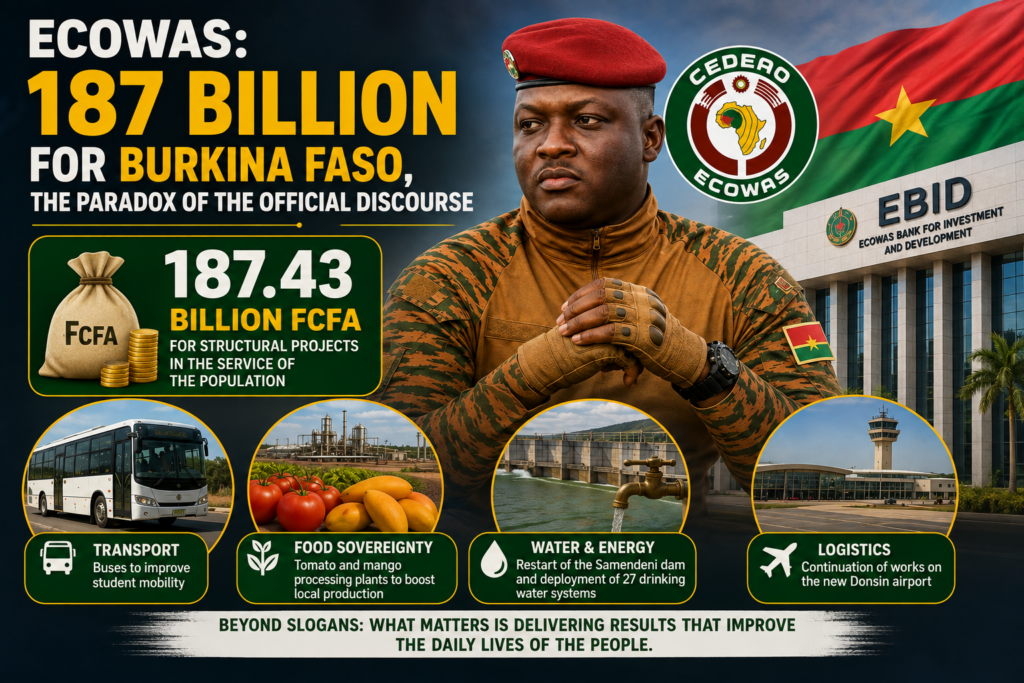
Officially, Burkina Faso’s transitional authorities frequently depict the Economic Community of West African States (ECOWAS) as an organization swayed by foreign interests. Despite such assertions, the country continues to receive substantial financial assistance from the same regional bloc. This juxtaposition of critical rhetoric and financial reliance highlights a fundamental divergence between political messaging and practical economic imperatives.
Avenues of financial collaboration with ECOWAS
The West African Development Bank (BOAD), a subsidiary of ECOWAS, has recently approved a funding commitment of 187.43 billion West African CFA francs for a series of essential national initiatives. These allocations span multiple vital sectors, including:
-
Enhancing public mobility and education: A fleet of modern buses is being procured to address student transportation bottlenecks, thereby improving access to educational institutions and alleviating daily travel burdens for families.
-
Advancing agricultural value addition: New processing facilities for tomato and mango cultivation are set to elevate local production standards, minimize post-harvest waste, and unlock new commercial prospects for agricultural stakeholders.
-
Strengthening water and energy resources: The rehabilitation of the Samendeni dam, alongside the deployment of 27 potable water systems in marginalized regions, seeks to address pressing developmental and socio-economic challenges.
-
Boosting trade and connectivity: The ongoing construction of the Donsin international airport is poised to serve as a pivotal infrastructure project, potentially catalyzing trade, regional integration, and broader economic growth.
These investments underscore the tangible benefits of regional collaboration, demonstrating that ECOWAS’s role extends beyond policy declarations to active participation in national development strategies.
The dichotomy of political critique and economic dependence
There exists an evident paradox between Burkina Faso’s public criticisms of ECOWAS and its simultaneous reliance on the institution’s financial mechanisms. While official discourse may portray ECOWAS as an adversary, its funding remains indispensable for financing critical infrastructure and public services.
This juxtaposition raises a pertinent inquiry: If ECOWAS is considered detrimental to Burkina Faso’s interests, why persist in utilizing its financial resources for high-priority initiatives? The answer lies in the recognition that economic pragmatism often supersedes ideological positioning. Governments must navigate the delicate balance between political narratives and the immediate needs of their populations, even when these needs are addressed by institutions they publicly oppose.
Redefining sovereignty through action
Sovereignty occupies a central place in Burkina Faso’s current political dialogue. However, genuine sovereignty is not synonymous with isolation. A nation can challenge regional policies while strategically engaging with cooperative frameworks that yield tangible benefits for its citizens. The true test lies not in rejecting all forms of collaboration but in ensuring that financial contributions are managed with integrity and aligned with national development objectives.
The 187.43 billion CFA francs infused into the economy represent far more than numerical data; they embody potential employment opportunities, enhanced public services, and economic prospects for the populace. Nonetheless, the allocation of funds alone does not guarantee their successful execution. Effective implementation will hinge on meticulous project management, strict adherence to timelines, rigorous infrastructure standards, and robust financial oversight.
The imperative of transparency and accountability
Accountability must serve as the foundation of these investments. Citizens are entitled to clear disclosures regarding fund utilization, project timelines, and mechanisms for oversight. Sovereignty cannot be asserted through rhetoric alone; it must be substantiated by responsible governance and the transparent administration of public funds. Otherwise, even the most significant financial commitments risk devolving into bureaucratic liabilities.
Measuring impact beyond political discourse
The discourse surrounding ECOWAS must transcend the confines of political or ideological debate. For students, farmers, households, and entrepreneurs, the tangible effects of these investments are of paramount importance. Will the newly procured buses alleviate transport challenges? Will the processing plants revitalize the agricultural sector? Will the water systems reach underserved communities? Will the international airport emerge as a driver of economic prosperity?
The ultimate measure of these initiatives’ success will be their ability to engender tangible improvements in the daily lives of Burkinabè citizens. While political rhetoric holds weight, it cannot replace the necessity of concrete outcomes. The people of Burkina Faso will assess their leadership not by the potency of its statements but by the enduring benefits these projects confer upon their communities.