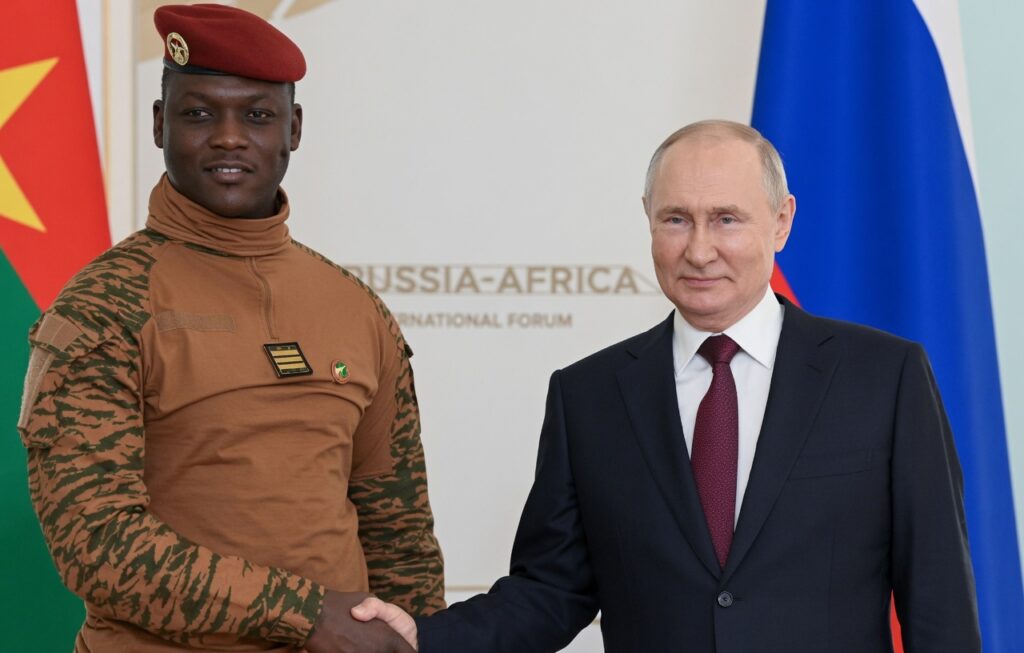
Ouagadougou’s recent pivot toward Moscow has been framed as a bold step toward reclaiming national sovereignty and securing much-needed stability. The government champions a partnership with Russia as a mutually beneficial alliance, built on principles of mutual respect and the absence of political strings attached. Yet beneath the polished rhetoric lies a far more complex reality—one that raises serious questions about the true cost and long-term implications of this burgeoning relationship.
Security cooperation: promises unfulfilled?
One of the central pillars of Burkina Faso’s engagement with Russia is the strengthening of military ties, presented as a solution to the country’s escalating security crisis. While the exact nature of this cooperation remains opaque, the persistent wave of attacks by armed groups across the country suggests that tangible improvements in safety remain elusive. Civilian casualties continue to mount, internal displacement has reached alarming levels, and communities in vulnerable regions still face the daily threat of violence. Against this backdrop, it is increasingly difficult to argue that the partnership with Russia has fundamentally shifted the balance of power on the ground.
The economic equation: sovereignty or compromise?
The narrative of regained independence often hinges on economic considerations, with officials highlighting new investment opportunities and trade agreements. However, the practical benefits for Burkina Faso’s economy remain modest at best. Key sectors continue to struggle under the weight of insecurity, supply chain disruptions, and declining productivity. Even more contentious is the reported exchange of gold reserves for Russian wheat—a move framed by some as a pragmatic adaptation to global food shortages. Yet this logic exposes a troubling paradox: if the nation’s most valuable natural resource is now being leveraged to secure basic food supplies, does this not signal a troubling erosion of self-sufficiency? True sovereignty extends beyond the choice of a new geopolitical partner; it demands the capacity to feed one’s population without mortgaging its future.
Education and human capital: a limited dividend
The collaboration in higher education, particularly scholarship programs for Burkinabè students in Russian universities, represents one of the more encouraging aspects of this partnership. These initiatives could, over time, contribute to building a more skilled workforce. Nevertheless, the scale of these programs remains modest, and their impact on addressing the broader challenges of youth unemployment and systemic educational gaps is negligible. Structural weaknesses in the national education system cannot be resolved by a handful of foreign scholarships alone.
A partnership without conditions? The geopolitical lens
The claim that Russia imposes no political or economic conditions on its engagement in Burkina Faso strains credulity. Every international partnership, no matter how it is presented, is driven by strategic interests. For Moscow, this alliance serves multiple objectives: expanding its diplomatic footprint in Africa, countering Western influence, and securing access to critical resources. To portray this relationship as purely altruistic is to ignore the realities of global power dynamics. The rhetoric of a ‘win-win’ scenario must be measured against the hard facts of geopolitical strategy.
The risks of over-reliance
Concentrating diplomatic and economic engagement with a single foreign power carries inherent risks. A narrow focus on Russia could limit Burkina Faso’s ability to diversify its partnerships, attract varied investment, or navigate a multipolar world with greater flexibility. True strategic autonomy is not achieved by substituting one dependency for another; it requires a balanced approach that leverages multiple alliances to serve national interests.
Measuring sovereignty by tangible outcomes
Ultimately, the success of any international partnership must be judged not by the elegance of its diplomatic framing, but by its real-world impact on the lives of ordinary citizens. Have security conditions improved? Are economic opportunities expanding? Can young people envision a future within their own country? On these fronts, the results remain underwhelming. The partnership with Russia may offer Burkina Faso new diplomatic avenues, but it has yet to prove itself as a catalyst for sustainable progress. For the Burkinabè people, the true test of this alliance will be whether it delivers measurable improvements in daily life—or whether it simply reshuffles the deck of foreign alliances without addressing the nation’s most pressing challenges.