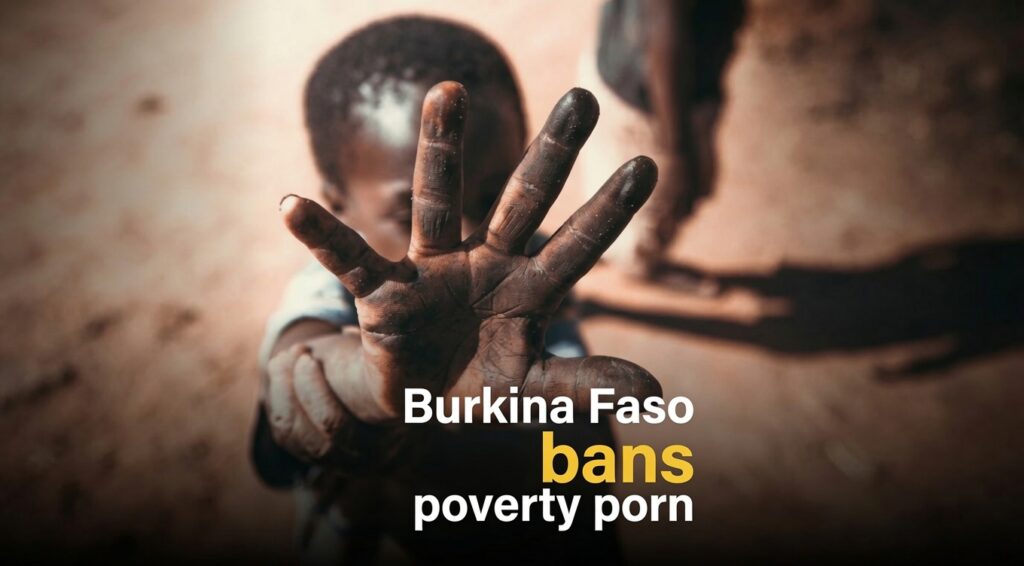
The Government of Burkina Faso has taken a decisive step to prohibit the exploitation of human distress for online engagement or financial gain. This landmark measure targets what sociologists term poverty porn, a practice that has increasingly blurred ethical boundaries in digital media.
Exploitation disguised as awareness
With the rise of social media, the commodification of suffering has become a profitable strategy. Content creators and aid organizations frequently depict vulnerable individuals—malnourished children, internally displaced persons, or families in dire conditions—using close-up imagery designed to evoke immediate emotional responses. While the stated goal is often fundraising or raising awareness, the approach itself raises serious ethical concerns.
By framing distress as spectacle, these videos strip individuals of their dignity and autonomy, reducing them to passive objects of pity. Burkina Faso’s authorities have now moved to dismantle this harmful cycle, asserting that such portrayals do not merely exploit human suffering—they also distort the nation’s public image.
The dual motives behind the ban
This regulatory shift is not solely motivated by ethical considerations. Burkina Faso is navigating a complex socio-political landscape, and the proliferation of poverty-centric imagery has raised concerns about national sovereignty and perception. The Government argues that unchecked dissemination of such content fosters a degrading narrative, often manipulated by external actors to undermine Burkina Faso’s standing.
The official stance emphasizes that the ban is not an attempt to conceal reality but to reject the reduction of a nation to a single narrative of helplessness. Instead, the authorities advocate for portrayals that reflect resilience and agency, even amid crisis.
The cost of silence: ethical dilemmas and hidden truths
Critics, however, perceive the law as a potential tool for information control. By restricting depictions of distress, they argue, the Government may be concealing the true scale of the humanitarian emergency unfolding across the country. Reports of widespread displacement, food shortages, and collapsing healthcare access persist, yet the new restrictions could stifle voices documenting these realities.
Opponents of the measure contend that while poverty porn is ethically dubious, the ban risks creating a veil over urgent crises. The dilemma remains: how can Burkina Faso address its challenges without silencing the very narratives that expose them?
Reimagining humanitarian storytelling
For aid organizations and journalists, the ban necessitates a fundamental shift in communication strategies. The path forward lies in solutions-driven narratives that highlight community resilience and collective action rather than vulnerability alone. This approach not only upholds ethical standards but also empowers affected populations by presenting them as active participants in their own recovery.
The challenge now is to maintain international attention on Burkina Faso’s struggles without resorting to exploitative imagery. By focusing on dignity, agency, and constructive solutions, stakeholders can ensure that the nation’s story is told with integrity—and without sacrificing truth for spectacle.