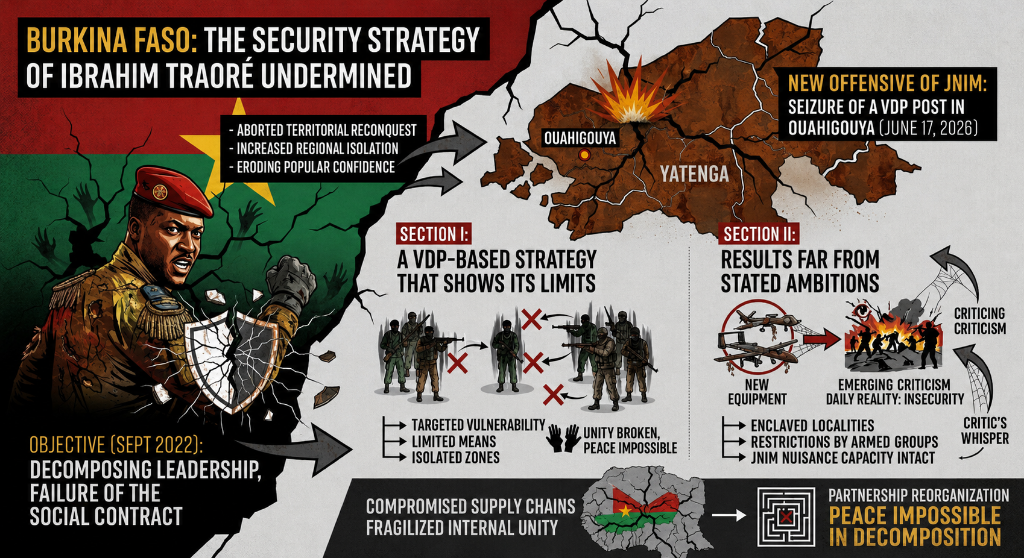
The security landscape in Burkina Faso continues to deteriorate as the Group for the Support of Islam and Muslims (JNIM), an Al-Qaïda affiliate operating in the Sahel, claimed responsibility for an assault on a Civilian Volunteer Defense Force (VDP) outpost near Ouahigouya on June 17, 2026. The attack occurred in the Yatenga Province, a northern region that has long been a focal point of instability.
Setbacks for transitional authorities’ territorial recovery plan
This latest offensive underscores the mounting challenges facing the transitional government’s security strategy, spearheaded by Captain Ibrahim Traoré since his rise to power in September 2022. Traoré’s administration had pledged to reclaim lost territory, yet the persistent attacks have cast doubt on the viability of this approach.
Civilian defense forces exposed as strategic vulnerabilities
The government’s reliance on the VDP to offset shortages in regular military personnel has exposed critical weaknesses. These civilian units, often deployed in remote and poorly equipped positions, have proven susceptible to coordinated strikes by armed factions. The Ouahigouya incident exemplifies this vulnerability, joining a series of setbacks in recent months where sustained military operations have failed to secure key areas.
Military analysts tracking the Sahel conflict suggest that the JNIM maintains significant operational flexibility, exploiting gaps in security measures across northern and eastern Burkina Faso. The group’s ability to conduct frequent and damaging attacks raises questions about the long-term effectiveness of current counterinsurgency efforts.
Public skepticism grows amid persistent instability
While transitional authorities emphasize advancements, such as the acquisition of surveillance and combat drones, many citizens continue to face daily threats. Numerous communities remain isolated, with access restrictions imposed by armed groups further exacerbating the crisis. This disconnect between official narratives and ground realities has fueled public discontent, particularly regarding the government’s primary justification for the 2022 overthrow of the civilian administration: the inability to protect its people.
As Ouagadougou reinforces its alliances within the Alliance of Sahel States (AES) and prepares to escalate military operations in 2026, the attack in Yatenga serves as a stark reminder of the limitations of a purely military response in combating asymmetric warfare.