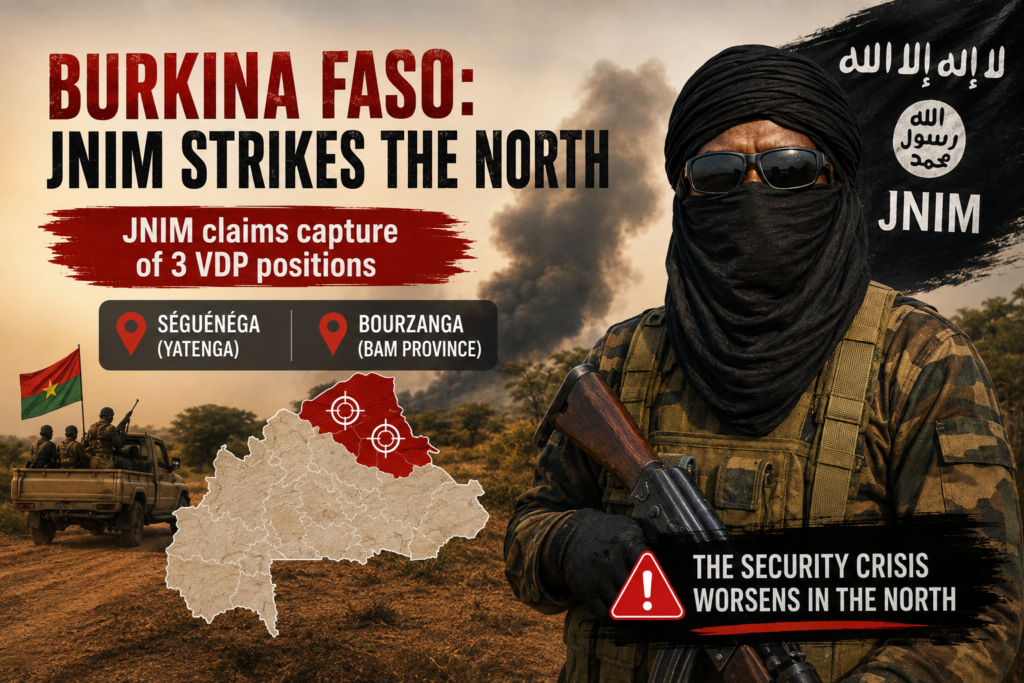
The ongoing security crisis in Burkina Faso has intensified concerns regarding the effectiveness of the transitional authorities’ communication strategy. On August 19, the JNIM armed group claimed responsibility for seizing three strategic positions held by the Volontaires pour la défense de la patrie (VDP) in the northern region. The attacks, executed with significant force, targeted Séguénéga in the Yatenga province and Bourzanga in the Bam province.
This latest assault underscores the persistent challenges faced by security forces in sustaining control over recovered or secured areas. The escalation of violence, heightened pressure on local communities, and the ongoing vulnerability of certain positions highlight a critical flaw: military reoccupation alone cannot guarantee long-term stability. It must be reinforced by a robust state presence, reliable intelligence, adequate logistical support, and, above all, genuine protection for civilians.
Military setbacks and civilian consequences
The situation is exacerbated by the VDP’s frontline role in Burkina Faso’s security strategy. Frequently deployed against armed groups with superior mobility and destructive capabilities, the VDP bears the brunt of each tactical loss. Such setbacks extend beyond military failures; they erode public trust, trigger mass displacements, and hinder humanitarian access to affected regions.
Political response falls short of expectations
Despite the worsening frontline situation, the response from Captain Ibrahim Traoré and his administration raises serious questions. Rather than addressing security failures with clarity and precision, the transitional leader has resorted to disjointed media engagements. These speeches, often populist in tone, appear more like deflection tactics than coherent crisis management. While they may temporarily appease public frustration, they do nothing to safeguard villages, secure roads, or prevent further attacks on military and auxiliary positions.
The Burkinabè population demands tangible results, not rhetoric. When towns remain exposed, civilians are forced to flee their homes, or positions fall despite substantial resources, the issue transcends mere communication. It reflects the core failure of the country’s security strategy and the state’s inability to uphold its commitments to its people.
Media repression deepens the crisis
Compounding the problem is the systematic suppression of critical voices. Once a vibrant and dynamic sector, the Burkinabè press now operates under severe restrictions. Journalists and dissenting voices attempting to report on ground realities face arrests, forced detentions in so-called re-education camps, or coercion into frontline service under the guise of patriotism. The silencing of independent media removes a vital tool for assessing progress, identifying weaknesses, and alerting authorities to civilian hardships. Far from resolving issues, this suppression distorts the narrative, widening the gap between official claims and lived experiences.
The paradox is striking: as the security crisis demands greater transparency, accountability, and public debate, the space for criticism continues to shrink. Yet, a robust strategy requires acknowledging setbacks, understanding their roots, and swiftly correcting mistakes. Avoiding dissent may offer short-term political comfort, but it deprives decision-makers of crucial insights needed to refine their approach.
By restricting free and independent information, the authorities trap themselves in a cycle of denial that fails to address the immediate security threats. Combating terrorism demands resolve and collective effort, but it also requires honesty, responsibility, and a willingness to confront difficult truths.
The ultimate measure of success lies in the safety of the populace. Until armed groups continue to inflict damage, expand their influence, or maintain relentless pressure on vulnerable areas, the government must be held accountable for the outcomes of its security policies. Rhetoric may shape public perception temporarily, but it cannot, in isolation, secure victory against terrorism.