Burkina Faso’s jihadist landscape shaken by internal strife
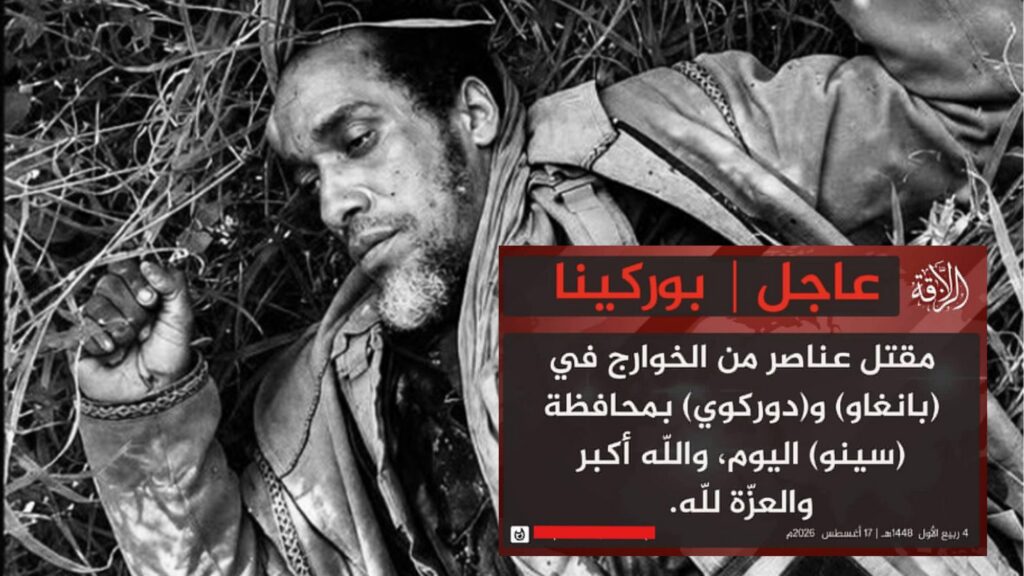
A senior commander of the Islamic State in the Sahel (EIS), Abou Zeid Al-Burkinabi, was killed in clashes with rival group JNIM on August 17, 2026, in Séno Province. Contrary to official claims attributing his death to military operations, evidence confirms he fell victim to internal jihadist violence—a stark reminder of the brutal divisions tearing apart the Sahel’s armed factions.
From propaganda to reality: the truth behind the commander’s death
The killing occurred in the towns of Bangao and Dorkoye, near the Niger border, a long-standing hotspot for insurgent activity. Initial reports suggested an army operation, but field sources confirm Al-Burkinabi was neutralized in clashes with JNIM, the Al-Qaeda-aligned coalition. His death underscores the escalating power struggle between Sahelian jihadist groups, where ideological and territorial rivalries often overshadow shared enemies.
As a key EIS figure, Al-Burkinabi orchestrated attacks on security forces, civilian intimidation campaigns, and forced resource extraction. His elimination weakens the group’s command structure, already strained by military pressure and JNIM’s aggressive expansion.
JNIM vs. EIS: a deadly rivalry reshaping Sahel’s terror landscape
The conflict between these factions isn’t new. Since 2019, JNIM and EIS have waged a bloody war for dominance, fueled by:
- Ideological clashes: JNIM favors pragmatic local alliances, while EIS enforces a takfiri doctrine marked by indiscriminate violence against civilians.
- Resource wars: Control of smuggling routes, gold mines, and transhumance corridors finances both groups, sparking repeated clashes.
- Escalating violence: Battles in Mali’s Gourma and Burkina Faso’s Séno have involved heavy weaponry, signaling a shift from asymmetric warfare to large-scale confrontations.
Al-Burkinabi’s death, orchestrated by JNIM, may temporarily shift the balance in Séno Province—but civilians remain trapped in the crossfire, facing retaliatory attacks and persistent insecurity.
What’s next for Burkina Faso’s fight against terror?
The episode highlights a grim truth: Sahelian security isn’t just about military victories—it’s shaped by internal jihadist fractures. While one faction’s defeat may weaken EIS, it often strengthens JNIM or other rivals, leaving populations vulnerable. For analysts and policymakers, tracking these splits is critical to predicting the region’s next destabilizing flashpoint.
The death of Abou Zeid Al-Burkinabi marks another chapter in the Sahel’s prolonged terror war, where the fiercest battles may be fought not against governments, but within the jihadist movement itself.