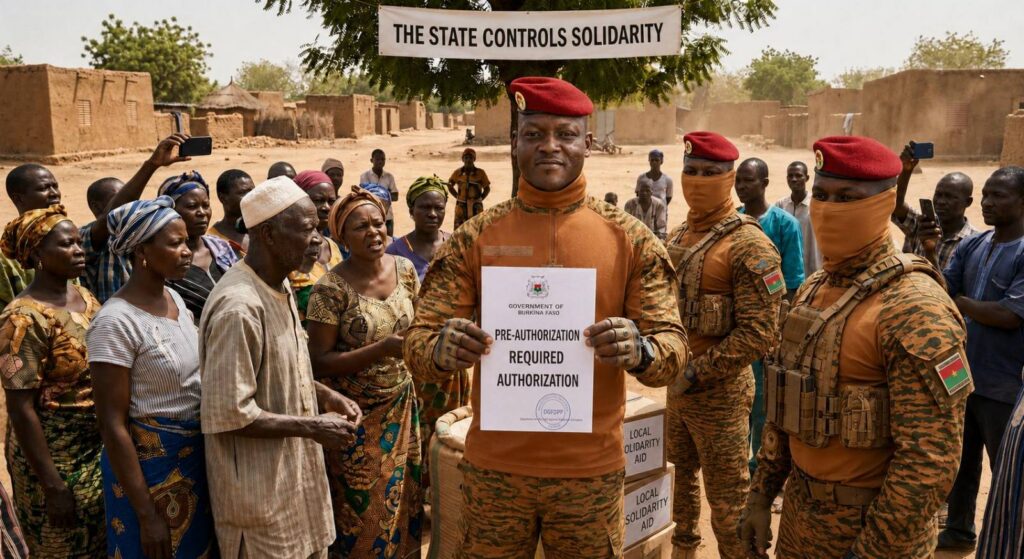
The days of unregulated charitable initiatives and unchecked online fundraising drives in Burkina Faso are over. The Ministry of Solidarity has enforced strict new measures: any charitable activity must now receive prior authorization from authorities, or face severe penalties. While officials justify this as a defense of dignity and a means to curb digital voyeurism, the policy raises a far more troubling question: are we still free to act on our own initiative when compassion itself becomes a potential offense?
From regulation to restriction: the fine line between oversight and oppression
At first glance, regulating charitable practices may appear justified. Social media has indeed commodified human suffering, turning empathy into viral content and financial gain. Yet, the distinction between addressing abuses and suppressing all citizen-driven initiatives is dangerously thin. By opting for blanket regulation instead of targeted interventions, the government risks framing every act of solidarity as a suspicious activity that requires prior administrative approval.
The requirement to obtain official clearance before extending a helping hand signals a dangerous erosion of individual freedoms. In a nation where governance increasingly perceives benevolence as a threat, the message is clear: even the purest form of human kindness must pass through the state’s filter. This approach not only undermines civic autonomy but also erodes the very trust between citizens and institutions that a functioning society depends on.
The paradox of solidarity under state monopoly
This policy exposes a deeper bureaucratic mindset—one that views civil society with suspicion the moment it organizes independently. By positioning itself as the sole arbiter of compassion, the transitional government led by Captain Ibrahim Traoré is not merely regulating aid; it is appropriating the very essence of humanitarianism. Every unsupervised act of generosity is now perceived as a challenge to state authority, revealing a troubling centralization of power where even the most selfless gestures fall under administrative scrutiny.
Such a strategy fosters an atmosphere of distrust. Citizens, associations, religious groups, and diaspora communities—long the first responders in times of crisis—now face the prospect of their initiatives being stifled by red tape. The state’s inability to replicate the agility and responsiveness of grassroots solidarity only compounds the problem. When bureaucracy dictates the pace of humanitarian response, the most vulnerable are left waiting in the cold.
A policy out of sync with reality
The government’s decision reflects a stark disconnect from the ground realities of Burkina Faso. Security challenges, mass displacements, and rising poverty demand urgent, decentralized solutions. Yet, by criminalizing spontaneous aid, authorities are creating a dangerous void—one that their own overwhelmed institutions cannot fill. Families in distress will not wait for a ministry’s stamp of approval to receive food or medical care. While authorization requests languish in government offices, suffering continues unabated.
This disconnect is particularly glaring given the critical role played by the so-called “solidarité de brousse”—the organic ties between diaspora communities, urban centers, and rural villages that have long sustained Burkina Faso amid public service failures. Imposing bureaucratic hurdles on these vital networks risks weakening the very fabric that holds communities together. Fear of sanctions or complex procedures may deter well-intentioned citizens from helping, further fraying the social bonds essential for resilience.
The illusion of dignity and the cost of silence
Officials argue that restricting public displays of suffering preserves the dignity of vulnerable populations. But at what cost? Is it truly dignified to let people suffer in silence, hidden behind ministerial decrees, while waiting for an administration that may never arrive? Dignity is not preserved by invisibility; it is upheld by ensuring timely access to assistance when and where it is needed most.
There exists a middle ground—one rooted in ethical fundraising, consent, and transparency. A government serious about protecting dignity should focus on combating exploitation without stifling the natural impulse to help. Instead, Burkina Faso’s approach risks transforming humanitarianism into a sterile administrative process, stripping it of its humanity and leaving the most marginalized without recourse.
The ultimate irony? A policy designed to reinforce state control may, in fact, weaken the very foundations of solidarity it claims to protect. In the end, the most vulnerable will bear the brunt of this misguided strategy—a strategy that prioritizes control over compassion, and bureaucracy over survival.