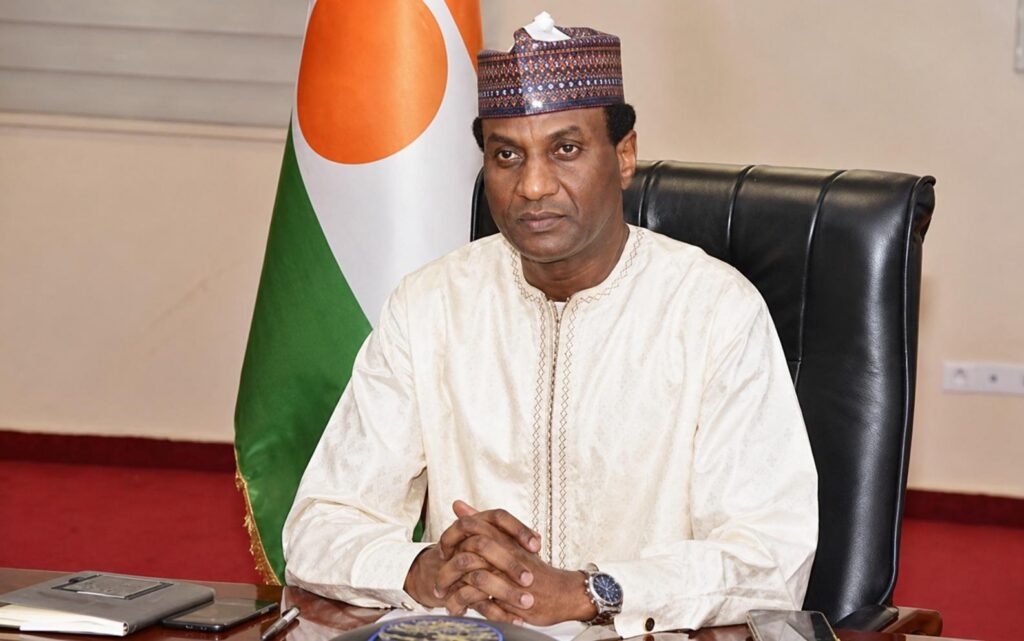
The shifting sands of power under Niger’s transitional regime
In military-led transitional governments, the line between trusted collaborator and potential threat can be dangerously thin. The case of Niger’s Prime Minister Ali Mahamane Lamine Zeine has recently exposed this precarious balance, prompting questions about the autonomy of civilian leaders within a system dominated by uniformed authorities.
Observers close to the Prime Minister’s office report growing unease among his inner circle. Security protocols surrounding Lamine Zeine have tightened abruptly, with his entire protective detail replaced without explanation. Visitors granted access now face rigorous body searches, a practice previously unheard of for a head of government. While officials cite a severe bout of malaria as the reason for his prolonged absence from the office, whispers in the corridors of power suggest a more ominous scenario: a de facto house arrest.
The absence of a clear and transparent justification has only fueled speculation. In a political landscape where information control is a key lever of authority, opacity breeds suspicion. The enhanced security measures around Lamine Zeine—more reminiscent of confinement than protection—have raised eyebrows among diplomats and analysts alike.
From collaboration to confinement: the mechanics of exclusion
The unfolding situation reflects a recurring pattern in Sahelian military transitions: the doctrine of absolute conformity. When civilian technocrats or officials resist aligning with the strategic or ideological directions set by the ruling military elite, the security apparatus swiftly moves to neutralize dissent. Unlike public dismissals, which could destabilize the facade of national unity, these regimes prefer subtle exclusion—limiting movement, restricting communications, and isolating the individual in question.
This approach serves multiple purposes. It preserves the illusion of institutional continuity while centralizing decision-making power in the hands of the military leadership. It also allows the regime to gauge reactions from the public, international partners, and internal factions before taking more decisive action. In Lamine Zeine’s case, the strategy appears to be testing the waters, ensuring no backlash emerges before a final decision is made.
A test of civilian autonomy in a militarized state
The Prime Minister’s predicament underscores a fundamental question: how much real authority do civilian leaders wield in military-led transitions? Across the Sahel, technocrats are often recruited to reassure donors, manage economic stability, and project an image of structured governance. Yet, their administrative legitimacy remains entirely contingent on unconditional political loyalty to the military command.
Niger is not alone in this dynamic. Comparable power struggles have played out in neighboring countries within the Alliance of Sahel States. The trajectory of Choguel Maïga in Mali and the political maneuvering surrounding Apollinaire Kyélem de Tambèla in Burkina Faso highlight a consistent reality: civilian leaders serve as economic buffers or diplomatic fig leaves. The moment their actions diverge from the military’s agenda, the consequences are swift and punitive.
The message behind the surveillance
The tightening grip on Lamine Zeine is not merely about preventing a hypothetical conspiracy. It is a deliberate signal to the entire state apparatus: no position, no matter how high, shields a leader from the watchful eye of the military core. The replacement of his security detail, the restriction of access, and the filtering of communications are not just security measures—they are political statements.
For Ali Mahamane Lamine Zeine, the challenge now extends beyond governance. He must navigate a web of suspicion where every movement is scrutinized and every silence is interpreted. This episode serves as a stark reminder that in military-led regimes, the presence of civilians in the hierarchy is often an illusion. Their power is conditional, fragile, and entirely subordinate to the military’s authority. The facade of a functioning civilian government masks a harsher truth: loyalty, not competence, dictates survival in these exceptional political systems.