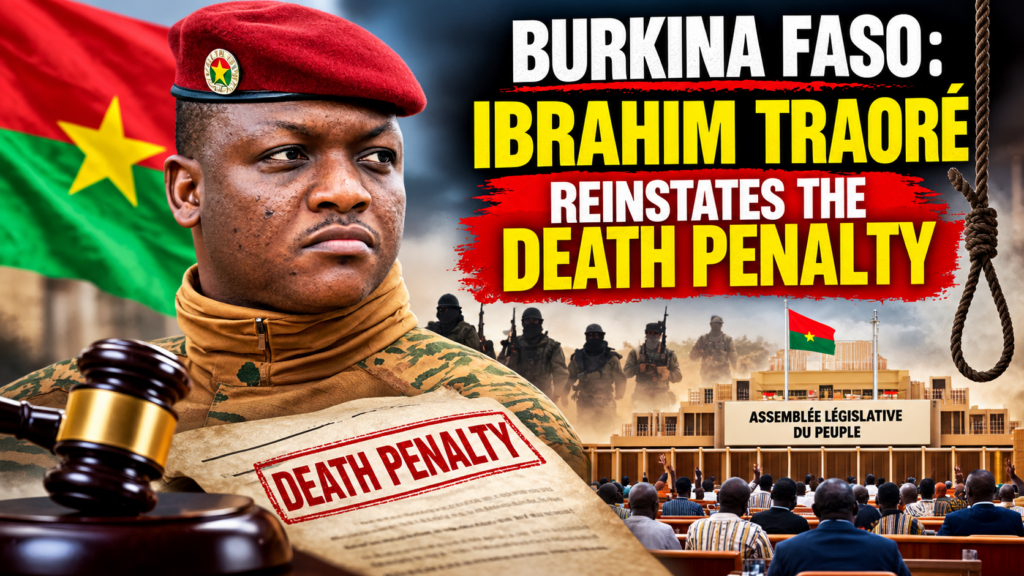
From abolished to restored: a punitive pivot in Burkina Faso’s fight against terrorism
Amid a spiraling security crisis fueled by jihadist violence, Burkina Faso has chosen to wield one of history’s most extreme legal weapons: the death penalty. The move, hailed by authorities as a decisive stand against crime and terror, raises a critical question for citizens and businesses alike: can such draconian measures truly restore peace, or will they erode public trust in a state already under strain?
The revival of capital punishment on October 20, 2026 passed unanimously by the Assembly of the Burkinabè People marks not just a legal milestone but a stark departure from the nation’s brief post-abolition era. While officials argue that the shift reflects unwavering commitment to security and sovereignty, critics warn that the policy risks transforming fear into a tool of governance, further fraying the fragile social fabric.

Crime control or crisis escalation? The limits of punitive power
Burkina Faso’s terror crisis shows no sign of abating. With armed groups relentlessly targeting civilians, villages, and critical infrastructure, the demand for a strong state response is understandable. Yet the reintroduction of the death penalty applicable now to terrorism, espionage, treason, parricide, and even the importation of deadly prohibited goods raises troubling concerns about proportionality and effectiveness.
The new penal code asserts that extreme penalties will deter would-be offenders. But security experts caution that harsh sentences rarely address the root causes of jihadist insurgency: porous borders, weak governance, and a population desperate for protection. Without robust intelligence, preventive action, and sustainable state presence in at-risk zones, the death penalty may prove little more than symbolic justice.
For families still burying loved ones in mass-casualty attacks, or farmers forced to abandon fertile land, the theoretical deterrent offers no relief only the bitter taste of unmet promises. True security, they argue, lies not in the shadow of the gallows, but in the shadow of a functional, present, and accountable state.
Justice under military rule: fairness in the balance
Ibrahim Traoré’s administration has framed the death penalty as a non-negotiable pillar of national defense. The president’s rhetoric has been uncompromising: “No leniency” for traitors or spies, he declared in late September. While such clarity may resonate with a population exhausted by violence, it also blurs the separation between justice and militarized authority.
A justice system that prioritizes speed over scrutiny risks prioritizing vengeance over truth. Capital punishment, by its irreversible nature, demands ironclad evidence, rigorous trials, and ironclad guarantees against miscarriages of justice. But in a climate where judicial independence is already questioned amid reports of forced enlistment, arbitrary detentions, and silencing of dissent how can citizens trust that the law will be applied fairly?
Critics point to provisions within the new penal code that re-criminalize certain forms of press criticism under the guise of national security. Such measures risk conflating legitimate oversight with subversion, turning public discourse itself into a potential crime. The government insists the changes are necessary to curb destabilization, but the chilling effect on free speech is palpable.
Fear as governance: who really benefits from a climate of dread?
Governments can and often do employ fear to maintain order. But in a country where the state’s reach is already insufficient in vast regions, relying on terror to combat terror may prove counterproductive. Fear can silence dissent, yes, but it cannot repair roads, restore markets, or rebuild schools.
The real test of Burkina Faso’s new penal policy lies not in how many convictions it yields, but in how many lives it saves. Can extreme penalties prevent the next attack? Can they restore a sense of normalcy to communities living under siege? Early indicators suggest the answer is uncertain. While authorities celebrate the legislative victory, ordinary Burkinabè continue to face daily hardship traveling to fields with armed escorts, sending children to schools behind sandbag barricades, and sleeping to the sound of gunfire in the distance.
For residents of the Sahel, the death penalty is not an abstract debate. It is a reality that must coexist with survival. The question is whether this punitive turn will serve as a shield against chaos or merely deepen the sense of abandonment.
Sovereignty vs. security: the long shadow of legislative change
The restoration of the death penalty is more than a policy shift it is a statement. Burkina Faso has chosen to assert sovereignty through the ultimate sanction, signaling to both domestic and international observers that it will not be cowed by either terror or criticism. Yet sovereignty without security is hollow. And security without trust is unsustainable.
Businesses operating in Burkina Faso face growing uncertainty. Investors rely on predictable, transparent legal frameworks. But with expanded definitions of treason and espionage, and harsher penalties for dissent, the risk profile for enterprise has shifted. Entrepreneurs and local traders alike now question whether innovation, critique, or even routine civic participation could be misconstrued as threats to the state.
The long-term consequences of this legislative overhaul remain unclear. Will the death penalty deter foreign fighters or financiers? Will it embolden security forces to act with greater accountability or less? The answers will define not only Burkina Faso’s immediate future but the very nature of its social contract.
Rebuilding legitimacy: beyond punishment, restoring faith in the state
No law, no matter how severe, can compensate for the absence of public services, the failure of intelligence networks, or the erosion of institutional trust. The people of Burkina Faso do not need more symbols of power they need results.
Security, after all, is not measured by the number of executions, but by the absence of attacks. Accountability is not ensured by swift sentencing, but by fair trials and transparent investigations. And national strength is not proven by harsh laws, but by a government that protects its people while upholding their rights.
As the death penalty returns to the penal code, the true measure of Burkina Faso’s leadership will lie not in how many it condemns, but in how many it saves and how many it convinces to stand with it, not against it.
By Marguerite Ndongo — Journalist