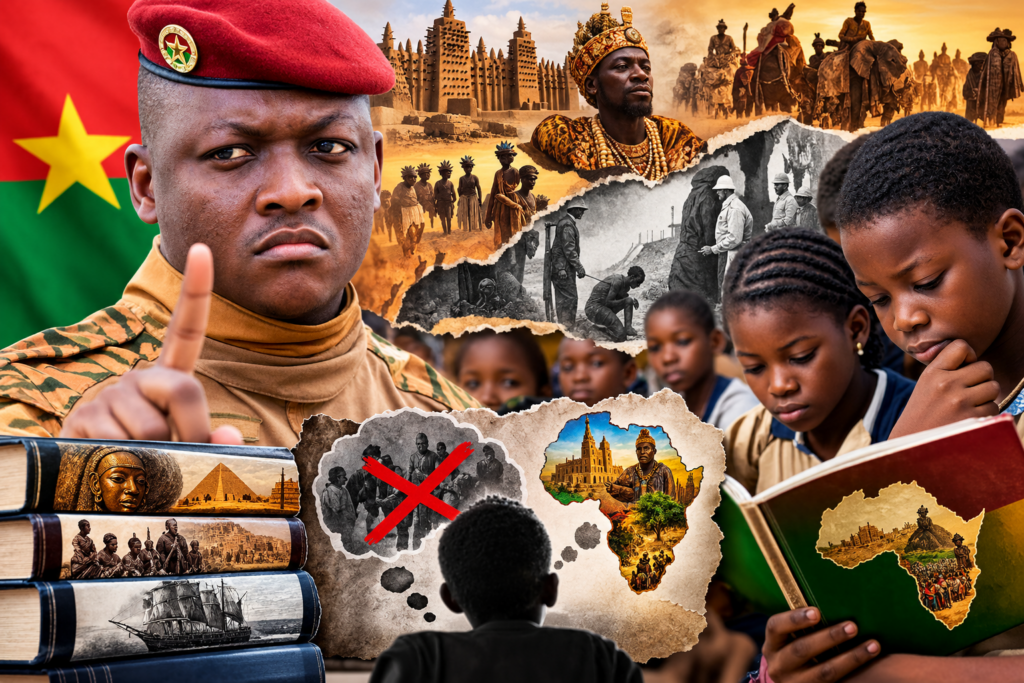
Burkina Faso is undertaking a significant overhaul of its history and geography curricula, aiming to “decolonize” school textbooks. While this initiative raises legitimate questions about the representation of African history in education, it also demands a critical examination: reforming curricula must not result in confining future generations to a partial interpretation of their own history.
History is not merely a record of colonization, of the suffering it caused, or of the conflicts it bred. It encompasses civilizations, empires, kingdoms, trade networks, discoveries, social transformations, and cross-cultural interactions. Presenting this history to young learners requires a rigorous approach one that acknowledges past wounds without reducing collective memory to a single narrative.
Education as a tool for reconciliation, not historical revisionism
The risk Burkina Faso faces lies in treating this reform as a means to retroactively correct historical wrongs by altering the narrative taught in classrooms. School programs can indeed shed light on the injustices of colonization, restore the legacy of African resistance movements, and celebrate long-overlooked figures. However, they cannot, in isolation, alter the course of history or retroactively repair the suffering endured by past populations.
This reform must prioritize the transmission of a more complete history not one constructed around a singular adversary. Otherwise, a well-intentioned effort to free young minds could inadvertently produce a generation whose understanding of the past is constrained by a new ideological framework.
Learning from regional perspectives: Côte d’Ivoire’s balanced approach
A balanced historical education must integrate national history, African empires and kingdoms, prominent continental figures, and international events that have shaped the world. Understanding one’s own nation does not necessitate ignoring others. Rather, situating local history within a broader context enables students to grasp the power dynamics, exchanges, and events that have molded contemporary societies.
The goal is not to replicate Ivory Coast’s model, Burkina Faso’s, or any Western framework it is to uphold a fundamental principle: history should enlighten, not indoctrinate; explain, not divide; empower, not confine.
Declarations of intent versus educational impact
The process of decolonizing education holds value if it corrects omissions, restores neglected facts, and reassigns deserved recognition to African civilizations. Yet this objective is undermined if it merely replaces one monolithic narrative with another. Students should study colonial crimes without being stripped of the complex realities of European societies, just as they should explore African civilizations without overlooking their internal contradictions, conflicts, and evolution.
Understanding historical injustices suffered by one’s ancestors is insufficient without also comprehending how these injustices arose, what mechanisms enabled them, which historical responsibilities can be assigned, and what lessons can be drawn for the future.
From memory to empowerment: the ultimate question for Burkina Faso
The debate transcends textbook revisions: What kind of memory does Burkina Faso wish to impart to its youth? A memory that traps them in perpetual confrontation with the past, or an education that equips them with the intellectual tools to analyze history critically, engage in debate, and shape their own future?
History’s wounds are not healed by censoring certain pages for future generations. They are addressed by providing the means to read, understand, and learn from every chapter. Only then can educational reform cultivate informed citizens those who know their roots without severing their connection to the wider world.
By Marguerite Ndongo — Journalist