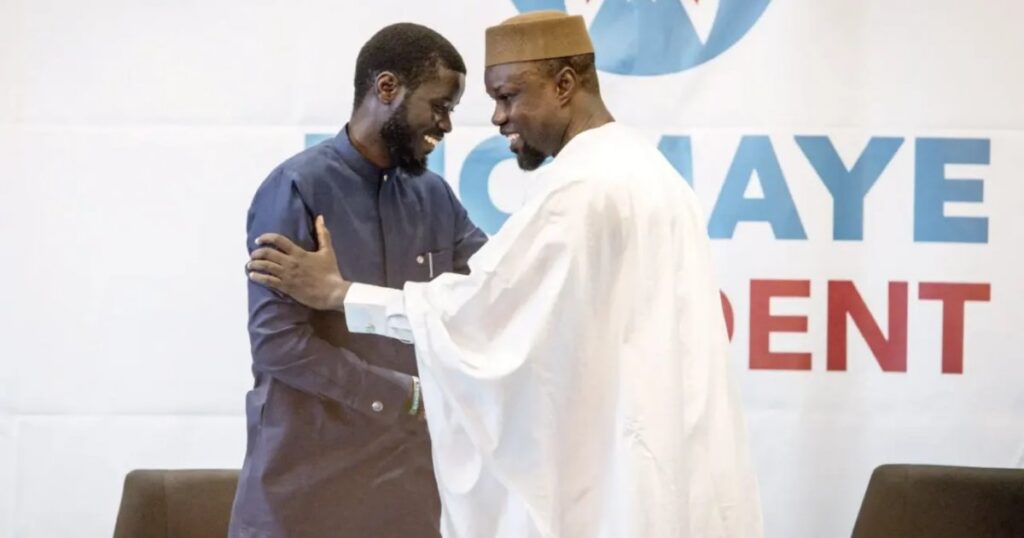
Can Senegal’s President really dissolve a parliament led by his rival?
Bassirou Diomaye Faye has openly acknowledged his break with Ousmane Sonko, and he is leaving the door open to dissolving the National Assembly — the very institution now led by his former ally. The question hanging over Senegalese politics is whether that threat is a real constitutional option or simply a political lever.
The constitutional question: a presidential prerogative kept in reserve
Speaking in New York on Thursday, September 24, the Senegalese head of state was asked directly whether he intended to dissolve the National Assembly. His answer was carefully calibrated: "Why rule out a prerogative that the Constitution grants you?" He announced neither a dissolution nor an election date, adding instead that "everything depends on necessity or context. When the time comes, depending on what we are facing, we will decide."
The exchange took place as his government prepares to defend its budget choices before a parliament dominated by Pastef. Faye tied any decision to how relations between the institutions evolve, leaving the option on the table without committing to it.
Naming the rupture with Ousmane Sonko
This time, the president did not avoid the subject of his split with Ousmane Sonko. Asked about the dismissal of his former prime minister, he cited "persistent divergences on certain issues." His explanation was blunt: "When that breach of trust persisted, I chose another prime minister."
He rejected the notion that talks with the International Monetary Fund alone had caused the separation, framing the disagreement as broader and more political than a single financial negotiation.
A new front: the battle moves to parliament
The conflict has shifted into the legislative arena. After leaving the government, Ousmane Sonko took the presidency of the National Assembly, giving him a central role in scrutinising the texts put forward by the executive. Questioned on the possibility that Pastef deputies could reject the revised finance bill, Faye defended the distinct responsibility of each institution: "Everyone assumes their responsibilities, and the people arbitrate."
To accusations of betrayal from some members of his former party, the president countered with his commitment to the office he holds. "The only thing I am capable of betraying is my oath," he said. How the Assembly receives the government’s financial measures will shape the next phase of the confrontation.
Macky Sall at the UN: defending an endorsement that raises eyebrows
Bassirou Diomaye Faye reaffirmed his support for his predecessor Macky Sall’s candidacy for United Nations secretary-general. Despite doubts about Sall’s chances, the Senegalese president insists that "the game is still open" and says he is in talks with the members who will influence the choice.
To justify his position, Faye points to Macky Sall’s international experience and the question of Africa’s representation at the UN. "Who is better placed today to defend a stronger place for Africa than President Macky Sall?" he asked during the interview.
The head of state also raised the debt issue, at the heart of Senegal’s current financial difficulties. In his view, Macky Sall has "endured the torments of debt," an experience that would make him suited to champion reform of the international financial architecture. In that answer, Faye did not address the responsibilities attributed to the former government over undeclared debt.
More Stories
Can Sadio Mané really beat Ousmane Sonko in Bambali in 2029?
Senegal’s local elections: will Bassirou Diomaye Faye’s secrecy backfire?
Can Alain-Georges Moukoko’s green justice background redefine Libreville’s prosecutor’s office?