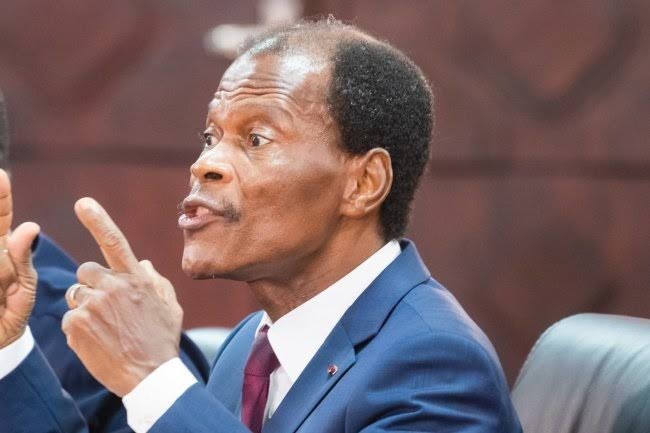
Cotonou — When a politically sensitive case drags on, the real question is not only what the judges decide, but what their decision says about the entire judicial system. In Benin, the continued pre-trial detention of Candide Azannaï, president of the Restaurer l’Espoir party and a well-known political figure, forces exactly that question into the open: does keeping him in custody strengthen the rule of law, or does it expose the courts to a different kind of risk?
The stakes behind a high-profile pre-trial detention
The case dates back to the thwarted coup attempt of 7 December 2025. Azannaï, a former minister, was arrested later that month as part of the investigation into the events that shook state institutions. The Court for the Repression of Economic Offences and Terrorism (CRIET) is pursuing charges that include conspiracy against state security and incitement to rebellion — accusations of exceptional gravity that, under Beninese law, justify close judicial scrutiny.
That is the context in which the Court of Appeal recently confirmed the decision to keep Azannaï in pre-trial detention. The ruling followed a rejected request for provisional release filed by the defence before the chamber of liberties and detention. Rather than a punitive reflex, the judges framed their decision as a procedural necessity: with suspects still at large, the investigation must continue without any risk of evidence being tampered with or witnesses being pressured.
What the appeal hearing revealed about the process
One thing the hearing made clear is that the case is not being handled behind closed doors. Azannaï was brought in person from his place of detention to appear before the judges — a routine but significant detail showing that the defence was given the opportunity to be heard and to present its arguments in open court.
The court took time to examine the case file before confirming the detention order. Its reasoning rested on two elements: the existence of fugitives in the same case and the need to complete the investigation without external interference. These are standard grounds in serious criminal proceedings, and they carry weight precisely because they are rooted in the Code of Criminal Procedure rather than in political convenience.
The defence’s own words tell part of the story
Perhaps the most revealing signal came from Azannaï’s lawyer, Me Aboubacar Baparapé. Speaking after the hearing, he acknowledged that the essential stages of the judicial investigation had been carried out properly. “His questioning on the merits is finished, there are no other elements left,” he said, confirming that his client had been able to give a full account of his version of events before the investigating judges.
Baparapé also stressed that his client had spoken freely throughout the proceedings: “In any case, he said he is not involved in this case, that he is not concerned by everything being invented around him in connection with this affair.” The lawyer’s account suggests the rights of the defence were preserved — Azannaï was able to proclaim his innocence and reject the accusations in court.
Looking ahead, the defence made clear it intends to keep using the legal channels available. “We will, when the time comes, file a new request until we are heard,” Baparapé added, a statement that points to the permanent mechanisms of judicial review built into Benin’s system.
Why the rule of law, not politics, is the real test
Detention decisions in cases with political overtones always provoke disappointment on one side and satisfaction on the other. But the appeal court’s ruling rests on a principle that matters beyond this single case: facts take precedence over political considerations. In an investigation of this magnitude, the judge’s timeline is not the timeline of urgency or emotion.
By allowing the investigation to continue while suspected co-authors remain at large, the judiciary says it is protecting society while preserving the guarantee of a fair and impartial trial. Whether that balance holds — and whether the courts can maintain public confidence as the case moves forward — is the question that will define this affair far more than any single hearing.


More Stories
Mali: can the army break the fuel blockade strangling central Mali after Djenné attack?
Can Benin’s Supreme Court decision end the legal battle over General Houndégnon?
Can good neighborly relations really curb terrorism across Africa’s borders? Inside Benin’s diplomatic gamble at the UN