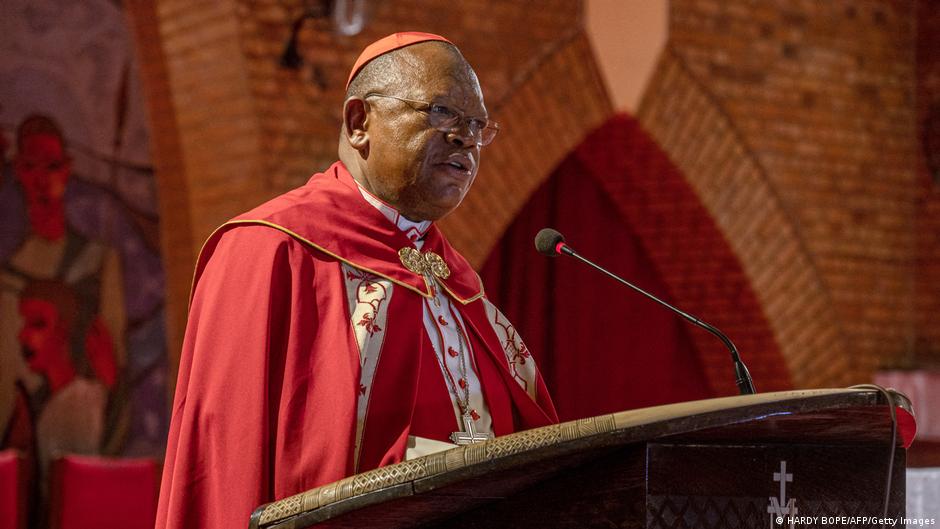
During the 66th anniversary of the Democratic Republic of Congo’s independence, Cardinal Fridolin Ambongo delivered a stark assessment of the nation’s current state. Speaking at the Notre-Dame du Congo Cathedral, the Archbishop of Kinshasa highlighted a series of crises, including persistent insecurity, armed violence, the presence of foreign military forces, widespread poverty, and the return of the Ebola virus. In light of these challenges, he argued that amending the Constitution is not a priority for the country.
“Do we honestly believe that revising the Constitution to pursue a third term is the most suitable response to the tragedies facing the Congolese people? Given the severity of our current landscape, we see neither the necessity nor the urgency for such a change. The priority for the Democratic Republic of Congo is peace. This is why the National Episcopal Conference of Congo continues its work and will remain committed to establishing the foundations for a comprehensive and inclusive dialogue,” Ambongo declared.
Opposition and religious groups unite
This stance is echoed by the Lay Coordination Committee, the Cenco, and the Church of Christ in Congo. These organisations also maintain that a constitutional overhaul is neither required nor appropriate in the present climate.
Marie-Ange Mushobekwa, a former minister and prominent member of the Front Commun pour le Congo (FCC)—the political platform of former President Joseph Kabila—was present at the service. She reiterated her group’s firm opposition to any changes regarding Article 220 of the Constitution.
“Article 220 is set in stone, and our Constitution is explicit: an elected president is entitled to a single renewable term. After these two terms, they must step down and hand over power to a successor chosen by the Congolese people. Consequently, all political parties and platforms within the FCC will henceforth join all public demonstrations to block any constitutional modification. We will be in the streets on July 8 to uphold and safeguard our Constitution,” Mushobekwa stated.
Mass protests scheduled for July 8
Civil society movements are also mobilising. Plamédie Bamata, representing the Patriotisme movement, has called upon the youth of Congo to join the opposition-led protest on July 8.
“We are committed to stopping this third-term project. Congolese citizens have already shed too much blood fighting for this Constitution to exist. We will take to the streets on July 8, marching to the Palais de la Nation to express our dissatisfaction and reject any attempts at the balkanisation of our nation,” Bamata emphasised.
A proposed law outlining the procedures for a referendum on constitutional change has already been approved by both chambers of Parliament and sent to the President for enactment. While the government and the parliamentary majority describe the law as a necessary legal framework for referendums, the opposition warns that it is a gateway to dismantling the nation’s fundamental law.