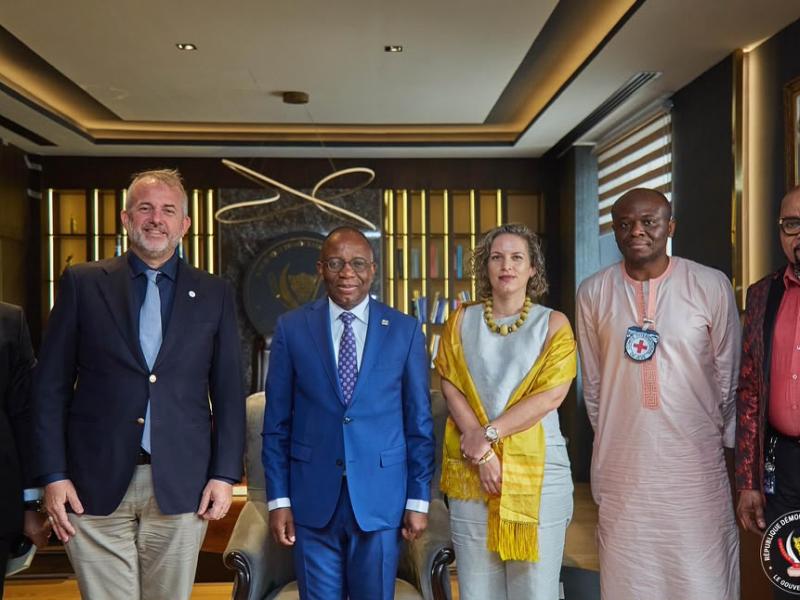
DRC government and ICRC deepen ties to improve prison conditions and humanitarian aid
- Politics
The International Committee of the Red Cross (ICRC) and the government of the Democratic Republic of the Congo (DRC) have agreed to strengthen their partnership to enhance humanitarian action and improve detention conditions across the country, particularly in the eastern regions. This commitment was reaffirmed during a meeting on July 14, 2026, between ICRC delegation head François Moreillon, concluding his mission in the DRC, and Minister of State, Minister of Justice, and Keeper of the Seals Guillaume Ngefa Atondoko Andali.
This high-level meeting served as both an evaluation of past cooperation and a platform to discuss future priorities. Both parties highlighted the positive trajectory of their collaboration, emphasizing a shared determination to consolidate efforts in support of humanitarian action and the rehabilitation of detention facilities in the DRC.
François Moreillon commended the quality of dialogue and cooperation maintained with the Ministry of Justice throughout his tenure. He noted that the ICRC and Congolese authorities have worked closely on critical issues, including improving prison conditions—especially in the eastern provinces, where humanitarian needs remain acute.
“My visit to the Ministry of Justice was primarily an opportunity to express my gratitude to the Minister for his collaboration with the ICRC over the past years. It was also a chance, after more than three years in the country, to reflect on our shared progress and identify areas where we can further strengthen our partnership. Our focus has been on enhancing detention conditions and ensuring the proper treatment of detainees, particularly in the eastern DRC, where the ICRC’s activities are concentrated. Discussions covered critical topics such as prison funding, food supply for detainees, and other shared priorities with the Ministry of Justice. Our relationship is marked by close, high-quality collaboration,” Moreillon stated to the press following the meeting.
The two sides also reviewed the key challenges facing the country’s penal institutions, including funding shortages, inadequate food supplies for detainees, and the need to strengthen their overall management. Moreillon reiterated the ICRC’s commitment to continuing its support for the Congolese government in addressing these pressing issues.
As his three-year mission in the DRC drew to a close, Moreillon reflected on the progress achieved through this partnership. He expressed satisfaction with the advancements made and emphasized the importance of sustaining this momentum to benefit the most vulnerable populations.
He concluded by reaffirming the ICRC’s support for communities affected by the ongoing crises in eastern DRC, urging continued joint efforts to protect their dignity, uphold their rights, and ensure compliance with international humanitarian law.
“This is a moment of deep satisfaction. It is also a message of resilience and solidarity that I wish to extend to the people of the Congo, who have endured decades of hardship, particularly in the eastern DRC. In our work with the Ministry of Justice, we have seen a strengthening of our efforts in recent months, with new ambitions that we hope will lead to sustainable solutions for detainees and better protection of their legal rights,” Moreillon added during his remarks.
The ICRC has been present in the DRC since 1978, providing assistance to those affected by armed conflicts and violence. Its work includes promoting respect for international humanitarian law and integrating these principles into national legal frameworks. This mission takes place amid a deteriorating humanitarian and security situation, particularly in the eastern regions of the country.
As a neutral humanitarian intermediary, the ICRC regularly facilitates the release and transfer of detainees between conflicting parties, including armed groups such as the AFC/M23 (allegedly supported by Rwanda, according to Congolese authorities) and the DRC government. Between April 30 and May 15, 2025, the ICRC facilitated the transfer of over 1,300 demobilized members of the Congolese armed forces and their families from Goma to Kinshasa—a journey covering nearly 2,000 kilometers through active conflict zones. This operation was conducted at the request of the DRC Ministry of Defense and Veterans Affairs, MONUSCO, and the AFC/M23, with the ICRC’s involvement underscoring its role as a neutral and impartial facilitator of humanitarian exchanges.
Clément Muamba