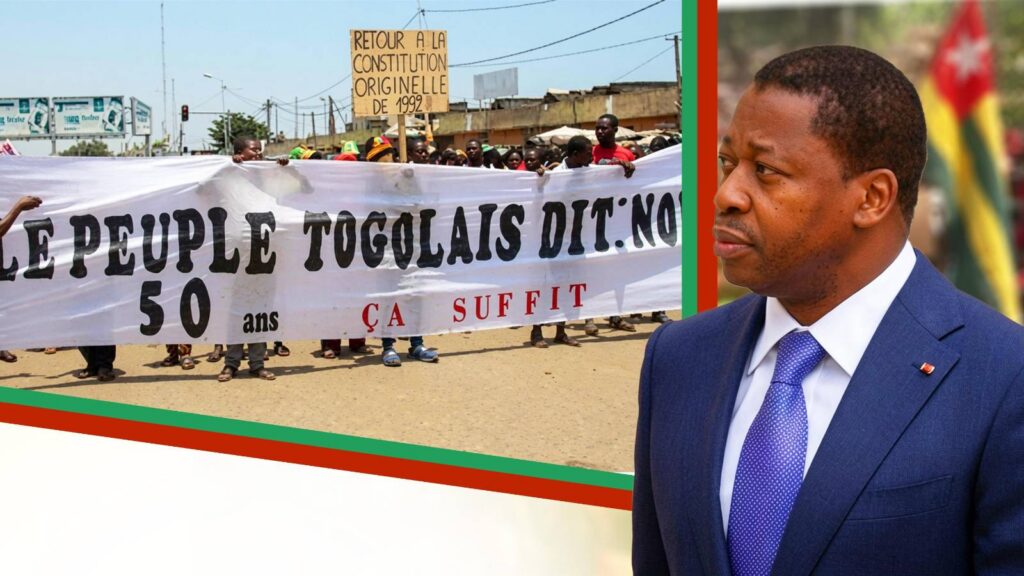
For countless young Togolese, the choice has become an unbearable burden: abandon their homeland in pursuit of a dignified life, or remain trapped in a cycle of unfulfilled ambition. This stark reality has fueled growing discontent, with many pointing to President Faure Gnassingbé’s decades-long leadership as the root cause of their dashed hopes.
Where past generations once dared to envision their futures within Togo’s borders, today’s youth see emigration not as an option, but as the only viable path forward. This shift reflects a profound disconnect between the aspirations of young citizens and the institutions meant to serve them—a crisis of confidence in the state’s capacity to foster an environment where dreams can take root and flourish.
The illusion of progress and the harsh reality of unemployment
Official narratives celebrating economic modernization and reformist policies stand in stark contrast to the grim realities of the labor market. While government statistics tout low unemployment figures, they obscure a far grimmer truth: underemployment and the informal economy dominate the lives of over 70% of young workers.
Each year, universities in Lomé and Kara churn out tens of thousands of graduates. Yet initiatives like the National Employment Agency (ANPE) or the National Coalition for Youth Employment (CNEJ) have proven woefully inadequate in addressing the scale of the crisis. Bereft of opportunities, legions of qualified young people find themselves relegated to the margins, forced into survivalist economic activities to make ends meet.
The economy of mere subsistence
In the absence of viable alternatives, even university graduates are reduced to driving motorcycle taxis (zémidjans) or eking out a living through precarious trade. Years of academic pursuit become little more than a distant memory as the harsh demands of daily survival take precedence. This systemic waste of human capital is not merely an individual tragedy—it represents a devastating loss for the nation’s economy, eroding competitiveness, stifling innovation, and crippling productivity.
The problem is compounded by an industrial landscape that offers scant opportunities for skilled employment. The creation of quality jobs remains critically insufficient to absorb the swelling ranks of graduates, leaving the economy anchored in low-value sectors that fail to match the qualifications of its workforce.
A system entrenched in patronage and exclusion
The frustration among young Togolese runs deep. Families invest heavily in education, believing merit alone will pave the way to success. Yet in Togo, merit is no longer enough.
Access to entrepreneurship and financing is a near-impossible hurdle. Government schemes like the Youth Economic Initiatives Support Fund (FAIEJ) exist in name only for most applicants. Securing credit without substantial financial guarantees or political connections is a fantasy. Public contracts and major economic opportunities remain concentrated in the hands of a select few aligned with the ruling UNIR party. For the average young Togolese, lacking what is colloquially termed le piston (a helping hand), social mobility is a distant mirage.
This perception of a system rigged in favor of connections over competence has fostered widespread despair. When hard work and perseverance no longer guarantee progress, the very foundation of social trust crumbles. The private sector, which should be a catalyst for job creation, is stifled by bureaucratic red tape, limited access to capital, weak purchasing power, and economic instability—factors that deter investment and stifle recruitment.
Emigration as the only path to survival
With the dream of success at home shattered, emigration is no longer a distant aspiration—it is a survival strategy. This exodus manifests in two particularly alarming trends:
- Lines at foreign missions: Daily queues form outside embassies, Campus France offices, and immigration agencies in pursuit of visas to France, Canada, and Gulf states.
- The brain drain of medical and technical professionals: Hospitals are stripped of their most vital human resources as doctors, nurses, and engineers flee to more welcoming shores. Researchers, IT specialists, educators, digital entrepreneurs, and innovators follow suit, draining the country of the very skills needed for progress.
The irony is stark: Togo invests heavily in educating its youth, only for the benefits to enrich foreign economies. Host nations gain from a workforce trained at the expense of Togolese families, while the country of origin is left struggling to replenish its professional ranks and foster growth.
The political deadlock: the end of hope for change
Economic despair is magnified by a deepening political crisis. For many young people, today’s challenges stem directly from a political system that refuses to evolve.
The controversial adoption of the Fifth Republic Constitution in 2024, which transformed the country into a parliamentary regime, has dashed the last vestiges of hope for democratic renewal. The reform is widely seen as a legal maneuver to indefinitely prolong President Gnassingbé’s grip on power, now under the title of President of the Council of Ministers. By eliminating any prospect of democratic alternation or generational renewal at the helm of the state, the regime has pushed its youth toward disengagement and exile.
For many, the issue transcends economics. They argue that without institutional renewal, a strengthened rule of law, independent judiciary, and genuine political competition, economic reforms will remain hollow. The conviction that a future lies abroad, rather than within Togo’s borders, grows ever stronger.
This disillusionment is breeding a crisis of civic participation. Disillusioned by the futility of political engagement, many young people withdraw from parties, associations, and public initiatives, convinced their voices no longer matter. This retreat weakens democratic vitality and deprives the nation of the creativity and dynamism of an entire generation.
Can a nation thrive without its youth?
Critics hold President Gnassingbé—who has led the country since 2005 following his father’s rule—directly accountable for this bleak landscape. Two decades of governance, they argue, have failed to create an inclusive economic model capable of meeting the demands of a burgeoning youth population. Instead, wealth continues to flow disproportionately to a privileged few, while the majority grapples with precarity or contemplates exile.
History underscores a harsh truth: no nation can achieve lasting prosperity when its most talented citizens view departure as their only horizon. The countries that thrive are those that retain their brightest minds, foster innovation, ensure equal opportunities, and cultivate trust between citizens and institutions.
The question now looms large for Togo’s future: how can a country hope to develop when its most dynamic, educated, and ambitious youth dream only of leaving? Without concrete solutions to unemployment, governance failures, transparency deficits, and the democratic aspirations of its people, Togo risks watching its brightest lights fade away—leaving behind a nation stripped of the very forces that should drive its progress.