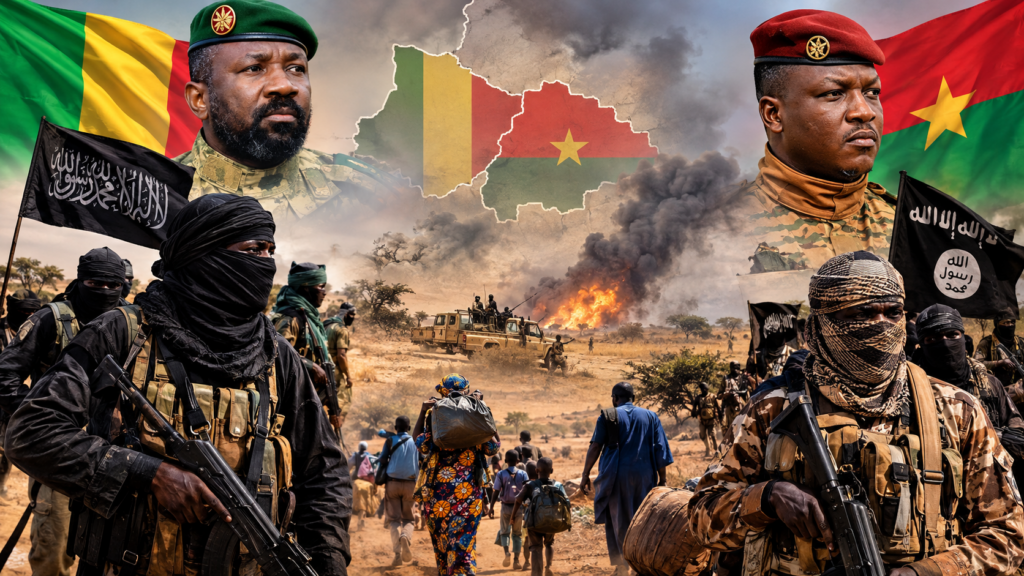
The arid expanse of the Mali-Burkina Faso borderland has become a high-stakes battleground where two of the Sahel’s most aggressive jihadist factions wage relentless campaigns for territorial dominance. Recent clashes between the Group for the Support of Islam and Muslims (JNIM), an Al-Qaeda affiliate, and the Islamic State in the Sahel (EIS) have not only intensified local violence but also laid bare the widening chasm between military rhetoric and ground-level reality.
The Human Cost Behind the Power Struggle
While the juntas in Bamako and Ouagadougou repeatedly pledge to restore state authority and protect civilians, the civilian population is trapped in a spiral of escalating violence. Entire communities face displacement as frontline villages become contested zones where armed groups impose their own brutal order. Schools shutter, markets close, and health services collapse under the weight of sporadic yet devastating attacks. The economic lifelines of border regions vital trade routes and agricultural corridors now serve as arenas for jihadist turf wars rather than pathways to prosperity.
Failed Promises and Unfulfilled Military Strategies
The juntas came to power on the promise of reversing years of insecurity. Yet despite extensive military operations, large portions of the border remain lawless. The failure to curb jihadist expansion has eroded public trust and underscored the limitations of kinetic military solutions. Each new declaration of victory is met with renewed attacks, revealing a security architecture that is reactive, fragmented, and, in many areas, altogether absent. The collateral damage extends beyond physical destruction: businesses close, investments flee, and local authorities retreat, leaving entire regions in a state of suspended governance.
Economic Fallout for Sahelian Communities
Trade disruptions: Border towns that once thrived on cross-border commerce now suffer from closed entry points and blocked routes, stifling regional trade and driving up the cost of essential goods.
Agricultural decline: Farmers in border areas, already vulnerable to climate stress, face additional threats from extortion and looting, pushing rural economies toward collapse.
Displacement crises: Tens of thousands have fled their homes, straining already overstretched refugee camps and straining the limited resources of host communities.
A Crisis of State Legitimacy
More troubling than the immediate violence is the structural corrosion of state authority. When armed groups can operate with impunity, impose taxes, and enforce their own justice systems, the very notion of sovereignty is undermined. The inability of the Malian and Burkinabe juntas to assert control over their borders raises critical questions about their long-term viability. International partners, observers, and local communities alike are left questioning whether military rule despite its initial popular backing can deliver on its central pledge: security.
The Limits of Military Solutions
While military operations continue to dominate the response, the persistent stalemate highlights a fundamental truth: defeating jihadism requires more than firepower. It demands intelligence networks rooted in local trust, civilian administration that can function even under pressure, and a shift from reactive security to proactive governance. Without these, the cycle of violence will likely persist, reinforcing the very conditions that fuel extremist recruitment.
An Uncertain Future for the Sahel
For the people living in the shadow of this conflict, the future remains uncertain. The promise of peace feels increasingly distant as roads become battlegrounds and markets become ghost towns. For the juntas, time is not on their side. Each passing month without decisive improvement in security erodes their credibility and fuels disillusionment. The jihadist factions, meanwhile, continue to exploit the void, deepening their grip on local populations and expanding their operational reach. The border between Mali and Burkina Faso is not just a line on a map—it is a crucible of conflict whose flames show no sign of dying down.
By Marguerite Ndongo — Journalist