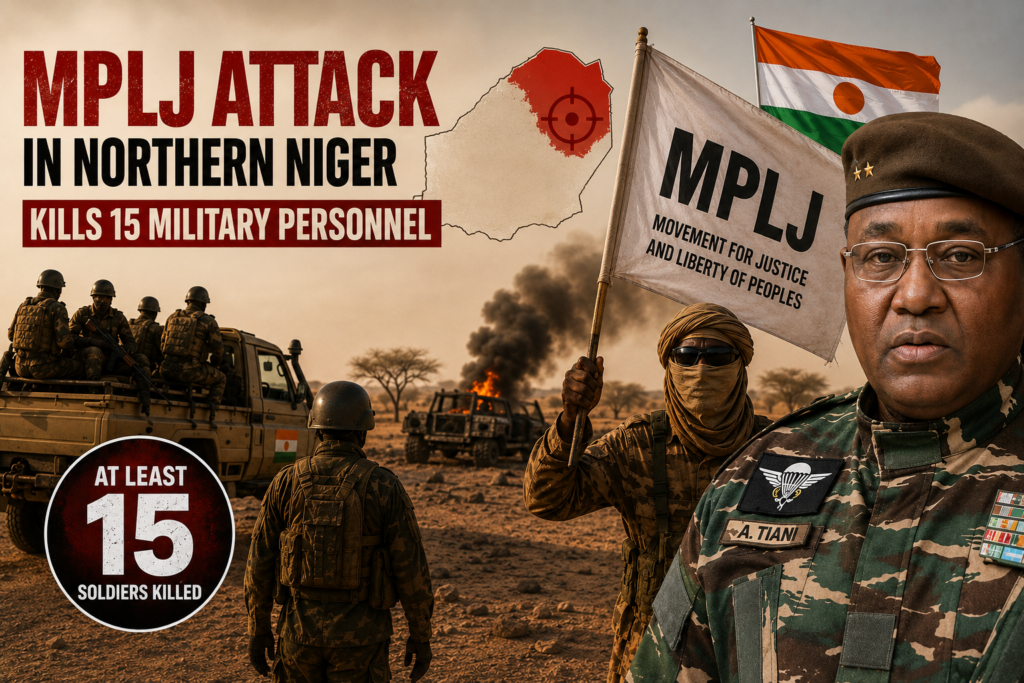
Fresh militant assault underscores Niger’s growing security dilemma
Niger’s military leadership faces mounting pressure as the latest attack by the Movement for the Justice and Freedom of Peoples (MPLJ) in the northern region leaves at least 15 soldiers dead. The assault, claimed by the armed group, underscores a harsh truth: the junta led by General Abdourahamane Tiani is struggling to fulfill the most fundamental duty of any government—ensuring the safety of its citizens and asserting control over its territory.
The attack raises serious concerns about the operational capacity of Niger’s security forces, particularly in the vast, sparsely populated desert and border regions. With an expansive and difficult-to-monitor terrain, Niger shares long frontiers with multiple countries grappling with their own armed threats. These unchecked zones provide fertile ground for militant groups to regroup, launch strikes, and vanish before security forces can respond.
This isn’t merely a matter of a single violent incident; it highlights systemic flaws in a security strategy that remains overly reliant on reactive military responses. Countering such threats demands more than firepower—it requires robust intelligence networks, sustained administrative presence, cross-border cooperation, and proactive measures to prevent armed groups from establishing permanent footholds.
Diplomatic dead ends and shifting blame
Following the coup in July 2023, the military regime has staked much of its legitimacy on the promise of breaking away from past security policies, emphasizing sovereignty, opposition to foreign interference, and forging new alliances. Yet for the civilians caught in the crossfire, these declarations ring hollow. The true test of leadership lies in tangible security—allowing people to live, work, and travel without constant fear of violence.
The regime’s recent difficulties in addressing the crisis have laid bare a stark contradiction: while Niger’s diplomats project confidence on the international stage, the reality on the ground tells a different story. Border regions and remote areas remain dangerously exposed, exploited by armed factions that thrive in the absence of state control.
With accusations against foreign actors—including France and regional bodies—yielding diminishing returns, the junta now faces a critical question: will it turn its frustration inward or double down on an unsustainable blame game? Algeria, a neighboring and strategic partner, could once again find itself in the crosshairs, or the regime might risk alienating newer allies by shifting blame anew.
Sovereignty beyond rhetoric: the test of governance
True sovereignty, however, cannot be measured solely by diplomatic posturing or the rejection of external partnerships. It is defined by a government’s ability to exercise authority over its land, secure its borders, and protect its people. The persistent violence in distant territories is becoming a defining challenge for the military administration, testing whether the changes implemented since 2023 have translated into real-world security improvements.
For the people of Niger, the cost of these failures is measured in lives lost and communities terrorized. Political announcements alone cannot quell the rising tide of insecurity. The junta must demonstrate that its new military and diplomatic strategies are yielding measurable results—not just headlines.
It would be a mistake to view each military setback as the sole responsibility of frontline troops. Their effectiveness hinges on a complex web of factors: intelligence quality, logistics, command structure, air and ground capabilities, and the political will to implement a long-term, coherent strategy. A thorough assessment of the entire security apparatus is long overdue—not just to assign blame, but to identify systemic weaknesses that leave soldiers and civilians alike vulnerable.
Isolation’s hidden cost in the Sahel
The junta’s strained relations with some regional partners risk undermining collective efforts to combat armed groups. Militant factions operating across the Sahel exploit porous borders, moving freely and reorganizing in the gaps between national jurisdictions. Effective counterterrorism requires seamless intelligence sharing, coordinated operations, and joint patrols—tools that diplomatic tensions can erode.
Equally troubling is the regime’s reluctance to acknowledge the need for a broader national strategy. While new alliances may offer short-term gains, they are no substitute for a unified, long-term approach. Success hinges on more than changing partners; it demands actionable results: early threat detection, civilian protection, secure supply routes, and an administrative presence that extends even into the most remote areas.
The path forward: institutions over slogans
The current crisis raises a fundamental question: can Niger’s stability be built on the popularity of anti-foreign rhetoric alone? Lasting security requires more than slogans. It requires strong institutions, a clear national strategy, pragmatic regional cooperation, and an administration capable of reaching every corner of the country.
The MPLJ attack is more than another tragic episode in the Sahel conflict—it is a reminder that sovereignty begins with the state’s ability to protect those living under its authority. Until Niger’s leadership addresses the security vacuum on its own territory, the cost will continue to rise, and the promise of stability will remain out of reach.