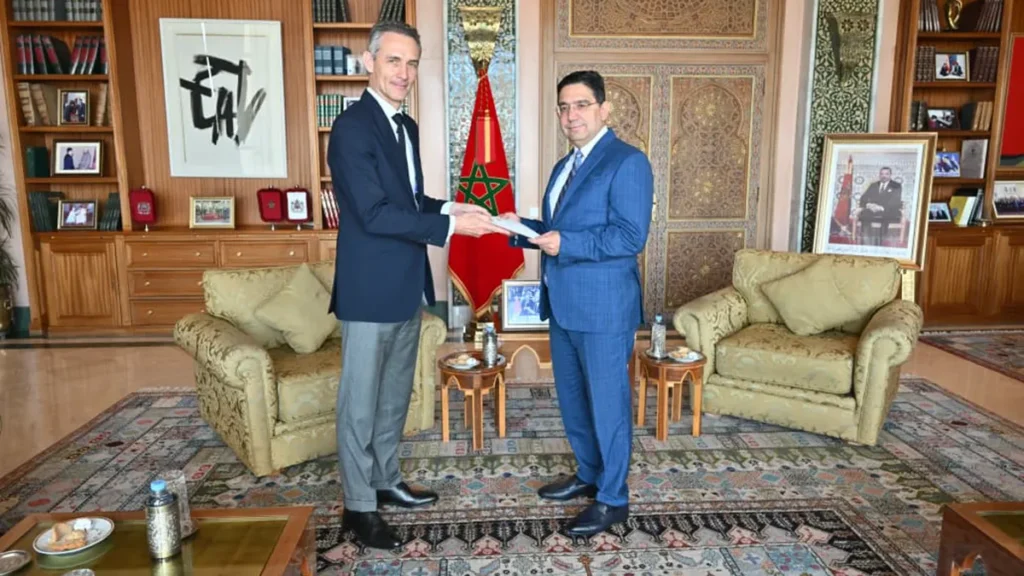
France and Morocco launch strategic partnership with new ambassador Philippe Lalliot
France’s new ambassador to Morocco has officially assumed his duties, presenting his credentials to Foreign Minister Nasser Bourita. Appointed in May, Philippe Lalliot’s mission is to strengthen the strategic partnership between Paris and Rabat and safeguard French investments ahead of the 2030 World Cup.
- The Sahara factor and Morocco’s strategic shift
- Economic investments and the 2030 World Cup
- Challenges in building a new bilateral framework
The arrival of a new ambassador is often a routine diplomatic event, but Philippe Lalliot’s posting to Rabat marks a turning point. Following his mid-May appointment, the French diplomat formally presented his credentials to Morocco’s Foreign Minister, Nasser Bourita, signaling the start of a bold new bilateral agenda.
This marks not just the end of years of strained relations but a redefinition of power dynamics in the Mediterranean and African spheres. The handover of his official documents was more than a formality—it symbolized a fresh chapter in Franco-Moroccan relations, one built on mutual trust and shared strategic interests.
His predecessor, Christophe Lecourtier, faced one of the most challenging periods in this bilateral history. Tensions peaked when France drastically reduced visa issuance for Moroccan citizens, compounded by what Rabat perceived as Paris’ lukewarm stance on Morocco’s national priorities. This led to a prolonged freeze in high-level dialogue and a significant erosion of French influence in Morocco’s foreign policy agenda.
Years of strained relations meant no high-level visits took place, and France’s historical closeness with Morocco gave way to a series of cold and distant gestures, weakening the alliance’s foundations.
The Sahara factor and Morocco’s strategic shift
A major turning point came in 2024, when discreet diplomacy culminated in a historic shift in France’s position. In an official letter to King Mohammed VI, President Emmanuel Macron endorsed Morocco’s autonomy plan for Western Sahara, calling it the only viable basis for resolving the conflict. For Morocco, this was a geopolitical victory of the highest order—not just the support of a traditional ally but the strategic alignment of a UN Security Council permanent member and key EU player. The move was significant enough to reshape regional power balances.
Following this announcement, diplomatic paralysis gave way to an intense revival of bilateral engagement. High-level meetings resumed, joint business delegations returned, and long-stalled economic projects were unblocked, restoring fluid communication channels between the two capitals.
The climax of this process was President Macron’s state visit to Morocco, where both sides declared an end to their distancing. Macron emphasized the need to realign their partnership with Africa’s evolving realities, while Bourita framed the new understanding in terms of mutual trust and shared strategic vision.
Behind this rapprochement lay a strictly pragmatic reading. During the years of tension with Paris, Morocco did not halt its foreign policy but instead diversified alliances, strengthening ties with the United States, Gulf monarchies, and multiple African governments. This diversification expanded its international maneuvering room.
Facing a rapidly changing regional landscape, the Élysée realized that maintaining a distant stance toward Rabat carried increasing political and economic costs it could no longer justify.
Economic investments and the 2030 World Cup
Ambassador Lalliot assumes his post at a pivotal moment. The economic dimension will be central to his agenda: French companies remain the leading investors in Morocco’s industrial sector, dominating key industries such as automotive, rail development, banking, energy transition, and major public infrastructure projects.
Morocco also serves as a strategic gateway for French firms seeking to expand into Sub-Saharan African markets. The appointment of Lecourtier’s successor—who later took charge of the French Development Agency (AFD) in Morocco—highlights Paris’ prioritization of the economic dimension in this realignment.
The AFD plays a pivotal financial role as Rabat accelerates public investment and infrastructure projects ahead of the 2030 FIFA World Cup, co-hosted with Spain and Portugal. This mega-event is a major draw for French companies and engineering firms, offering lucrative opportunities in construction, logistics, and event infrastructure.
Challenges in building a new bilateral framework
While institutional normalcy has returned to diplomatic circles, deeper power dynamics are being redefined. France seeks to rebuild its presence in Africa after setbacks in traditional spheres of influence, while Morocco consolidates an ambitious foreign policy centered on its Atlantic and Mediterranean reach.
Key areas of cooperation—regional security, migration control, Sahel stability, and trade—will continue to shape the daily agenda. These are fields where convergence is evident, though not without potential friction.
Ambassador Lalliot’s real test will not be sustaining current goodwill but proving the alliance’s resilience when inevitable strategic divergences arise. Past crises showed that trade alone cannot prevent ruptures—these occur when one party feels the other no longer understands or respects its core priorities.