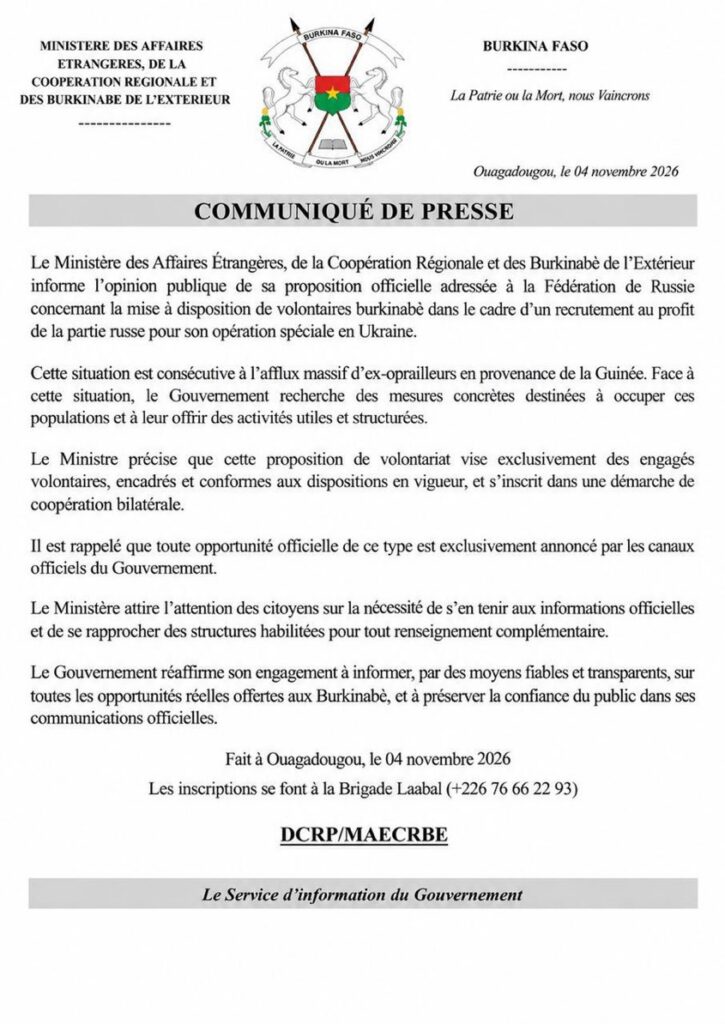
Burkina Faso’s evolving partnership with Russia has taken a controversial turn, as reports indicate Ouagadougou may be considering deploying Burkinabè gold miners expelled from Guinea to fight in Ukraine alongside Russian forces. The proposal raises serious ethical and humanitarian concerns about the exploitation of vulnerable populations in geopolitical strategies.
Behind the diplomatic facade: a human cost to military cooperation
The potential arrangement stems from Burkina Faso’s recent expulsions of Burkinabè nationals from Guinea, where many worked in clandestine gold mining operations. Returning to Ouagadougou, these miners now face economic hardship and uncertain prospects. Against this backdrop, their possible recruitment for a foreign war underscores a troubling dynamic: can strategic alliances justify redirecting displaced individuals into active combat zones?
The situation highlights a stark contradiction. While Ouagadougou and Moscow present their collaboration as a path to sovereignty and security, the real-world implications for Burkinabè citizens remain dangerously ambiguous. Behind official statements lies a question that demands urgent clarity: Are these miners being offered a second chance, or are they being funneled into a role they never consented to?
The journey from expulsion to potential frontline service
Most of these miners were forcibly returned from Guinea after operating in precarious conditions in the goldfields. With their livelihoods destroyed and no immediate employment opportunities in Burkina Faso, their vulnerability creates a precarious environment for potential recruitment drives. The timing of their mass return paired with the logistical coordination to Ouagadougou has sparked speculation that their regrouping serves purposes beyond repatriation.
Military observers warn that such recruitment tactics, particularly when targeting economically desperate populations, can resemble coercion rather than voluntary enlistment. The shadow of doubt grows when considering that these individuals have already experienced displacement and legal instability. Would their decision to join a foreign army be truly informed, or merely expedient?
Burkina Faso-Russia ties under the microscope: beyond rhetoric and into reality
Since Ibrahim Traoré’s rise to power, Burkina Faso has deepened its ties with Moscow, framing it as a counterbalance to Western influence. Documented deployments of Russian paramilitary personnel in the country have further solidified this partnership. Yet, the proposal to send Burkinabè to Ukraine forces a critical evaluation: Can security cooperation be expanded without compromising the welfare of citizens?
The question of sovereignty, often invoked in defense of Burkina Faso’s pivot from former allies, now faces a stark test. If these expulsed miners are indeed sent to the front lines, their deployment would mark a new chapter in the Russia-Burkina Faso alliance not merely as partners in security assistance, but as facilitators of foreign combat deployments.
What would such an agreement demand from the individuals involved?
Informed consent: Are these miners fully aware of the risks, obligations, and absence of legal protections in Ukraine?
Contractual transparency: What legal status would they hold? Are they signing up as mercenaries, contractors, or under another framework?
Duration and exit provisions: Is there a clear timeline for service, and a guaranteed path back to Burkina Faso afterward?
Protection and liability: In the event of injury, capture, or death, what recourse would they or their families have?
Without transparent answers to these questions, the arrangement risks violating the very principles of sovereign responsibility Burkina Faso claims to uphold.
The human dimension: lives at the mercy of geopolitics
This controversy transcends diplomatic calculations. It centers on individuals men and women who have already endured expulsion, economic ruin, and uncertainty. To redirect them toward a warzone would not only exploit their desperation but also redefine their role from displaced workers to expendable assets in a distant conflict.
The optics of this potential transfer paint a grim picture: a nation claiming independence while outsourcing the most dangerous aspects of military partnership to its most vulnerable citizens. It raises a fundamental ethical dilemma: Can a country truly claim sovereignty if its citizens become pawns in a foreign war they neither chose nor fully understand?
A call for accountability and transparency
The fate of these miners should not be left to speculation or behind-closed-doors negotiations. Burkina Faso owes its citizens and the international community clear explanations about the following:
Who brokered the proposal with Russia?
What are the stated and unstated objectives behind regrouping these individuals in Ouagadougou?
Have the miners been given full disclosure about the nature of the military role proposed?
What safeguards exist to prevent coercion or misrepresentation in recruitment?
The stakes are high. If this is merely a humanitarian mission to reintegrate expulsed nationals, then the mobilization is justified. But if it’s a covert recruitment pipeline to bolster Russia’s war effort, then Burkina Faso risks becoming complicit in exporting human suffering for geopolitical gain.
In the end, the true test of Burkina Faso’s independence lies not in rejecting old alliances, but in ensuring that no citizen is sacrificed in the name of strategic expediency.
By Marguerite Ndongo — Journalist