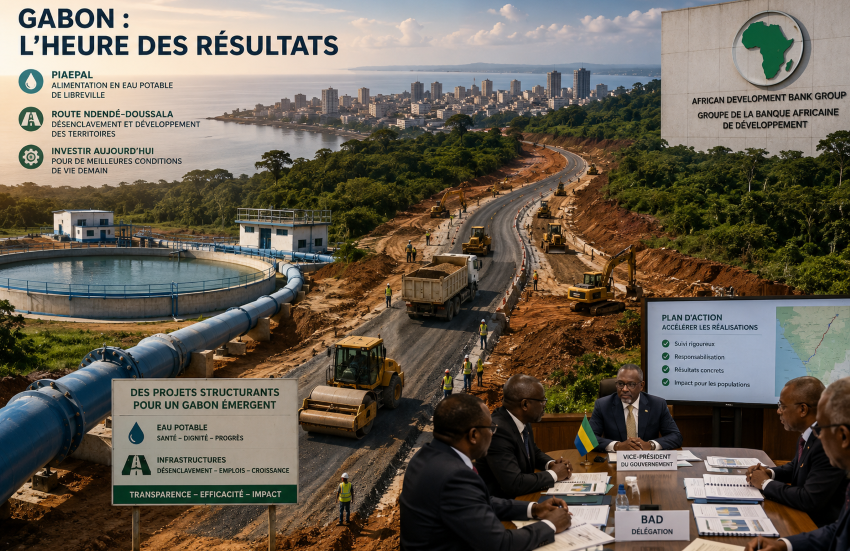
Gabon has signaled a major shift in its approach to international financing. Facing persistent delays in several key initiatives funded by the African Development Bank (AfDB), the government is now insisting on concrete outcomes. The message is clear: every dollar of debt must translate into visible progress for the nation.
A high-level meeting recently took place in Libreville between Hermann Immongault, Vice President of the government, and an AfDB delegation led by Country Manager Mamour Ousmane Ba. The discussions centered on a growing priority for the authorities: ensuring that mobilized funds are effectively transformed into real-world achievements that benefit the population.
Priority projects under the spotlight
Two major infrastructure works are at the heart of this new scrutiny. The first is the Integrated Program for Drinking Water Supply and Sanitation in Libreville (PIAEPAL), designed to provide sustainable water access across the capital. The second is the Ndendé-Doussala road, a vital strategic link intended to boost regional integration and economic trade with neighboring countries. While these projects are considered essential, their slow progress has sparked significant concern and public impatience.
An end to project delays
For several years, Gabon has secured substantial funding from international institutions to modernize its national infrastructure. However, many of these projects have struggled to meet their original deadlines, leading to frustration among the public. The recent dialogue with the AfDB represents a turning point in official policy, with the executive branch now focusing heavily on performance and accountability.
In a period of tightening budget constraints, the government believes it is no longer enough to simply secure loans. The focus must shift to ensuring those resources are used efficiently. Citizens are no longer judging the success of government policy by the amount of money spent, but by the tangible improvements in their daily lives.
The PIAEPAL project is a prime example of these stakes. As water shortages continue to affect various districts of Libreville, expectations are high. Every delay erodes public confidence in state-led programs. Similarly, the Ndendé-Doussala road, long promised as a catalyst for economic development, continues to face hurdles that stall the benefits intended for local businesses and residents.
Shared responsibility and administrative reforms
One of the most revealing aspects of the recent discussions was the acknowledgement that delays often stem from a variety of sources. Hermann Immongault emphasized the need to clarify the roles of all stakeholders and pinpoint the exact bottlenecks hindering project execution. This marks a departure from the habit of placing blame solely on external contractors or lenders.
By identifying internal administrative weaknesses, the government is admitting that complex factors—such as heavy bureaucracy, poor coordination between institutions, and slow decision-making—often impede progress. This level of transparency is a significant indicator that the state is serious about systemic reform in how public projects are managed.
Proving the effectiveness of the new approach
The AfDB representative, Mamour Ousmane Ba, maintained a supportive yet professional stance, confirming the bank’s readiness to align with Gabon’s national priorities. He noted that the bank would take the government’s new directives back to its leadership for consideration.
Ultimately, the success of this partnership depends on national execution capabilities. The credibility of the government’s new stance will be tested by how quickly it can deliver measurable results. Improving water access in the capital and completing the Ndendé-Doussala highway have become the primary benchmarks for this political will.
In the global competition for international development funding, the most attractive nations are those that can prove they turn debt into operational infrastructure. Gabon has sent a firm message: it wants every funded project to be a visible success, aiming to finally break the cycle of chronic delays that has hampered national development for too long.

More Stories
Can Niger still call itself a state of law after jailing lawyer Abdourahamane Lirwana?
Can Benin replicate its 2023 financing success with 328 billion FCFA in 2026?
Burkina Faso: can the official narrative on four years of Ibrahim Traoré’s rule withstand scrutiny?