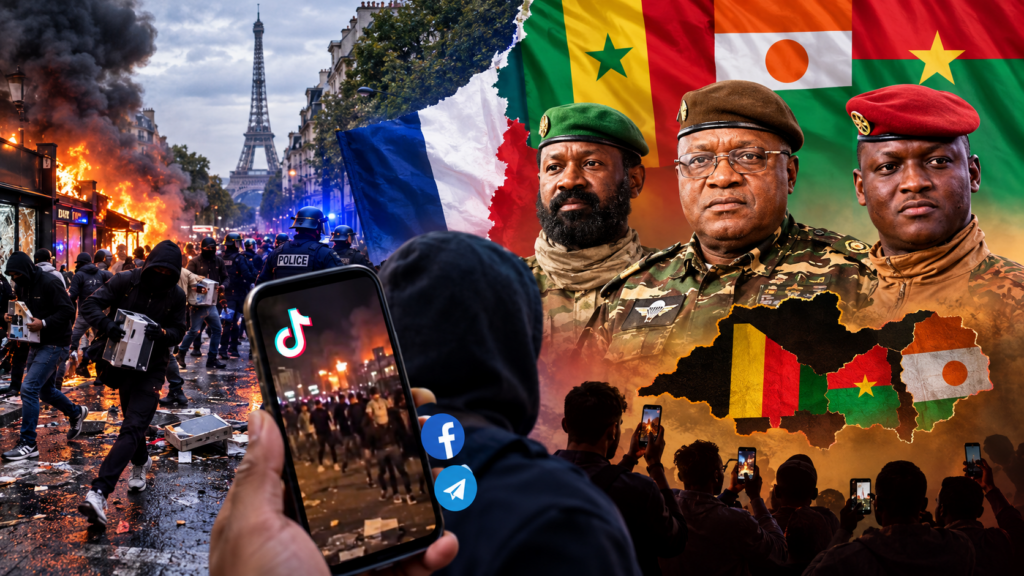
The ripple effects of recent civil unrest in France extend far beyond its borders, particularly in the Sahel region where military-led governments in Mali, Burkina Faso, and Niger have severed ties with Paris. Far from being mere spectator events, the images of looting, property damage, and clashes with law enforcement are being rapidly repurposed across TikTok, Facebook, and Telegram to fuel narratives critical of France’s democratic record, security policies, and rule-of-law commitments.
The strategic recalibration of these visuals serves a dual purpose for Alliance of Sahel States (AES) leadership: it challenges France’s moral authority to critique Sahelian governance while positioning the juntas as legitimate alternatives. By juxtaposing footage of French disorder with official pronouncements on stability and development, propagandists are constructing a juxtaposition designed to erode confidence in Western institutions altogether.
Legal accountability remains non-negotiable for all parties
Amid this geopolitical contest of narratives, a separate but equally critical dimension demands attention: the potential judicial consequences for individuals including foreign nationals—who may have violated French law during the unrest. Reports indicate that citizens from Mali, Burkina Faso, and Niger, some of whom may be residing in France without valid documentation, have allegedly participated in acts of vandalism, theft, and assault. Should investigations confirm involvement, such individuals will be subject to prosecution under the same legal standards applied to all suspects, regardless of nationality or residency status.
Establishing individual responsibility
French judicial authorities are now conducting detailed inquiries to determine the precise roles played by each suspect. Investigators are collecting evidence, interviewing witnesses, and analyzing digital footprints to build comprehensive case files. For foreign nationals, immigration status may influence the scope of punishment where infractions are proven, administrative consequences such as deportation orders or visa revocations may follow, in accordance with French and European regulations.
Foreign status does not confer immunity. Anyone present on French soil must comply with national laws.
Judicial impartiality applies universally. Nationality or ethnicity is irrelevant to guilt or sentencing.
Administrative measures are separate from criminal penalties. Deportation hearings proceed independently of court convictions.
Propaganda thrives on selective perception facts must prevail
It is within the realm of disinformation that the AES-aligned digital ecosystem finds its most fertile ground. Short clips of burning barricades, looted shops, or confrontations with police are often stripped of context and repackaged as “evidence” of systemic failure in France. Yet such isolated images reveal little about the nation’s overall stability, policy coherence, or long-term resilience. They do even less to substantiate success claims by Sahelian military governments, whose security metrics measured in reduced attacks, improved governance, and public service delivery remain matters of debate rather than fact.
Disinformation campaigns often rely on three core tactics:
Authentic footage framed with misleading captions or editorial commentary
Outdated videos presented as real-time evidence
Localized incidents portrayed as nationwide crises
Verifying authenticity requires cross-referencing timestamps, geo-locating scenes, and analyzing user networks. Independent fact-checking initiatives have repeatedly demonstrated how content can be weaponized when stripped of its original context yet such distortions do not amount to coordinated state-sponsored operations unless concrete evidence of orchestration is uncovered.
Selective outrage exposes a double standard
This moment also raises uncomfortable questions about consistency in public discourse. When criticism is directed at the AES governments for alleged human rights abuses or governance deficiencies, pro-junta commentators invoke the principle of national sovereignty. Conversely, when individuals from Sahelian states are suspected of criminal activity in France, the same voices sometimes default to generalized condemnations or collective blame against entire expatriate communities a contradiction that undermines rhetorical credibility on both sides.
It is essential to distinguish between:
Political rhetoric and legal accountability one cannot be used to shield the other
Individual actions and collective identity nationality does not imply shared guilt
Public diplomacy and judicial due process institutions, not influencers, must determine outcomes
Beyond the screen: restoring credibility through action
For France, the path forward demands a two-tier response. First, it must ensure that judicial proceedings against suspected offenders regardless of origin are conducted with transparency and fairness. Second, it must counter disinformation not with counter-propaganda, but with demonstrable improvements in policy, governance, and public trust.
The Sahelian juntas, in turn, face their own reckoning: their legitimacy cannot be sustained on anti-colonial rhetoric alone. Citizens across the region will increasingly judge their leaders not by what they oppose, but by what they deliver. Meanwhile, the international community will continue to monitor both the legal outcomes of France’s unrest and the performance metrics of Sahelian governments each measured against the same standards of evidence and accountability.
Ultimately, the most consequential impact of the French unrest may not be in the courtrooms of Paris or the propaganda channels of Bamako and Ouagadougou, but in the court of public opinion where facts, not fictions, determine lasting credibility.
By Marguerite Ndongo — Journalist