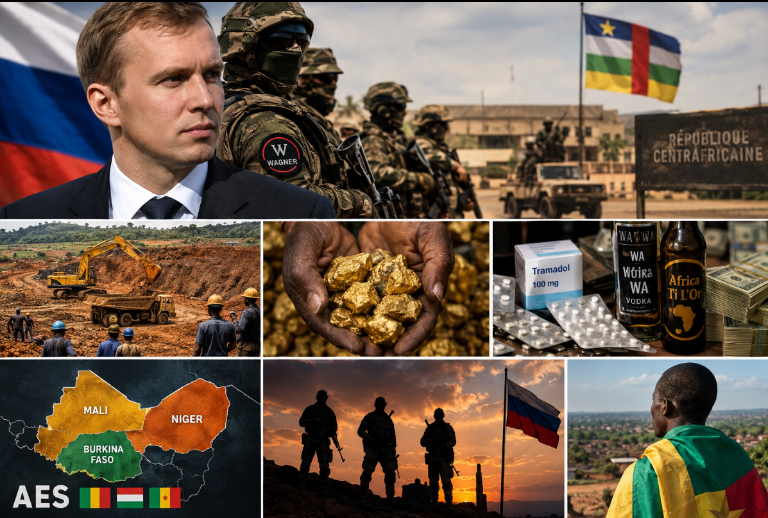
Russia’s expanding security footprint across Africa has quietly transformed gold-rich countries into strategic bargaining chips. In the Central African Republic (CAR), where state security remains fragile, the intertwining of military protection and gold mining operations has created a high-stakes model that Sahel nations—including Mali, Burkina Faso, and Niger—are watching closely.
The hidden cost of security: when gold becomes the currency of protection
In CAR, recent reports indicate that economic networks linked to the former Wagner Group continue to generate over $400 million annually—more than ten times the country’s security budget. While these figures remain unverified, they underscore a troubling reality: when foreign armed groups become de facto guarantors of regime stability, their compensation often extends far beyond salaries into access to natural resources, trade routes, and long-term economic control.
The most lucrative symbol of this arrangement is gold. At a single mine reportedly connected to Russian-linked entities, production is estimated to exceed $250 million worth of gold annually. Yet the methods of extraction, export control, and revenue sharing remain opaque, raising serious concerns about who truly benefits—local communities or external operators.
From mercenaries to businessmen: how security evolves into economic dominance
The convergence of military force and commercial enterprise under Wagner’s legacy is not accidental. Analysts describe a system where protection for the Bangui government, private military operations against rebels, and large-scale gold extraction operate as a single, self-reinforcing cycle. Combatants secure the capital and mining zones; revenue from gold finances continued operations; and political influence solidifies access to future concessions.
This model extends to other sectors. Investigations suggest networks linked to Wagner affiliates have monopolized lucrative trade in alcohol, arms, and pharmaceuticals—including the illicit tramadol market. While these claims remain unproven, they reveal a worrying pattern: military partnerships can rapidly mutate into shadow economies that prioritize profit over public welfare.
The Sahel dilemma: can security partnerships avoid central Africa’s fate?
The Central African Republic offers both a cautionary tale and a potential blueprint for the Sahel’s three newest allies—Mali, Burkina Faso, and Niger. Each faces a deadly mix of jihadist insurgencies and strained relations with Western partners. In response, all three have deepened military ties with Moscow, including Wagner-linked forces and now, Moscow’s stated Africa Corps. What remains uncertain is whether their governance will be strong enough to prevent economic concessions from eclipsing security gains.
The stakes are high. In Mali, controversies over Russian operations have fueled public distrust. In Burkina Faso and Niger, the arrival of Russian trainers and combatants has raised questions about long-term costs—both financial and geopolitical. Critics warn that a dependence on foreign security providers could come with invisible strings: mining deals signed in back rooms, profit-sharing formulas kept secret, and economic benefits flowing away from local populations.
Who really holds the power when gold pays for protection?
The heart of the issue is sovereignty. When a state’s survival hinges on foreign armed forces that also control access to its most valuable resources, decision-making may no longer reside with its own leaders. Contracts for security services, mineral concessions, and revenue management must be transparent, negotiable in public, and subject to independent audits. Without these safeguards, even the most immediate security gains can erode national autonomy over time.
Central Africa’s experience shows how quickly military partnerships can spiral into economic entanglements. The Sahel now stands at a crossroads: it can negotiate Russian support with clear red lines—ensuring that any security cooperation does not become a gateway to foreign-led resource exploitation. Or it can repeat the CAR model: stability bought with gold, and sovereignty traded away in the fine print.
Three red flags Sahel nations should watch
- Unequal contracts: Agreements that grant long-term mining rights to foreign actors without competitive bids or public oversight.
- Revenue opacity: Gold proceeds flowing into offshore accounts or state coffers with no transparent allocation to education, health, or local infrastructure.
- No exit clause: Deals that prevent renegotiation or withdrawal, effectively turning security partners into permanent economic stakeholders.
A warning, not a prediction
Russia’s military presence in Africa is not inherently exploitative—many African governments welcome the support amid urgent security crises. But history in CAR shows how rapidly military aid can morph into economic dependency. For the Sahel, the choice is not between Western powers and Moscow; it is between alliances that protect citizens first, and those that protect foreign interests first.
The real test facing Mali, Burkina Faso, and Niger is not who signs the security pact—it’s who writes the fine print. Because in the end, when gold pays for protection, the currency of sovereignty is what’s really at stake.