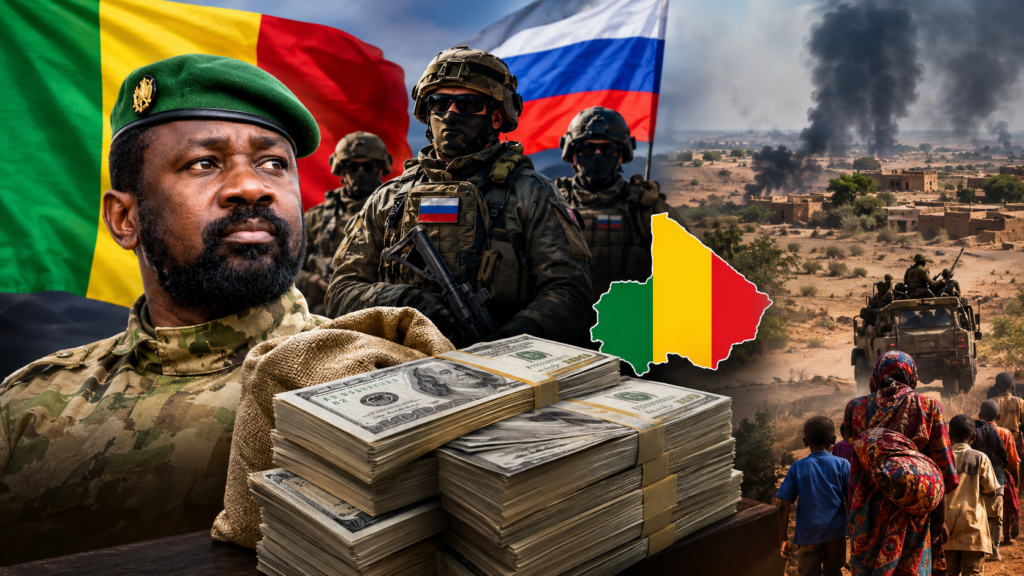
The economic and strategic weight of Mali’s billion-dollar partnership with Russia
The Malian government has allocated nearly one billion dollars to fund its controversial military cooperation with Russian forces, a move initially involving Wagner Group fighters before transitioning to the Africa Corps framework. With estimated costs hovering around $10,000 per fighter per month, this financial commitment has thrust Bamako into a precarious position: defending a strategy that demands justification in tangible outcomes.
While the Malian authorities severed ties with Western partners, particularly France, under the banner of regaining national sovereignty, the effectiveness of this pivot must now be measured against real-world results. At stake is not merely the expenditure itself, but the actual security gains for Malian citizens, the stability of key infrastructure, and the government’s ability to restore state authority across its territory.
Billions spent, but security gains remain elusive
A billion-dollar military contract is more than a financial transaction it represents diverted public funds that could have been allocated to education, healthcare, or critical infrastructure in regions devastated by conflict. However, the complexity of counterinsurgency operations means that no military partnership can guarantee instant victory. The Malian government’s challenge is to demonstrate that these resources have produced measurable improvements in security.
Yet the evidence remains troubling. Attacks on civilians persist, military outposts remain vulnerable, and entire communities live under the constant threat of armed groups. The central question is whether this costly collaboration has delivered tangible benefits or whether it is merely sustaining a cycle of dependency. For a transitional administration that has staked its credibility on this alliance, the absence of clear progress raises serious doubts about its long-term viability.
From Wagner to Africa Corps: rebranding without results
The reorganization of Russian forces in Africa shifting from Wagner Group to Africa Corps has done little to alter the fundamental concerns surrounding Mali’s military partnership. While structural or operational changes may occur behind the scenes, the population’s security remains the true measure of success. Have these forces enhanced coordination with Malian troops? Improved intelligence-sharing? Provided more reliable protection for civilians? Without verifiable progress in these areas, the rebranding appears little more than a cosmetic shift.
A military partnership, no matter the size or origin of the forces involved, cannot replace the necessity of a capable, well-equipped national army. If Mali’s security remains critically dependent on foreign fighters, the very sovereignty it claims to have regained comes into question. A nation’s strategic autonomy requires more than choosing allies it demands accountability, measurable outcomes, and the ability to evaluate results without political interference.
The unspoken political cost of a failed security narrative
The Malian transition government justified its alliance with Russia as a means of breaking free from historical dependencies and reclaiming military initiative. However, when national security becomes a matter of political rhetoric rather than empirical results, governance itself is undermined. Citizens deserve transparency: How much are these forces costing? What specific missions have they undertaken? What concrete improvements in security have they delivered? Without clear answers, the public is left to question whether this strategic shift is anything more than a costly experiment.
Transparency is not an act of defiance against allies it is a cornerstone of democratic governance. When billions of dollars are spent in the name of sovereignty, the absence of thorough evaluation risks reducing a vital policy decision to mere political posturing. The larger the investment, the greater the obligation to demonstrate its returns.
The ultimate test: lives saved, territory secured
Beyond financial ledgers and diplomatic announcements, the true measure of Mali’s security strategy lies in the daily reality of its people. Families in conflict zones, traders relying on safe passage, farmers attempting to access their land, and displaced communities yearning for return all depend on visible improvements in safety and stability. These are the metrics that matter most, not the narratives of political leaders.
If Russian support has failed to translate into fewer attacks, stronger military presence, or restored state functions in vulnerable regions, the Malian government must explain why. Without reliable data on expenditures, force levels, operational timelines, or pre- and post-deployment security trends, the billion-dollar investment cannot be credibly assessed. Public trust erodes when rhetoric outpaces results, leaving Mali at risk of squandering not just financial resources, but its citizens’ confidence in governance.
A billion dollars, but what has Mali truly gained?
The Malian government’s decision to prioritize Russian military cooperation over its predecessors was a deliberate political choice. Yet the sustainability of such a partnership cannot be measured in press releases or diplomatic handshakes. It must be judged by the security it delivers territorial integrity preserved, civilians protected, and state authority restored.
While no military alliance guarantees immediate victory in a complex insurgency, the sheer scale of investment demands that the government demonstrate tangible progress. Otherwise, the billion-dollar gamble with Russia risks becoming nothing more than a costly miscalculation a strategic pivot justified by ideology rather than results. In a nation long plagued by insecurity, sovereignty cannot be built on the shifting sands of unmet promises and unanswered questions.
By Marguerite Ndongo — Journalist