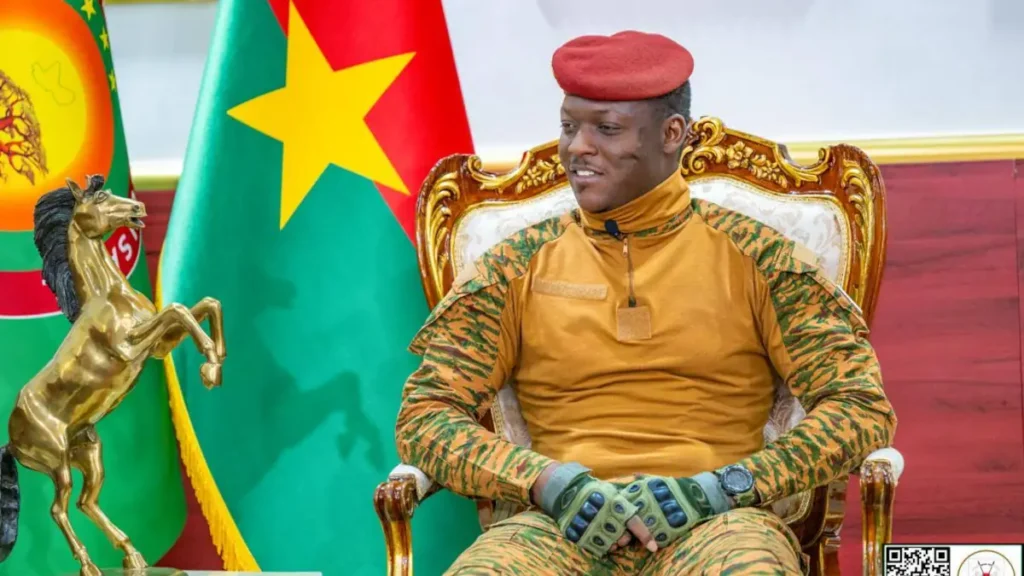
The ambitious federal vision for the Alliance of Sahel States (AES), championed by Ibrahim Traoré, increasingly confronts the practicalities of governance where immediate regime survival often overshadows deep institutional integration. While official statements laud the emergence of a sovereign confederation poised to break free from Western influence, the operational reality frequently reverts to bilateral approaches, with each capital seemingly prioritizing its own border security. This individualized, ‘à la carte’ strategy undermines the Alliance’s cohesion, transforming the federal concept into a collection of national defense tactics. These are united by a common adversary but lack the organic solidarity mechanisms necessary to endure beyond the tenure of current heads of state.
Politically, Ibrahim Traoré’s recent call for populations to “forget democracy” signals an authoritarian shift that could compromise the AES’s long-term legitimacy. By elevating an ‘all-security’ doctrine as the sole guiding principle, Traoré appears to sacrifice public freedoms for an efficiency that has yet to deliver lasting territorial stabilization. This perspective, advocating for a perpetual ‘Sahelian exception,’ risks alienating segments of civil society and youth. Initially drawn to the discourse of radical change, these groups might eventually perceive the AES not as a catalyst for liberation, but as a framework for social control and the suppression of dissenting voices.
The economic landscape of the Alliance also grapples with the consequences of this hybrid management, oscillating between aspirations for monetary autonomy and heightened reliance on new geopolitical patrons. Despite Traoré’s numerous pledges for endogenous transformation and food sovereignty, economic indicators reveal persistent vulnerability to external shocks and difficulties in operationalizing the AES investment bank. A striking paradox emerges: while denouncing imperialism, Ouagadougou strengthens strategic and financial ties with powers like Russia and Turkey, often through opaque agreements. This raises concerns that bilateral expediency might ultimately dilute the true economic substance of the federal ambition.
Finally, the military credibility of the AES, a foundational pillar of its project, faces significant challenges due to a communication strategy increasingly detached from the complex realities on the ground. Although the acquisition of new military hardware is celebrated as a triumph of sovereignty, the integration of civilians into anti-terror operations introduces substantial risks of community-based conflicts, which the existing AES structure appears ill-equipped to manage. By positioning himself as the guarantor of an imminent victory against jihadism, Ibrahim Traoré adopts an ‘all or nothing’ rhetoric. While this stance may galvanize supporters in the short term, it leaves the entire Alliance vulnerable to any tactical setback, exposing the fragility of an equilibrium that relies more on the charisma of an individual leader than on the inherent strength of a regional organization.