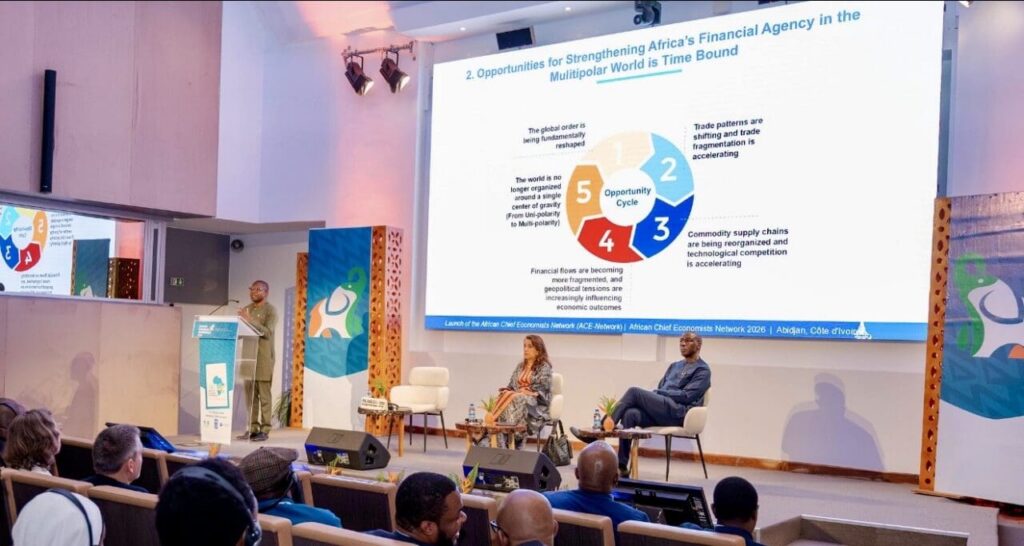
After three days of intensive discussions, the 2026 African Economic Conference concluded in Abidjan with more than just a diagnosis of the continent’s vulnerabilities—it charted a bold new path forward. The gathering, co-organized by the African Development Bank (BAD), the United Nations Development Programme (PNUD), and the Organisation for Economic Co-operation and Development (OCDE), emphasized that Africa must move beyond adapting to global upheavals and instead forge its own destiny in an era of shifting power dynamics.
Throughout the event, economists, policymakers, and global institution leaders converged on a singular vision: Africa must stop being a passive observer of economic transformations and instead become an active architect of its future. The closing remarks reinforced this ambition, positioning the continent as a strategic player in the evolving global economy rather than a peripheral participant.
Turning global turbulence into sustainable power
Raymond Gilpin, Chief Economist at the UNDP’s Regional Bureau for Africa, framed economic volatility not as an insurmountable obstacle but as an opportunity to reinforce resilience. « Global economic storms will persist and test our institutions, » he acknowledged, « yet they cannot erode the fundamental strength and adaptability of African societies. »
His message underscored the conference’s core theme: accelerating reforms, deepening partnerships, and acting with greater urgency to build the Africa we aspire to—a continent not only resilient in the face of challenges but also prosperous and influential on the world stage. The shift in perspective is clear: the focus is no longer merely on survival but on converting geopolitical upheavals into strategic advantages.
Redefining development strategies for a complex world
The sessions highlighted a critical need to dismantle siloed approaches to policymaking. Ida McDonnell, Senior Advisor at the OECD, stressed that traditional divisions between trade, debt, investment, climate action, fiscal policy, and development financing are obsolete. « Today’s challenges demand integrated analysis, » she argued, « where data and knowledge flow freely between institutions to guide smarter public decisions. »
The reality is stark: interlinked crises—energy shortages, financial instability, climate shocks, and geopolitical tensions—now send cascading effects through African economies. Addressing these requires coordinated, cross-sectoral solutions rather than isolated interventions.
From dialogue to tangible outcomes
Marie-Laure Akin Olugbade, Vice President of the African Development Bank Group, made a compelling call to action: the insights from Abidjan must translate into concrete policies and development partnerships. « The recommendations emerging from this conference lay the groundwork for policies and alliances that will bolster Africa’s geopolitical influence and trade resilience, » she stated.
The next phase is critical. With limited fiscal space and intensifying global competition, the challenge lies in turning ambitious discussions into measurable progress—ensuring that the commitments made in Abidjan do not remain empty promises but drive real change.
Building African economic sovereignty
Ahunna Eziakonwa, UN Assistant Secretary-General and UNDP Regional Director for Africa, framed the conference as just the beginning. The true test, she argued, lies in dismantling barriers to intra-African trade, ramping up innovation investment, accelerating regional value chain development, and equipping the continent’s burgeoning youth population for a rapidly transforming global economy.
Her closing words captured the conference’s spirit: « In a multipolar world, Africa’s greatest lever for influence will not be choosing sides but strengthening its own economic power. » Sovereignty, she emphasized, is not won through alignment with global powers or isolationism but through Africa’s ability to create its own value, finance its growth, and defend its interests.
Abidjan as a launchpad for a new African narrative
The 2026 African Economic Conference also served as the annual meeting of the Global Network of Chief Economists from Development and Financing Institutions, alongside the launch of the African Chief Economists Network (ACE Network). More significantly, it marked a shift in how the continent’s development is discussed—not as a recipient of aid but as a driver of global economic rules.
In an era of disrupted international balances, organizers are optimistic that Africa stands at a historic crossroads. The task ahead is monumental: translating collective ambition into public policies, strategic investments, and measurable results. Only then can the promises made in Abidjan evolve from declarations into the foundation of a more sovereign, resilient, and globally influential Africa.