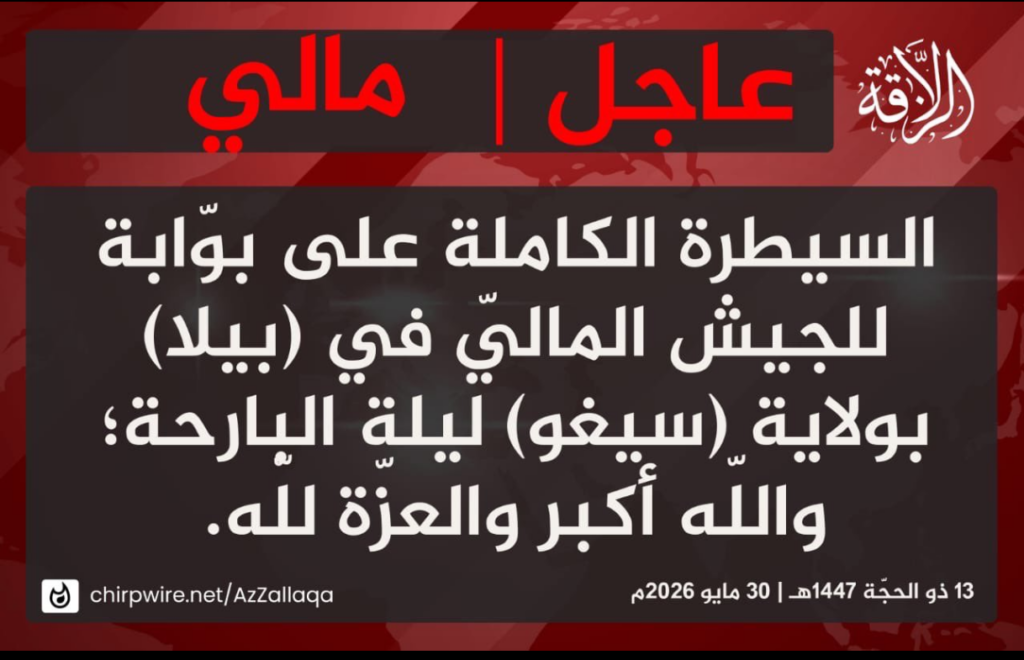
The night of May 29-30 saw a bold offensive by the Group for the Support of Islam and Muslims (JNIM), an al-Qaeda-affiliated jihadist coalition, which targeted a Malian Armed Forces (FAMa) outpost in the Ségou region. The group’s propaganda channels later confirmed the operation, claiming control over the strategic site and seizing a substantial cache of weapons and ammunition. While Bamako has yet to release an official statement, local sources confirm intense overnight clashes, underscoring the persistent threat posed by armed groups in Mali’s central belt.
Ségou under siege: a night of chaos and destruction
The JNIM’s communiqué, released at dawn, detailed the scale of the assault. Fighters reportedly executed a coordinated strike, overwhelming the FAMa position before securing the area. The attack not only exposed vulnerabilities in Mali’s security apparatus but also highlighted the group’s operational reach in regions once deemed relatively stable. Despite the military’s heavy presence, the jihadists demonstrated their ability to strike with impunity, leaving behind a trail of abandoned equipment and human casualties.
Security failures and the limits of Russia’s military partnership
The collapse of the Ségou outpost comes as a stark reminder of the junta’s unkept promises to reclaim control over the country. Since the transitional government’s shift toward Moscow—marked by the withdrawal of Western forces and the arrival of Russian instructors—security conditions have deteriorated rather than improved. Aerial demonstrations and large-scale sweeps carried out with Russian support have failed to curb the JNIM’s mobile tactics, which exploit gaps in Mali’s defenses.
The military alliance with Russia, once touted as a game-changer, now appears ill-equipped to counter asymmetrical warfare. Rather than reversing the tide, the strategy has entrenched insecurity, revealing a leadership struggling to adapt to an evolving conflict.
From bullets to hunger: the human cost of the crisis
The escalation of violence has triggered a secondary catastrophe: a looming food emergency. Ségou, historically a breadbasket thanks to its proximity to the Niger River, now faces agricultural paralysis. Fields lie fallow, livestock markets are plundered, and commercial routes are choked by improvised explosives. Farmers dare not till their land, and supply chains to urban centers are severed. The JNIM’s tactics extend beyond combat—they weaponize hunger, leaving entire communities at risk of starvation.
Humanitarian agencies warn that the state’s paralysis has left gaping voids in emergency response. Displaced families, now numbering in the thousands, flee to overcrowded urban shelters or Bamako, only to find themselves in squalor. Women and children bear the brunt of this collapse, as social services—already stretched thin—collapse under the weight of the crisis.
Desperate exodus: civilians abandoning the countryside
The relentless violence has sparked an exodus of unprecedented scale. Villages across Ségou are emptying as residents seek refuge in perceived safer zones, though few destinations offer true security. Displaced families languish in makeshift camps, lacking clean water, medical care, or shelter. Local NGOs, overwhelmed by the scale of need, struggle to provide even basic assistance. The state’s preoccupation with military campaigns has left these communities abandoned, their survival dependent on dwindling external aid.
A fractured nation: the path forward?
The JNIM’s latest strike in Ségou shatters the illusion of progress peddled by Bamako’s transitional leaders. A purely martial approach—bolstered by foreign mercenaries—has failed to restore peace or legitimacy. Without a shift toward protecting civilians, restoring essential services, and addressing the hunger crisis, Mali risks descending further into fragmentation. The country’s social fabric, already frayed, may not withstand another cycle of violence and deprivation.