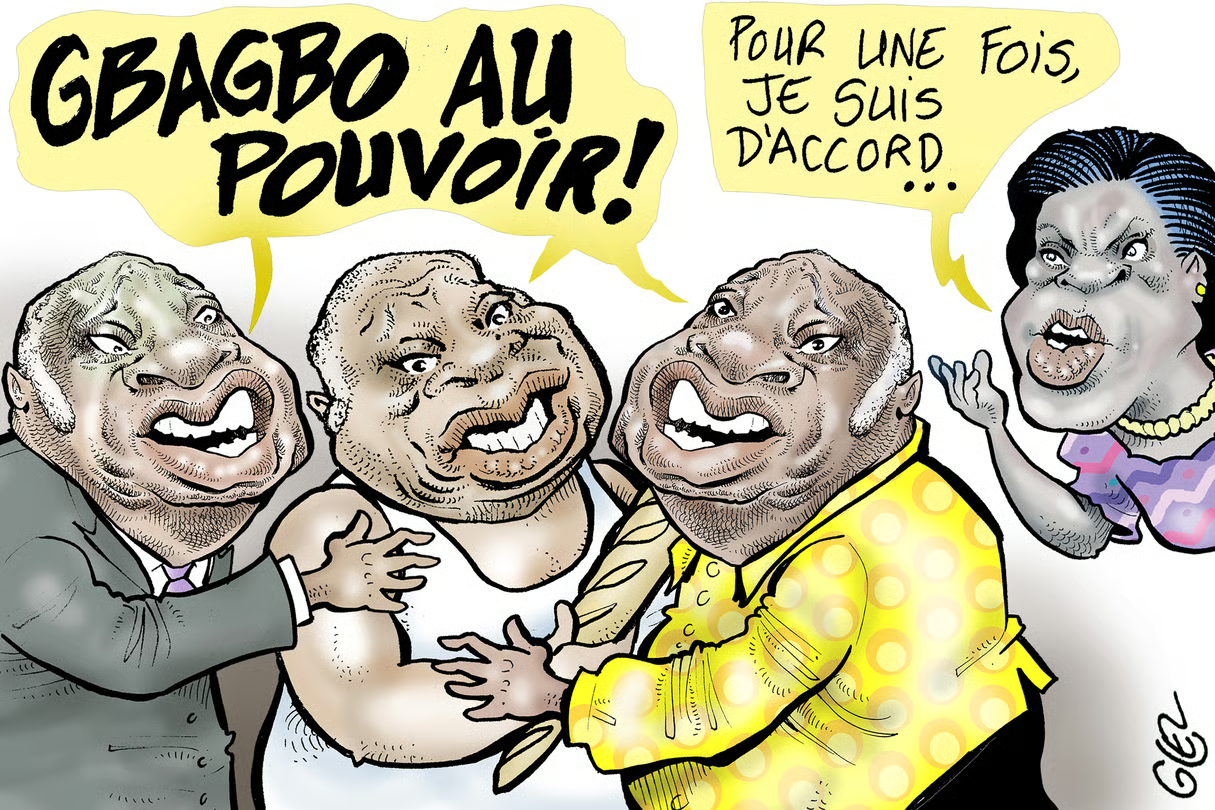
After years of political uncertainty and public debate over his potential retirement, former Ivorian President Laurent Gbagbo has once again taken center stage in Côte d’Ivoire’s political arena. His unexpected decision to remain at the helm of the Parti des peuples africains-Côte d’Ivoire (PPA-CI) has sparked both surprise and renewed energy within the party.
Just days after the party’s first ordinary congress, held on May 14 and 15 at the Treichville Cultural Palace, Gbagbo was unanimously reaffirmed as its president—despite his absence from the event. The move, framed as a response to overwhelming popular demand, underscores a clear desire to maintain continuity while reinvigorating the party’s presence in Ivorian politics.
From political retirement to renewed leadership
The 80-year-old leader, who was barred from running in the last presidential election due to a legal technicality, had previously signaled intentions to step back from active politics. However, the decision of his long-time rival, President Alassane Ouattara, to extend his own political career appears to have shifted the dynamics entirely. Gbagbo’s supporters argue that Côte d’Ivoire needs his guidance during a period of significant challenges, framing his return as a patriotic duty.
The PPA-CI, however, has struggled to gain momentum in recent years. The party notably boycotted both the 2025 presidential election and the subsequent legislative polls, leaving it sidelined in the national political landscape. Yet, the congress’s atmosphere was charged with enthusiasm, as delegates celebrated Gbagbo’s leadership with chants and applause, reinforcing the image of a united party.
Internal strife and party discipline
Behind the scenes, the congress served as a critical moment to address deep divisions within the PPA-CI. The party’s leadership took decisive action against dissenting voices, including the expulsion of three prominent dissidents and the suspension of 62 others for periods ranging from three to eighteen months. Among those penalized were Prince Arthur Dalli, mayor of Lakota, independent deputy Stéphane Kipré, and professor Georges Armand Ouégnin.
The disciplinary measures stemmed from disagreements over the party’s strategic direction, particularly regarding its decision to boycott recent elections. The expelled members had openly defied the party line, advocating instead for internal reforms and greater power-sharing. Their exclusion from the congress highlighted the leadership’s resolve to enforce discipline and present a united front.
The party’s new leadership structure, unveiled during the event, suggests that Gbagbo intends to take a step back from day-to-day management while retaining overall authority. This approach aligns with his reputation as a strategist rather than an administrator—though history shows that his influence rarely fades entirely.
The reaffirmation of Gbagbo’s leadership marks a pivotal moment for the PPA-CI, signaling both a return to its roots and an attempt to chart a new course. As the party grapples with its relevance in a rapidly changing political landscape, the question remains: can Gbagbo’s symbolic leadership translate into tangible political gains for his movement?