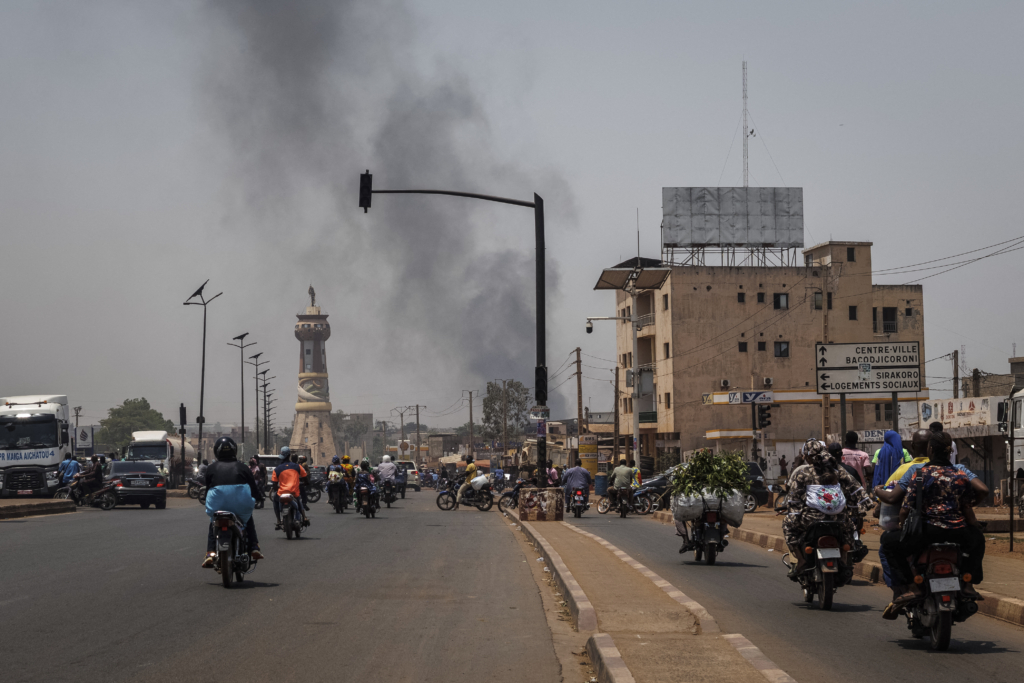
The ongoing blockade of Bamako is inflicting unacceptable hardships on civilians, threatening their rights to food security, healthcare, and safety, while raising serious concerns about violations of international humanitarian law. The Groupe de soutien à l’islam et aux musulmans (GSIM), an armed group linked to Al-Qaïda, imposed the blockade on April 28, cutting off three major supply routes into the capital and disrupting the flow of essential goods.
On May 6, the GSIM targeted a civilian convoy transporting fruits between Bamako and Bougouni, underscoring the indiscriminate nature of the blockade. Eyewitness accounts confirm the convoy lacked military escort or cargo, violating fundamental protections under international law. « Attacks on civilian vehicles carrying non-military supplies are prohibited. Every party in a conflict must distinguish between combatants and civilians—this is a cornerstone of wartime conduct,» stressed regional rights advocate Marceau Sivieude.
Blockade violates wartime rules, escalates civilian suffering
The GSIM’s blockade, announced via a video statement, differs sharply from its 2025 campaign, which had targeted only fuel tankers. Now, all commercial trucks entering Bamako face disruption, with at least three of six key routes severed by May 15. Residents report soaring prices for staples like rice and cooking oil, while access to clean water and medical supplies dwindles. The United Nations High Commissioner for Human Rights has urged an immediate halt to hostilities, emphasizing civilian protections.
While the GSIM claimed a partial easing on May 6—allowing medical evacuations—verification remains elusive. « Blockades cannot be wielded to deny civilians their economic and social rights. The GSIM must ensure Bamako’s population receives uninterrupted access to food, water, and healthcare,» Sivieude emphasized.
Survivor recounts GSIM’s brutal convoy attack
A survivor of a January 2026 ambush shared harrowing details of the GSIM’s assault on a military-escorted fuel convoy near Diboli and Kayes. The attack, involving over 200 militants on motorcycles, left multiple drivers and apprentices executed after refusing to flee. « They forced captives to dig graves for fallen fighters before slaughtering them. At least 12 were killed in cold blood,» the driver recounted under anonymity.
The assault continued even after military reinforcements arrived, with militants torching vehicles and slaughtering troops. Sivieude condemned the violence as a blatant breach of international law, demanding accountability: « These acts demand urgent investigation. Victims of war crimes deserve truth, justice, and reparations—no exceptions.»
Escalating violence fuels crisis in Mali
The blockade follows coordinated GSIM attacks on April 25 across Bamako, Kati, Mopti, and Gao, targeting military bases and political figures. On May 6, militants struck villages in central Mali, killing at least 40 and leaving several missing. As the blockade tightens, civilians bear the brunt of a conflict that shows no signs of abating.