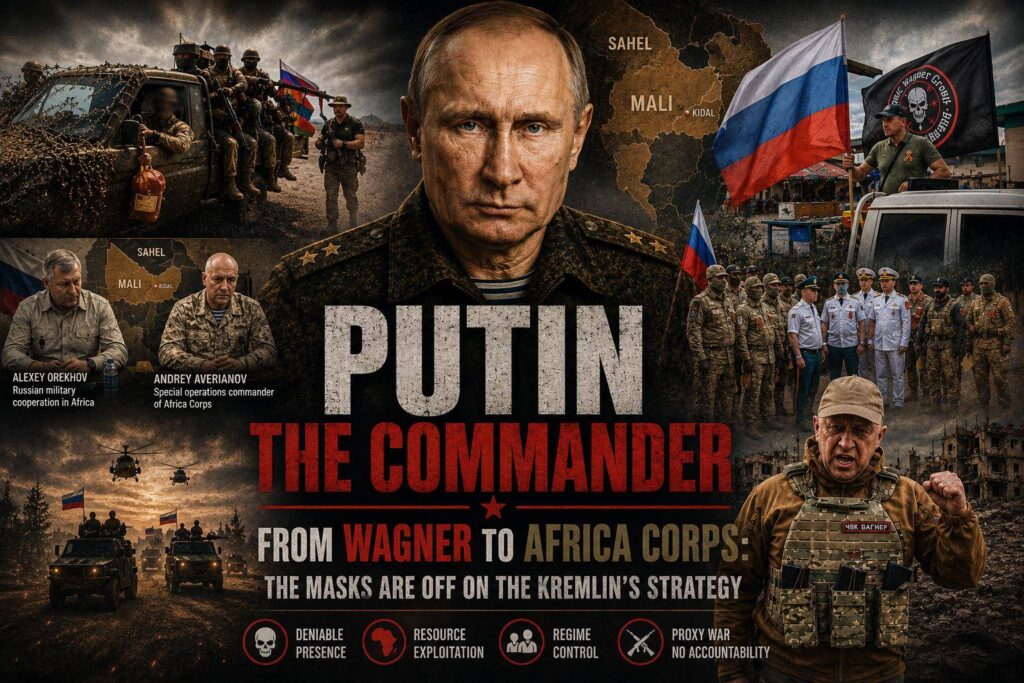
The once-expansive Russian influence across Africa, built on mercenary operations, disinformation campaigns, and anti-Western populism, now faces an undeniable decline. What began as a decade-long surge under the banner of Kremlin-backed security solutions has collided with harsh realities—unfulfilled security promises, military quagmires, and growing public disillusionment. The notion of a waning Russian imperialism on the continent is no longer speculative; it is an observable and accelerating trend.
the illusion of a security alternative
In the mid-2010s, Russia exploited the strategic void left by the retrenchment of traditional powers, particularly France. From Bamako to Bangui, via Ouagadougou and Niamey, Moscow marketed a ready-made security doctrine—one unburdened by human rights constraints and delivered through the Wagner Group, now rebranded as Africa Corps. Yet, years later, the results speak for themselves: rather than stabilizing the Sahel, the Russian intervention has deepened insecurity.
The turning point arrived with the catastrophic battle of Tinzawatane, near the Algerian border, where dozens of Russian mercenaries and Malian soldiers perished. This defeat shattered the myth of Russian military invincibility and exposed the true nature of Moscow’s engagement: a transactional arrangement where security was exchanged for access to mineral wealth—gold, diamonds, and uranium. For local populations, the revelation was stark: the colonizer had merely exchanged one flag for another.
three structural weaknesses undermining Russian influence
An assessment of current trends reveals that Russia’s retreat stems from three fundamental vulnerabilities:
1. the ukrainian quagmire
The prolonged conflict in Ukraine has drained Russia’s financial and military resources. Elite units have been redeployed to the European front, and heavy weaponry once exported to Africa is now reserved for domestic warfare. The illusion of a dual-track military strategy—sustaining both a European war and African operations—has collapsed under economic strain.
2. the absence of an economic model
Russia’s global profile remains rooted in military and narrative power, not economic capacity. Its GDP is comparable to that of Spain, rendering it incapable of matching the European Union’s development aid or China’s infrastructure investments. Once the initial political euphoria fades, African juntas and governments recognize that emergency grain shipments and social media disinformation campaigns cannot sustain populations or economies.
3. the rise of african sovereignty
Russia’s diplomatic strategy relied heavily on the rhetoric of a ‘second decolonization.’ However, the sovereign sensibilities of Africa’s digitally connected youth are uncompromising. Public opinion, now more vigilant than ever, rejects Moscow’s tutelage with the same fervor once directed at Paris. Swapping the French tricolor for the Russian tricolor is no longer seen as liberation, but as a fool’s bargain.
the emergence of a multipolar reconfiguration
The decline of Russian imperialism does not imply a return to Western dominance in Africa. Instead, a redistribution of influence is underway, favoring actors perceived as more pragmatic and less ideologically burdensome.
The People’s Republic of China is quietly consolidating its economic foothold, prioritizing contractual stability over the Kremlin’s militarized approach. Meanwhile, Turkey and the United Arab Emirates are positioning themselves as key alternative partners, offering advanced drone technology and financial investments without the geopolitical baggage that accompanies Russian engagements.
lessons for africa’s future
Russia’s imperial venture in Africa, though intense, has proven historically short-lived. Its failure underscores a fundamental truth: influence cannot be sustained through coercion and manipulation alone. For African leaders, the lesson is clear—there are no geopolitical shortcuts. Security and development cannot be outsourced to foreign mercenaries, regardless of their origin. The retreat of Russian dominance may mark the beginning of a new era, one in which Africa seeks not masters, but genuine partners.