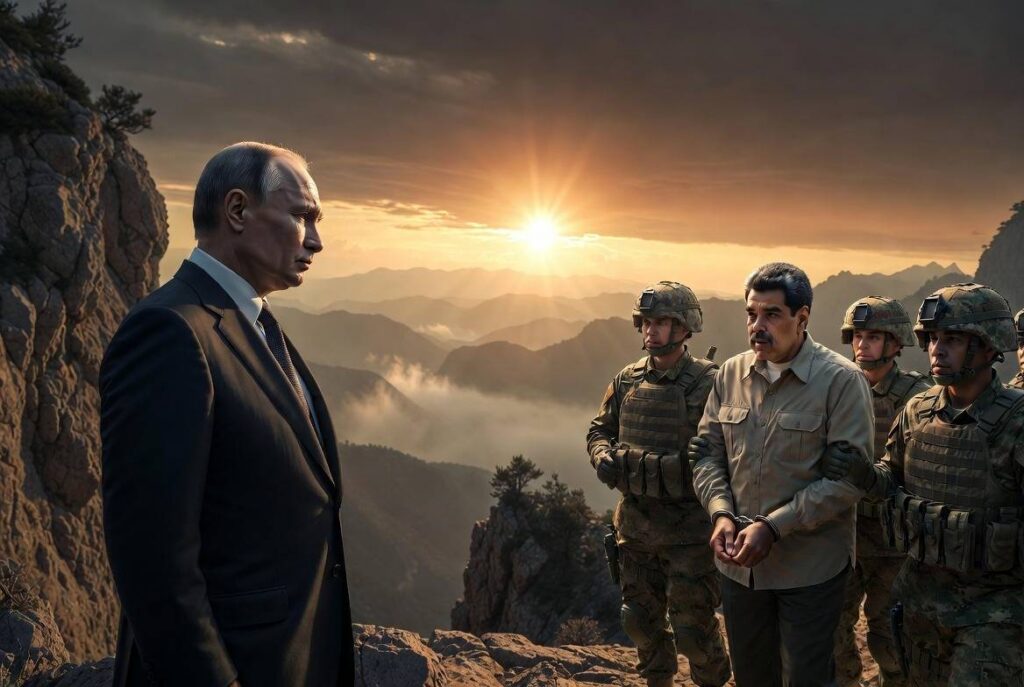
Moscow’s hollow roar: where was Russia when Venezuela needed it most?
Some silences speak louder than words. Others reveal the unmistakable scent of strategic retreat. When Caracas convulsed in early 2026—after a sweeping American military surge and the dramatic apprehension of Nicolás Maduro—the response from the Russian Federation was nothing short of stunning. For a nation that had only recently portrayed itself as Venezuela’s sovereign guardian, blocking what it called “Yankee imperialism,” this sudden retreat into perfunctory diplomatic statements amounted to a surrender of operational voice.
Where had Moscow’s once-formidable swagger vanished to? Where were the televised ceremonies, the solemn pacts, the solemn pledges of ironclad alliance?
Words as the only weapon
The Ministry of Foreign Affairs did issue a stern condemnation of what it termed an “armed aggression,” and Foreign Minister Sergei Lavrov dutifully invoked the sanctity of bilateral agreements. Yet beyond these ritualistic salvos, what concrete action followed? A belated submarine sortie to shadow a sanctioned oil tanker. A hopeful murmur about Washington “respecting international law.” And that was it.
No resolute naval task force. No veto at the United Nations Security Council. No credible counter-pressure campaign. Instead, an eerie quiet descended over the Kremlin corridors, leaving Caracas defenseless against a freshly rebranded Monroe Doctrine sweeping through the Western Hemisphere.
The 2025 Strategic Partnership Treaty, celebrated with such fanfare, now reads like a flimsy sheet of paper. At the first real test of steel, the Russian shield splintered, exposing gaping cracks in Moscow’s vaunted power projection.
The trap of strategic exhaustion
This studied muteness is not a tactical choice; it is the cold arithmetic of depletion. Years of open conflict, compounded by a self-consuming “death economy,” have drained Russian treasuries and manpower alike. Venezuela, once hailed as a geopolitical linchpin, became an involuntary bargaining chip—or worse, collateral damage—in a wider Russian retreat from global commitments.
By confining itself to diplomatic grumbling, Moscow broadcasts a stark warning to every partner from Minsk to Beijing: Russian protection ends where Russian hardship begins.
A geopolitical betrayal
In allowing a transitional administration under Washington’s thumb to take root—and by tacitly endorsing the fait accompli—Russia inflicts a double wound. It forfeits a strategic foothold in Latin America and, more damagingly, forfeits its claim to global counterbalance. At the moment Caracas needed a bulwark, the great Slavic protector was nowhere to be found.
The curtain fell, and the erstwhile shield never even stepped onto the stage.
Russia’s silence was not diplomatic restraint; it was the quiet admission of a strategic failure. In choosing polite impotence over resolute action, Moscow lost not only an ally and preferential access to the planet’s largest oil reserves—it lost its mantle as a global counterweight.