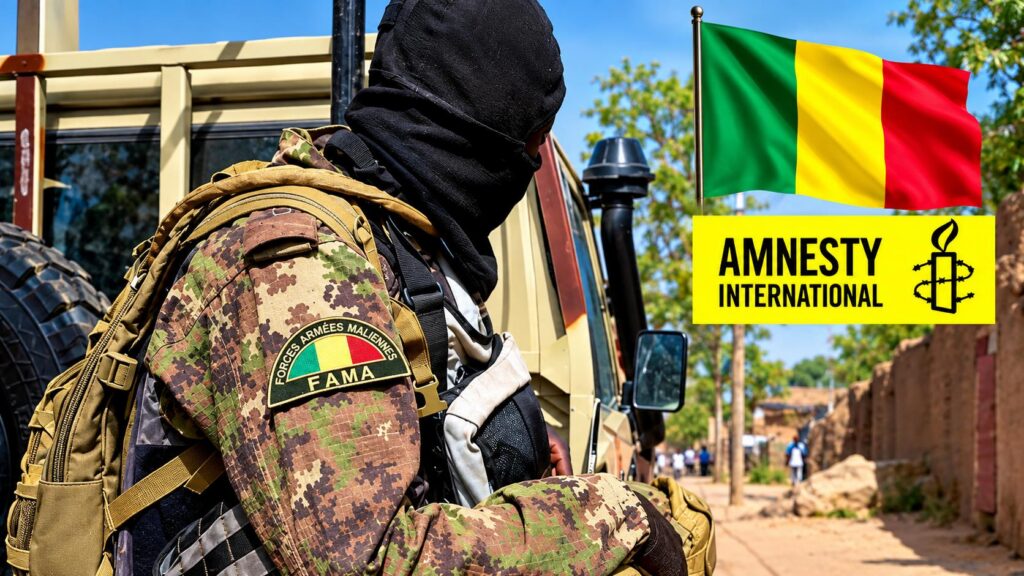
Bamako — A sweeping new human rights investigation has cast a harsh light on more than a decade of conflict in Mali, asking a question that grows more urgent with every passing year: when civilians are killed, tortured and uprooted, can anyone be held to account? The findings, released on 28 September 2026, accuse members of the Malian Armed Forces (FAMa), operating alongside foreign fighters from the Wagner group, of committing war crimes against civilians between 2023 and 2025.
What the investigation found across central and northern Mali
Titled “No one is spared”, the report draws heavily on field research conducted in Mauritania among Malian refugees. Investigators say they gathered testimony from 119 people originally from the Ségou, Mopti and Tombouctou regions, cross-checking their accounts against other sources and analysing information related to military operations.
The picture that emerges is grim: at least 34 civilians are said to have been killed in seven Malian localities between June 2023 and December 2025 during operations attributed to Malian forces and their Wagner allies. The report also documents cases of torture, forced disappearance, looting and the destruction of civilian property.
Civilians caught in the crossfire of military operations
The documented incidents are concentrated in Mali’s central and northern regions — Ségou, Mopti and Tombouctou — areas long battered by insecurity and the activity of armed groups.
According to the investigation, some victims were killed as they tried to flee or after they had been detained. The report describes cases in which people were reportedly slit at the throat or burned. In Tin Adanda, in the Tombouctou region, four people are said to have been killed during a joint patrol in February 2025.
One of the report’s central concerns is the targeting of pastoral communities, particularly Fulani, Arab and Tuareg populations. Investigators believe many of the victims belonged to these communities, accused or suspected of ties to armed groups simply because of their origin or their presence in areas controlled or frequented by insurgents.
The report warns against what it sees as a dangerous generalisation: equating an entire community with armed groups could expose civilians to collective reprisals.
Drone strikes under scrutiny
The investigation also examines two drone strikes carried out in 2025 by Malian forces in the Tombouctou region. According to the findings, they killed at least 23 people, including at least five children.
One of the most closely documented cases concerns the Ejdeir market, struck on 16 March 2025. Investigators say 16 people were killed and seven others wounded. They state they found no evidence establishing the presence of fighters or military objectives at the market at the time of the strike.
Malian authorities had said they were targeting “meetings of terrorists”. The investigation notes that the geographical information provided by the authorities corresponds to the location struck at Ejdeir. In the absence of a verified military target, it argues, such an attack could amount to a direct attack on civilians and should be investigated as a possible war crime.
This is a particularly sensitive issue in a conflict where Malian authorities present military operations as necessary to fight jihadist groups and other armed organisations. The report does not challenge, in principle, the right of authorities to combat armed groups. It insists, however, on the obligation to respect international humanitarian law and protect civilian populations.
Torture allegations inside military bases
Another especially grave section of the report concerns allegations of torture and ill-treatment of detainees.
Investigators say they interviewed 15 men who described being tortured during joint patrols or inside military bases, notably in Léré and Nampala. Their accounts, the report says, were corroborated by witnesses who claimed to have seen acts of torture involving around 30 people.
The methods described are particularly violent: suspending detainees by their arms, simulated drowning, beatings with metal bars or sticks, and electric shocks. According to the findings, five people died in military bases as a result of torture or poor detention conditions.
The report states that the acts were mainly committed by Wagner members, sometimes in the presence of Malian soldiers. Some individuals were reportedly held for days or even months without being brought before a court, without access to legal assistance, and without being able to contact their families.
Wagner is gone, but Africa Corps remains
The report comes as Russia’s presence in Mali has shifted. The Wagner group, present in the country since late 2021, was replaced in June 2025 by Africa Corps, a structure placed under the control of the Russian Ministry of Defence.
The investigation calls on Malian authorities to publicly clarify their relationship with Africa Corps and the oversight mechanisms applicable to its members. For the organisation behind the report, a change of structure must not translate into an absence of accountability when violations of international law are committed.
This shift comes amid a profound transformation of Mali’s security policy. Since the 2020 coup, authorities have gradually strengthened military cooperation with Russia while reducing their dependence on Western partners.
A crisis that goes beyond government forces
The report nevertheless stresses that the documented abuses cannot be attributed to a single side. In recent years, armed groups active in Mali have also been accused of serious violations of international humanitarian law.
It recalls in particular that armed groups have committed unlawful killings, abductions and other abuses against civilian populations. This nuance matters in a complex conflict involving multiple armed actors, where civilians often find themselves trapped between different forces.
The humanitarian situation also remains deeply concerning. According to figures presented in the report’s Mali assessment, more than 2,036 schools were closed because of insecurity, depriving hundreds of thousands of children of access to education.
The question of impunity
Beyond the accusations themselves, the report raises a central question: that of justice.
Investigators say they shared their conclusions with Malian authorities on 3 August 2026 and had received no response by the time the report was published. They call on Bamako to open “effective and impartial” investigations into the alleged crimes and, where evidence warrants, to prosecute those responsible before courts that uphold fair-trial guarantees.
The judicial question takes on an additional dimension following Mali’s announced decision in June 2026 to withdraw from the Rome Statute, the founding treaty of the International Criminal Court. According to the report, that withdrawal does not end proceedings already covered by the ICC’s jurisdiction: the court would retain jurisdiction over crimes within its mandate committed during the legally applicable period.
In this context, the report appears less as a simple inventory of abuses than as a warning about the risk of entrenched impunity.
Survival, displacement and the fragile line between combatant and civilian
For the civilian populations of Ségou, Mopti and Tombouctou, the challenge remains immediate: surviving a conflict in which the distinction between combatants and civilians is often fragile. For Malian authorities, the accusations now form an additional file that must be answered — in the name of protecting populations, but also of the credibility of the institutions responsible for delivering justice.
Behind the statistics — 34 documented deaths, dozens of detainees tortured, and dozens of other alleged victims — lies a reality harder to measure: displaced families, villages emptied of their inhabitants, and a population living between the threat of armed groups and the operations of security forces.
The report thus recalls a fundamental requirement of international law: fighting armed groups does not exempt any party to a conflict from protecting civilians. In Mali, the battle against insecurity is therefore also being fought on another front — that of justice, accountability and the protection of populations.
More Stories
Will Togo’s Faure Gnassingbé broker the breakthrough east DRC needs?
Can Nigeria’s military campaign end the kidnapping economy in the north?
Can Algeria’s expertise truly reshape Benin’s defense strategy?