Security landscape shifts dramatically in northern Mali
The northern regions of Mali are gripped by a palpable sense of unease. Within a matter of days, the nation’s fragile security equilibrium has been profoundly disrupted. Following the symbolic fall of Kidal, armed factions have accelerated their advance, while the Group for the Support of Islam and Muslims (JNIM) introduces an unprecedented political maneuver by publicly advocating for the overthrow of the transitional government.
Military setbacks echo past conflicts
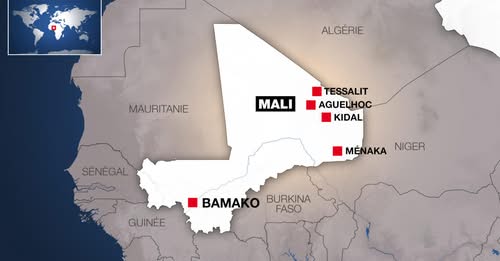
The unfolding crisis bears haunting resemblances to the 2012 upheaval. On May 1, 2026, militants from the JNIM and separatist fighters from the Liberation Front of Azawad (FLA) seized strategically vital camps in Tessalit and Aguelhoc. The withdrawal of the Malian Armed Forces (FAMa) and their Russian Africa Corps partners facilitated the adversaries’ unobstructed advance.
A verified image has become emblematic of the humiliation: it depicts Seidane Ag Hitta, a prominent JNIM leader, triumphantly displaying the keys to the Tessalit camp. This act carries profound symbolism, occurring five years after the departure of the French Barkhane force. Since April 25, the towns of Ber, Tessit, Hombori, and Gourma Rharous have fallen, leaving residents of Gao and Tombouctou in a state of mounting dread.
Bamako’s defiant response and international backing
Despite these setbacks, the leadership in Bamako remains resolute. General Assimi Goïta has issued a rallying cry for national unity, asserting that no level of intimidation will deter Mali from its chosen path.
The counteroffensive strategy encompasses two critical dimensions:
- Aerial and Ground Operations: The Malian military has intensified precision strikes on Kidal, targeting the governorate and logistical depots. Although the FLA disputes casualty figures, Bamako claims several terrorists have been neutralized.
- Logistical Resilience: As jihadist blockades choke the primary routes into the capital, a convoy of 800 tanker trucks successfully broke through this week, accompanied by air support and ground troops.
From Moscow, Dmitri Peskov has reaffirmed Russia’s unwavering commitment to Mali’s transitional authorities, dismissing concerns over a potential Russian withdrawal following the losses in Kidal.
JNIM’s strategic pivot: blending politics with ideology
The most striking development lies in the group’s rhetorical shift. In a statement released on April 30, the JNIM abandoned its customary bellicose language in favor of a political narrative designed to resonate with broader segments of society.
The faction now appeals to the nation’s « vital forces, » including political parties and religious leaders, urging them to unite in forming a « common front » to establish a « peaceful transition » and end the « dictatorship of the junta. » By employing terms such as « sovereignty » and « dignity, » the JNIM seeks to attract disillusioned citizens while reaffirming its ultimate objective: the imposition of Sharia law.
« In the worst situations, one seeks the least harmful option, » remarks a former opposition minister, encapsulating the dilemma now facing Mali’s political elite: should dialogue with yesterday’s adversaries be pursued to stem the tide of collapse?
Internal fractures deepen under pressure
Tensions have seeped into the corridors of power in Bamako. The Prosecutor General of the Bamako Court has announced the detention of several Malian soldiers, accused of colluding with last weekend’s attacks.
With rebel factions advancing territorially, the JNIM’s ambiguous political overtures, and the economic stranglehold of blockades, the transitional regime faces its most severe crisis yet. The battle for Mali is no longer confined to the deserts of the north—it now extends to the very legitimacy of governance in the capital.