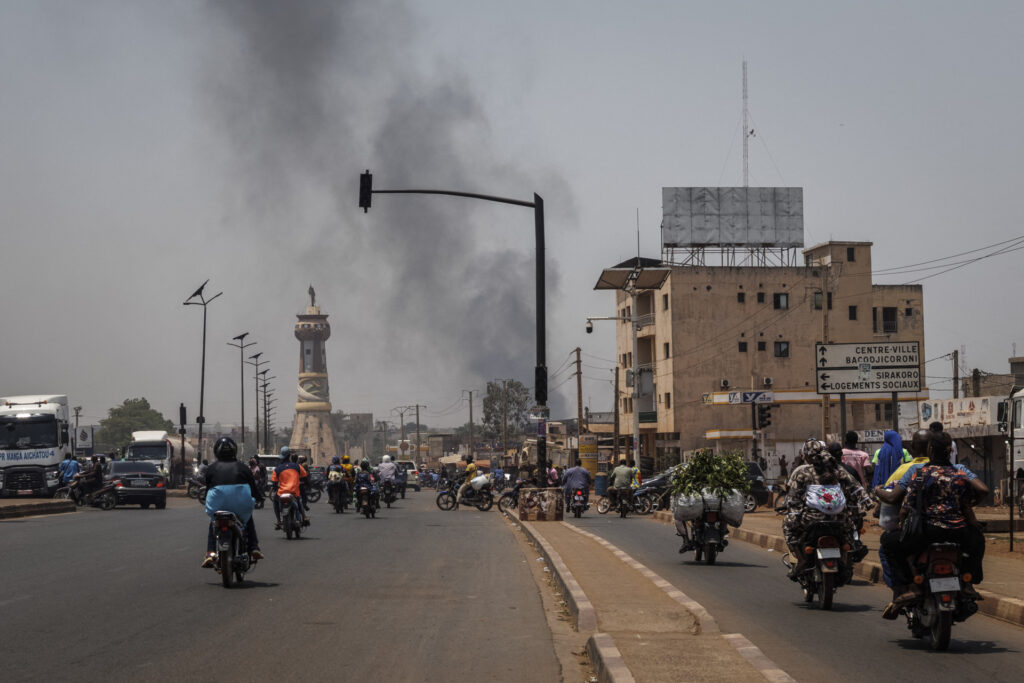
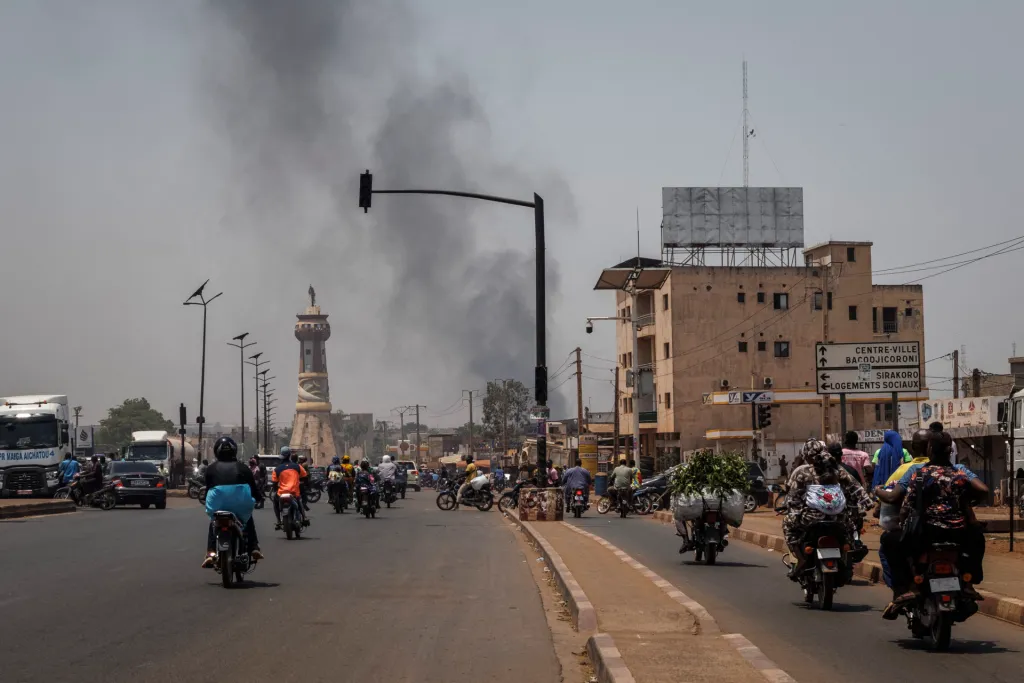
In the early hours of April 25, the silence surrounding the military garrison town of Kati, located just 15 kilometers from Mali’s capital, Bamako, was broken by heavy gunfire and explosions. This marked the beginning of a massive, coordinated offensive involving the jihadist group JNIM (Jama’at Nusrat al-Islam wal-Muslimin) and the Tuareg separatist movement FLA (Front de Libération de l’Azawad). By the following day, the ruling military junta confirmed that Defense Minister Sadio Camara had died from wounds sustained during an assault on his home. Reports also suggest that the intelligence chief, Modibo Koné, was either killed or critically injured in the same wave of violence. Despite official claims that the military had regained control, the ongoing clashes across the country highlighted a stark divide between government propaganda and the grim operational reality.
These strikes represent the most significant threat to the leadership of Assimi Goïta since his 2020 coup. The military regime was already in a precarious state due to a months-long blockade by JNIM, which has crippled the landlocked nation. Since last September, attacks on over 130 fuel tankers have halted essential imports from Sénégal and Côte d’Ivoire, leading to nationwide fuel shortages and the closure of schools. Although the junta denied releasing over 100 JNIM captives to secure a brief pause in the blockade, the recent violence underscores the group’s ability to weaken the Malian state far beyond the traditional front lines.
This resurgence serves as a critical test for the junta’s core promise: that stability could be achieved through Russian military support and the restriction of civil liberties, replacing the democratic models and Western partnerships that preceded them. The success of these militant operations is likely to cause concern for similar military regimes in Burkina Faso and Niger, which have also distanced themselves from Western alliances.
A recurring alliance of jihadists and separatists
This is not the first time such a coalition has threatened the state. In 2012, a similar partnership of jihadist and separatist forces overwhelmed the Malian military in the north. While the separatists of the MNLA (Mouvement National pour la Libération de l’Azawad) sought independence for the Tuareg people, their jihadist partners aimed to establish an Islamic emirate. That rebellion was fueled by fighters returning from Libya following the fall of Muamar Qaddafi, bringing heavy weaponry and combat experience. Though the alliance eventually collapsed into internal conflict, it proved that a united front could seize vast territories from the central government.
The current coordination between JNIM and the FLA marks their first major joint effort in over a decade. While their long-term goals remain fundamentally different, they currently share a tactical interest in exposing the Malian state’s vulnerability. For JNIM, the strategy is one of attrition—gradually exhausting the junta’s resources and political will until the regime implodes from within.
The late Defense Minister Camara was the primary architect of Mali’s alliance with Russia, facilitating the arrival of the Wagner Group in late 2021. This shift led to the withdrawal of French forces in 2022 and the end of the UN peacekeeping mission in 2023. Following the death of Yevgeny Prigozhin, the Russian presence was reorganized as Africa Corps under the Kremlin’s direct oversight. However, this transition has diminished combat effectiveness. While Wagner acted as a frontline force, Africa Corps has shifted toward a training and advisory role, with active engagements dropping significantly as resources are diverted to the war in Ukraine.
The symbolic loss of Kidal
The changing nature of Russian support is best illustrated by the situation in Kidal. After a decade of insurgent control, Malian and Wagner forces captured the city in November 2023, a victory the junta used to justify its pivot to Moscow. However, following the April 25 attacks, Africa Corps opted for a tactical withdrawal from the city, effectively surrendering a hard-won gain without significant resistance.
This retreat mirrors the broader failures of the Alliance of Sahel States (AES). The juntas in Mali, Burkina Faso, and Niger argued that Western partners were ineffective, yet the security environment under their own defense alliance has deteriorated. By staking their legitimacy on military success, these leaders have left themselves vulnerable as the scale of insurgent violence continues to grow.
Since 2012, insecurity has been the primary justification for five different coups in the region. Assimi Goïta himself led the 2020 takeover and a subsequent power consolidation in 2021. However, he now faces the same pressures that led to the removal of leaders like Paul-Henri Sandaogo Damiba in Burkina Faso, who was ousted after failing to improve security. With political parties banned and Goïta’s term extended until 2030, the regime’s legitimacy is thin. A failed coup attempt in August and the recent intelligence failures have likely increased friction within the military’s officer corps.
Shifting dynamics for U.S. counterterrorism
For years, Mali was central to U.S. counterterrorism efforts in the Sahel until the 2012 and 2020 coups triggered legal restrictions on aid. Recently, however, there are signs that Washington may be reconsidering its approach. The lifting of sanctions on certain Malian officials and high-level diplomatic visits suggests a move toward a new bilateral relationship focused on intelligence-sharing and access to critical minerals like gold and lithium.
The recent insurgent offensive ironically gives the United States more leverage. With the Russian partnership appearing increasingly ineffective, Bamako may be more open to a minerals-for-security arrangement, similar to the deal the U.S. established with the Democratic Republic of the Congo. Such an agreement could involve private security entities and advanced surveillance technology to help the junta regain its footing.
The latest events in Mali confirm that the current security strategy is failing. JNIM has demonstrated it can strike the capital at will and has added drones and economic sabotage to its arsenal. With the Malian state weakened and regional security structures like ECOWAS fractured by the withdrawal of AES members, the threat to the region has never been more acute. Neighbors and other African nations considering Russian security guarantees are likely watching the collapse of the Malian model with deep concern.