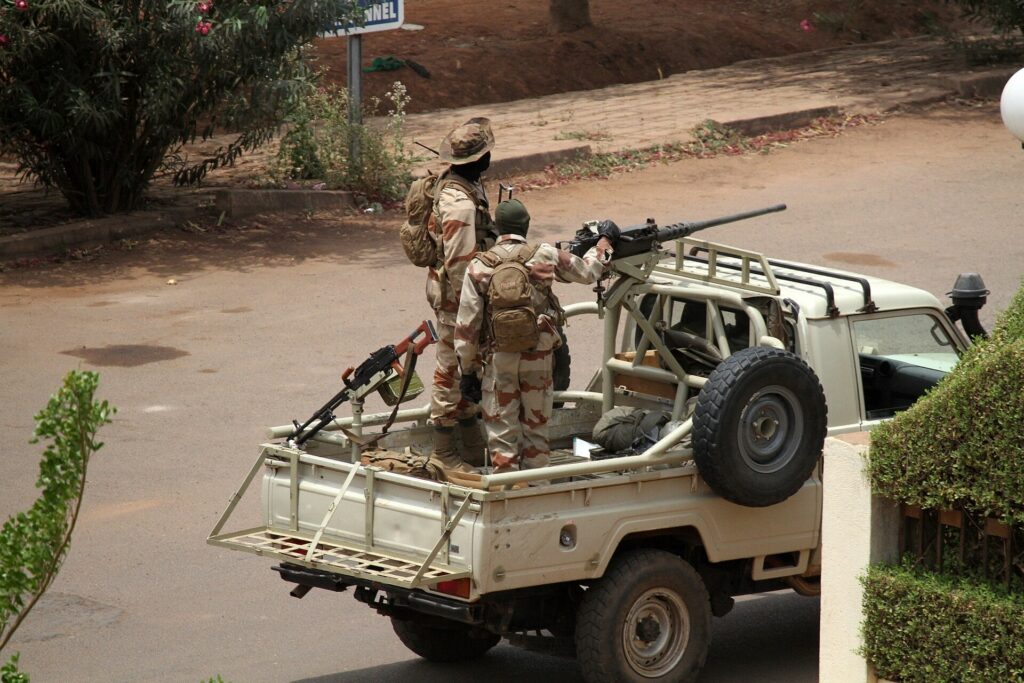
The coordinated military assault that unfolded across Mali on April 25 marked more than just another chapter in the nation’s decade-long turmoil. It represented a pivotal shift in the conflict’s trajectory. Islamist militants and Tuareg separatists launched synchronized attacks on strategic military outposts and civilian hubs, forcing Russian-backed government troops to abandon their positions in the pivotal northern stronghold of Kidal. This operation exposed a troubling expansion of insurgent capabilities, now posing a direct threat to the capital, Bamako. For the wider Sahel region—and especially Algeria—the pressing question is no longer about the inevitability of instability but whether any entity remains capable of reversing the trend.
The junta’s miscalculated security shift
To grasp how Mali reached this critical juncture, it’s essential to examine the decisions made following the 2021 coup. Colonel Assimi Goita’s military leadership expelled French military contingents, terminated the UN’s MINUSMA peacekeeping mission, and embraced the Wagner Group—recently rebranded as a Russian state-backed entity—as its primary security partner. Western observers cautioned that this strategic pivot would create a dangerous security void. The junta dismissed these concerns as attempts at neocolonial interference. The April offensive has since confirmed every warning they issued.
Russia’s military contractors, once touted as a decisive counter-insurgency force, have now been expelled from Kidal, a city of immense historical and strategic importance as the traditional heartland of Tuareg resistance. The militant groups did not merely withstand Russian firepower—they evolved, collaborated, and advanced. The junta’s gamble of swapping French logistical support and regional expertise for Russian backing has proven woefully insufficient against an insurgency that has only grown more adaptable and formidable.
The alliance between Islamist factions and Tuareg separatists driving this offensive is itself a significant development. Historically, these groups have operated in opposition, competing for control over the same ungoverned territories in northern Mali. Their current tactical cooperation signals a shared assessment: the junta’s position is fragile enough to exploit from multiple fronts. They appear to be correct in their evaluation.
Algeria’s mounting security dilemma
No neighboring country is observing Mali’s deterioration with greater concern than Algeria. Algiers shares a lengthy, poorly secured southern border with Mali, a frontier long exploited as a transit route for arms, drugs, migrants, and militant recruitment networks. Algerian authorities know from hard-won experience that unaddressed security crises do not respect borders—they spread, intensify, and escalate.
The current predicament for Algeria is steeped in irony. For years, Algiers positioned itself as the region’s indispensable peace broker, playing a pivotal role in negotiating the 2015 Algiers Peace Agreement between Bamako and Tuareg representatives. That agreement unraveled when the Malian junta formally withdrew from it in early 2024, a move Algerian officials viewed as a deliberate snub. Tensions peaked in March 2025 when Algerian forces intercepted and shot down a Malian drone near the shared border, sparking a sharp diplomatic rift with Bamako and its allies in Burkina Faso and Niger—all members of the Russia-aligned Alliance of Sahel States.
Algeria now faces a stark reality: it lacks the influence to impose a resolution in Mali, cannot reliably engage with a junta that views it with open hostility, and cannot afford to remain passive, as the alternatives—including armed factions establishing permanent footholds along its southern frontier—pose an existential risk to national security.
Algerian Foreign Minister Ahmed Attaf recently adopted a resolute public stance, affirming support for Mali’s territorial sovereignty and condemning terrorism without ambiguity. Yet, bold statements cannot compensate for the absence of a functional diplomatic channel.
America’s withdrawal and the rise of instability
The Sahel’s unraveling is also a narrative of American disengagement. The United States scaled back its counter-terrorism operations across West Africa under pressure from governments aligned with Moscow, and has yet to craft a meaningful alternative strategy. The result is a dangerous power vacuum that Russia fills through mercenary contracts, while Islamist networks exploit the void more comprehensively by providing governance, taxing local populations, and recruiting fighters in areas abandoned by the state.
The lesson unfolding in real time in Mali carries a clear message for Washington. Military partnerships, intelligence cooperation, and sustained counter-terrorism efforts are not optional extras in maintaining regional stability—they are the foundational requirements. When these elements disappear, the vacuum doesn’t stay empty. It gets filled by forces far more dangerous than those that were there before.
Three possible futures for Mali—and the Sahel
Three potential outcomes now loom over Mali’s crisis. First, the junta could enter negotiations with Tuareg factions, halting further territorial losses but conceding significant control. Second, it could escalate militarily, leaning on Russian air and ground support to contest the north, though with uncertain prospects for success. Third, it could continue its pattern of tactical retreats while insisting on its legitimacy, risking a scenario where Bamako itself becomes a battleground.
Algeria is monitoring each of these trajectories with growing dread. The collapse of the Sahel is no longer a distant humanitarian issue—it is arriving at Algeria’s doorstep.