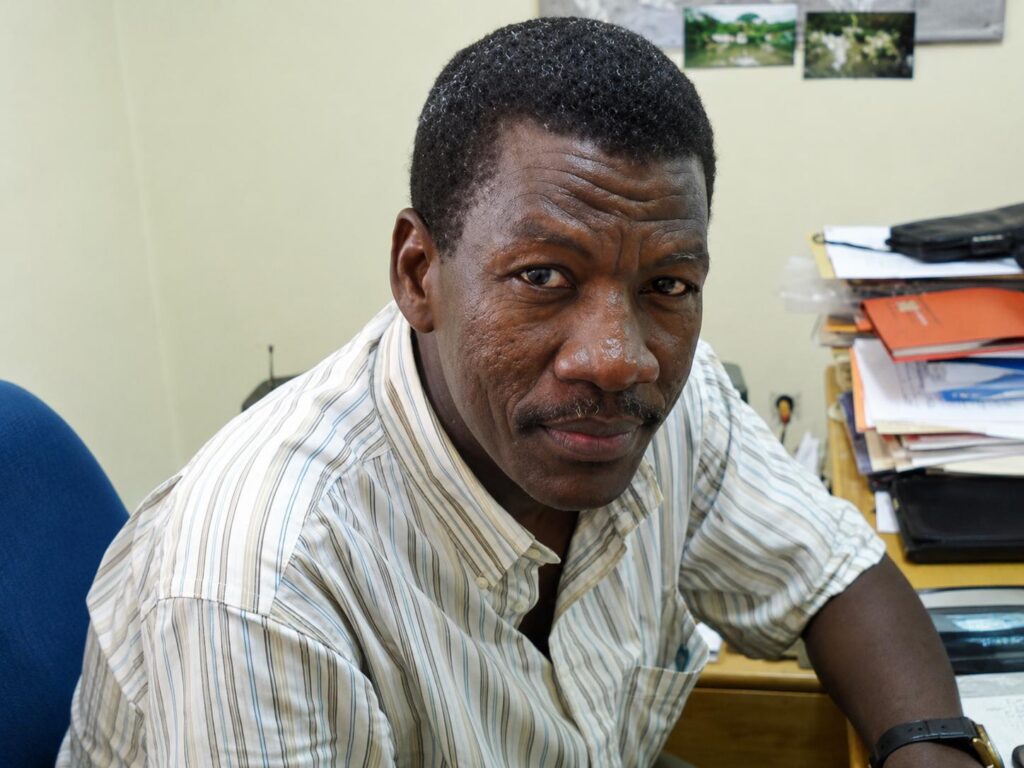
What happens to a country’s public debate when one of its most experienced journalists vanishes without a trace? That is the question pressing on Niger’s capital after Moussa Kaka, director-general of Radio Télévision Saraounia (RTS) and a veteran of Sahelian reporting, disappeared in Niamey several weeks ago. No official arrest order has been produced, no security service has acknowledged holding him, and the enquiries made by his family and colleagues have so far led nowhere. For the profession, the silence itself is the story.
What we know — and what is missing — about his last days
Moussa Kaka left his home in Niamey and has not been seen or heard from since. Those close to him say no reason for any detention has ever been communicated by the transitional authorities, and repeated approaches to police stations and security offices in the capital have produced no answer. In a case like this, the absence of information becomes its own form of pressure: families are left to guess, newsrooms are left to speculate, and the public is left without a single authoritative account.
Why Moussa Kaka’s case worries the whole profession
For decades, Moussa Kaka has been a familiar voice and face for audiences across West Africa. His reporting on security crises, political transitions and complex community dynamics in the Sahel earned him a reputation for rigour — and, over the years, repeated exposure to pressure from various governments. A journalist with that kind of reach is not easy to replace, and his disappearance raises a question every reporter in the region now has to ask: what happens to me if I do the same work?
RSF’s demand: answers, transparency and proof of life
Reporters sans frontières (RSF) has reacted forcefully. Speaking on Africa Radio, Sadibou Marong, who heads RSF’s West Africa office, described the situation as deeply alarming and said the organisation fears a worrying forced disappearance or undisclosed detention.
“Moussa Kaka’s disappearance is an extremely alarming signal for the entire Nigerien and Sahelian media landscape. We urgently call on the Nigerien authorities to shed full light on his situation, to state whether he is being held by intelligence services, and to guarantee his physical integrity and immediate release,” Marong said.
RSF also stresses that protecting journalists is the responsibility of the transitional government, and that doing the job of informing the public should never be treated as an act of destabilisation.
The wider stakes for journalism across the Sahel
This case does not exist in isolation. Across the Confederation of Sahel States, which brings together Niger, Mali and Burkina Faso, the space for civic and media activity has narrowed sharply since military transitional governments took power. International broadcasters have been suspended, journalists and civil society figures have reported intimidation and arbitrary detention, and self-censorship has become a routine survival strategy for local reporters.
For Niger’s press corps, Moussa Kaka’s fate has become the clearest test yet of what remains of the guarantees that once allowed journalists to work. The sub-region faces enormous security and economic challenges; losing one of its most respected voices to silence makes the future of free reporting in Niamey harder to see.
Three questions that now hang over Niamey
- Where is he? Weeks after his disappearance, no authority has confirmed whether Moussa Kaka is detained, and by whom.
- Who answers for it? If the state holds him, it must say so; if it does not, it must show it is searching.
- What does it mean for the rest? Every unanswered question tells other journalists how far they can safely go.
More Stories
Why is Faure Gnassingbé betting on Chadian rebels to silence Togo’s opposition?
Mali: can the junta’s russian bet survive 358 dead in three years?
Olympe Bhêly-Quenum at 100: can one lifetime truly hold a century of literary genius?