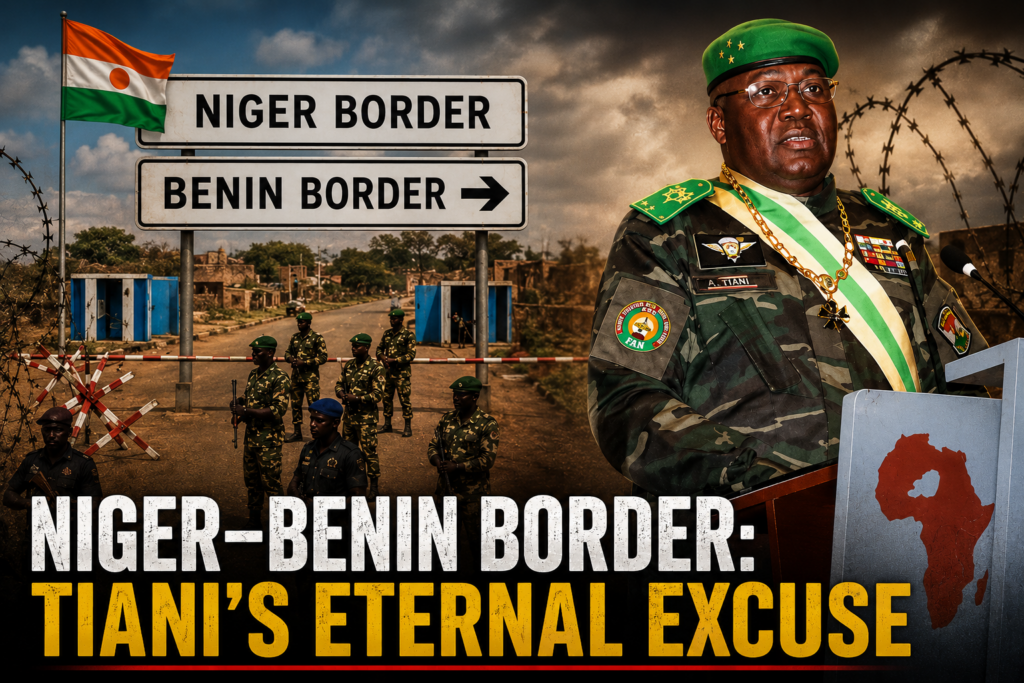
The border dispute between Niger and Benin has entered its third year, with no resolution in sight despite recent diplomatic efforts. Eight weeks after Beninese Finance Minister Romuald Wadagni’s visit to Niamey and five weeks following technical discussions between experts from both nations, hopes for a swift resolution had begun to emerge. The meetings suggested a potential pathway toward a gradual reopening of the border, fostering renewed optimism for cross-border trade and mobility.
Yet on July 26, during a national address marking the first anniversary of his rise to power, General Abdourahamane Tiani categorically ruled out any imminent easing of restrictions. Speaking on national broadcaster ORTN, he declared, ‘Certain prerequisites must first be addressed before any irreversible decision can be made regarding the reopening of the border.’
This statement underscores a persistent pattern: the border has evolved from a mere transit point into a geopolitical tool. For nearly three years, Niamey has wielded it as a means to reinforce a narrative of sovereignty while maintaining pressure on Cotonou.
Vague prerequisites without concrete benchmarks
The crux of the impasse lies in the lack of specificity surrounding these so-called ‘prerequisites.’ No official document or public statement has outlined what these conditions entail, how they might be fulfilled, or the timeline for their resolution. This deliberate ambiguity grants the military leadership in Niger unchecked flexibility to prolong the closure indefinitely, sidestepping the need for transparent justification.
Each passing day introduces new, unspecified demands, ensuring the border remains a perpetual bargaining chip rather than a subject of negotiation. The resulting uncertainty stifles any prospect of durable normalization between the two nations.
Security rhetoric that rings hollow
Since the July 2023 coup, Niger’s military regime has repeatedly cited security concerns as the primary justification for keeping the border closed. Officials allege that Benin’s territory serves as a rear base for armed groups or foreign powers threatening Niger’s stability.
However, these claims have never been substantiated with verifiable evidence. Meanwhile, the frequency of terrorist attacks in Niger—particularly in Tillabéri, Tahoua, and Diffa—has shown no significant decline since the closure. This raises a critical question: if the border’s closure were indeed a security measure, why have internal threats persisted at such alarming levels?
The recent technical discussions between Beninese and Nigerien experts had aimed to reconcile security imperatives with the resumption of commercial flows. By dismissing these efforts, General Tiani signals that the border’s fate rests solely on political whims rather than collaborative problem-solving.
The economic toll: a self-inflicted wound
The prolonged closure has exacted a heavy economic price on both sides of the border. Benin has seen a decline in transit traffic to the Port of Cotonou, reduced customs revenue, and sluggish activity among transporters. For landlocked Niger, however, the consequences are far graver.
Niger relies heavily on regional corridors for imports and exports. The diversion of trade routes through alternative countries has inflated logistical costs, which are then passed on to consumers:
- Steep increases in food prices;
- Rising costs for construction materials;
- Elevated prices of imported medicines and goods;
- Supply chain disruptions for local businesses;
- Diminished competitiveness for Nigerien enterprises.
Small-scale traders along the border have been among the hardest hit, with many seeing their livelihoods evaporate. Some once-thriving border communities now face economic stagnation, as the closure disrupts daily life and stifles growth.
Regional cooperation in peril
The closure has also undermined broader regional collaboration. Joint university exchanges, cross-border local governance initiatives, shared development projects, and anti-smuggling efforts have all become increasingly difficult to sustain. Paradoxically, the absence of legal trade has done little to curb illicit activity. On the contrary, the vacuum left by formal commerce often fuels the expansion of informal networks, further complicating border security.
The military regime’s framing of the border closure as an ‘irreversible’ sovereign act is laden with symbolic weight. Yet this narrative prompts a fundamental inquiry: does sovereignty truly lie in isolating an economy or in safeguarding the welfare of its people? Critics argue that the prolonged closure prioritizes political messaging over measurable security gains, serving as a tool to bolster domestic legitimacy among certain segments of the population.
The human cost of a political standoff
Behind the official declarations are the untold struggles of ordinary citizens. Truck drivers left without income, merchants facing ruin, students barred from travel, separated families, and business owners grappling with uncertainty—these are the human faces of a crisis that rarely makes headlines. With each passing week, the hardships intensify, and the prospect of a return to normalcy grows more distant.
Three years into this stalemate, the Niger–Benin border has become less about security and more about power. By cloaking its actions in vague, ever-shifting conditions, Niamey retains full control over the timeline, ensuring the status quo persists for as long as it deems strategically advantageous. Meanwhile, the people of both nations bear the brunt of a decision whose tangible benefits remain conspicuously absent.
True resolution may only come when political posturing gives way to pragmatic cooperation—one rooted in dialogue, mutual trust, and a shared commitment to the well-being of the region’s citizens.


More Stories
Ivory Coast’s Baleine deal: how SOCAR’s 10% stake will hit jobs, revenue and energy bills
Benin’s 60-37 AirBadminton win over Algeria: what it means for the tournament and the sport’s growth
Togo: how a journalist’s sanction resonates far beyond newsrooms