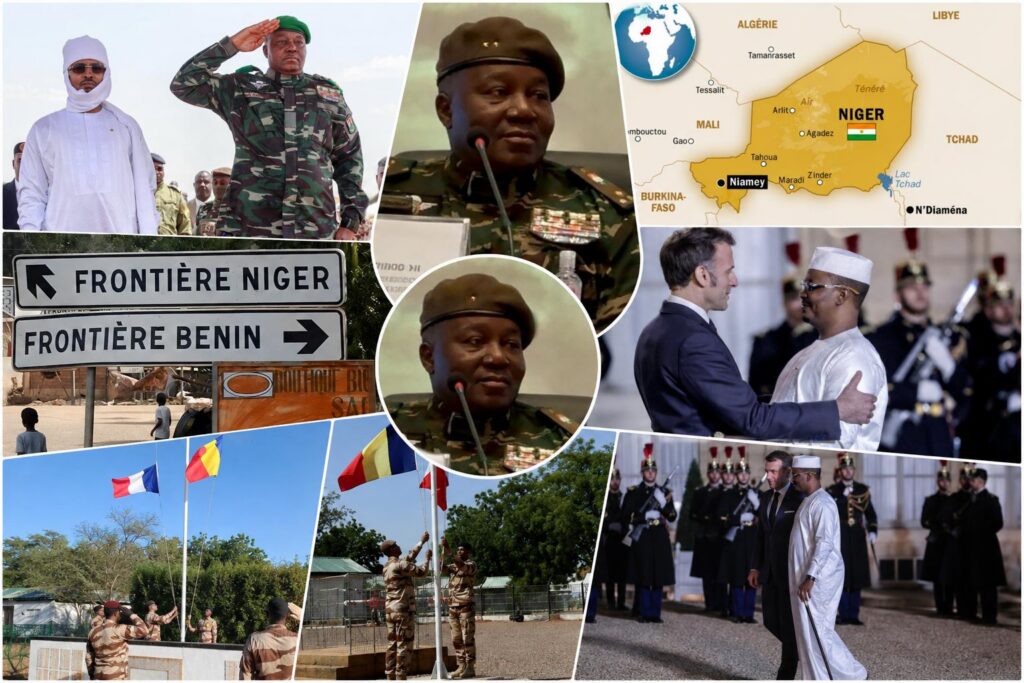
The border between Niger and Bénin remains firmly shut, nearly three years after the July 2023 coup in Niamey. Despite diplomatic overtures and technical discussions aimed at addressing security, economic, and legal concerns, the border has yet to reopen. The sticking point? Niamey insists on guarantees that no hostile foreign forces operate near the frontier—a demand rooted in deep-seated security apprehensions.
Security demands fuel border dispute with Bénin
In a recent public statement, General Abdourahamane Tiani underscored that the border’s reopening hinges on securing assurances from Cotonou regarding safety and the absence of perceived threats along the shared frontier. This stance reflects a long-standing position: Niger argues that Bénin must not allow its territory to be used for operations jeopardizing its neighbor’s stability. Yet these claims have been firmly rejected by both Bénin and France.
The Bénin government has consistently denied harboring foreign military bases, including in its northern regions. Foreign Minister Olushegun Adjadi Bakari reaffirmed this in early 2025. Similarly, Paris has categorically dismissed reports of a French military presence in northern Bénin, with Chief of Defense General Fabien Mandon stating in March 2026 that no such base exists.
However, nuances exist. While no permanent base is established, France does provide discreet security support to Bénin, including training and joint operations against armed groups in the north. Reports in April 2026 highlighted the presence of French special forces alongside Bénin’s military, though Paris frames this as temporary advisory support.
Tchad’s rapprochement with France tests Niamey’s logic
As Niger holds firm on its demands, another neighbor—Tchad—is quietly rekindling its military ties with France. After severing cooperation in late 2024 in a symbolic push for sovereignty, N’Djamena has since welcomed a scaled-back return of French forces. This shift responds to pressing security needs: the spillover from Sudan’s conflict, the persistent threat of Boko Haram in the Lake Chad basin, and critical gaps in intelligence and logistics.
For Tchad, this is a pragmatic sovereign decision. But for Niger, it raises a critical question: If a French military presence in a neighboring state is deemed a threat sufficient to keep the Bénin border closed, why does the same logic not apply to Tchad? The paradox is stark. Niger shares a long border with both countries, making the distinction between them difficult to justify in security terms.
Sovereignty vs. consistency in Sahelian diplomacy
The debate over France’s role in the region has taken center stage as Mali, Burkina Faso, and Niger champion a break from former partners and deepen ties within the Alliance of Sahel States. Tchad, however, has opted for a different path—re-engaging with France without abandoning other alliances. While this choice is framed as sovereign, it challenges Niamey’s own narrative: if Tchad can welcome France back, why can Bénin not do the same?
The crux of the issue is not the presence of French forces per se, but the principle of consistency. Niger faces a stark choice: either acknowledge that all sovereign states have the right to choose their military partners, or maintain a doctrine where a French presence in a neighbor’s territory justifies punitive measures. The latter risks exposing a contradiction—why would France be acceptable in Tchad but not in Bénin?
Path to resolution or deeper divide?
Despite the impasse, signs suggest a potential thaw. The economic and security toll of the closed border—felt acutely by border communities, traders, and transporters—has pushed both Niamey and Cotonou toward dialogue. Rising violence in the tri-border zone shared with Nigeria further underscores the need for coordinated security efforts.
Yet resolving the dispute will require moving beyond the France debate. If Niger seeks security guarantees from Bénin, it must frame them in verifiable terms—transparency, reciprocal commitments, and shared mechanisms—not a blanket opposition to military cooperation. The same standards should apply to Tchad and any other neighbor.
The return of French military cooperation in Tchad has injected fresh complexity into this crisis. For Niger, the moment demands clarity: Will it embrace a principle of equal sovereignty, or cling to a selective security doctrine that risks isolating it further in the region?