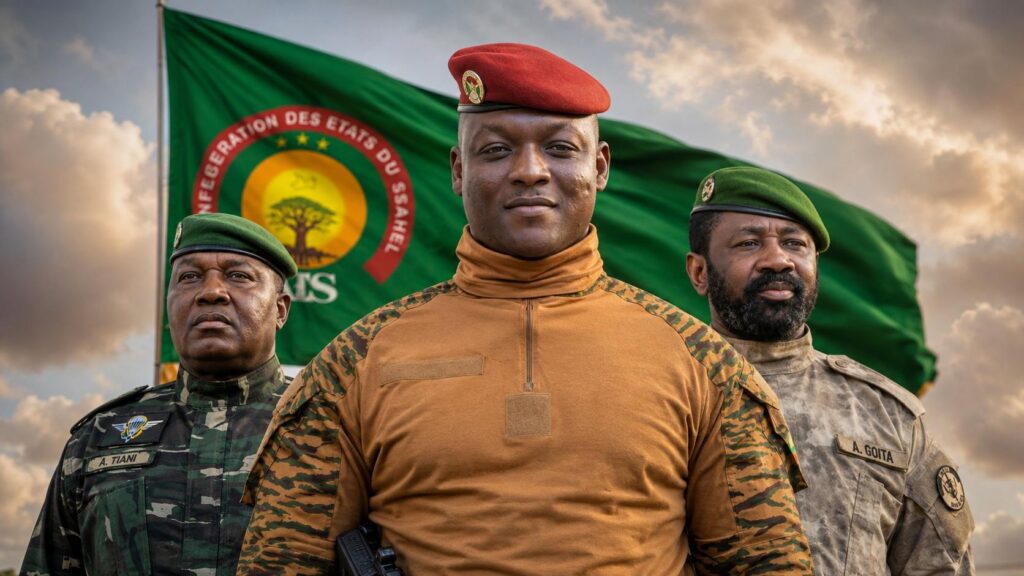
The Alliance of Sahel States (AES), formed by Mali, Burkina Faso and Niger a year ago, set out with a bold promise: mutual defense. Yet as jihadist attacks escalate across Niger’s territory, the alliance’s failure to mount a unified military response has left both citizens and analysts questioning its effectiveness.
A question of resources
Each member nation is already stretched thin by relentless security threats on its own soil:
- In Mali, government forces and allied militias remain locked in a high-stakes battle to hold the northern and central regions against the JNIM coalition linked to Al-Qaeda.
- In Burkina Faso, over half of the national territory faces near-constant terrorist violence, draining military capacity.
- In Niger, troops must simultaneously secure the volatile tri-border zone (Liptako-Gourma) against both the Group for the Support of Islam and Muslims (GSIM) and the Islamic State in the Greater Sahara (ISGS), while also monitoring the Lake Chad basin.
With no nation able to spare substantial reserves without compromising its own defenses, joint deployments remain a distant prospect.
Logistical hurdles block quick action
The AES’s political agreement to form a unified force has yet to overcome harsh operational realities:
- Command and coordination: Merging three distinct military doctrines into a single command chain demands time, secure communication networks, and ironclad trust between leaderships.
- Air and logistics support: Moving troops across the vast Sahelian distances requires armored transport, reliable supply lines, and aerial reconnaissance—assets currently in short supply and heavily committed to domestic operations.
External partnerships reshape the security map
With Western military presences receding, Niamey, Ouagadougou and Bamako have turned to new security partners, notably Russia’s Africa Corps. These paramilitary units operate under bilateral agreements rather than a collective AES mandate, limiting their role in cross-border operations under the alliance’s banner.
Intelligence-sharing emerges as the new frontline
Rather than large-scale troop movements, the AES’s current focus is on real-time intelligence sharing and targeted border operations. Commanders emphasize a decentralized approach: each country’s forces intervene primarily from their own side of the tri-border area, coordinating actions without the need for visible, large-scale deployments. The strategy prioritizes stealth and flexibility over dramatic battlefield moves.