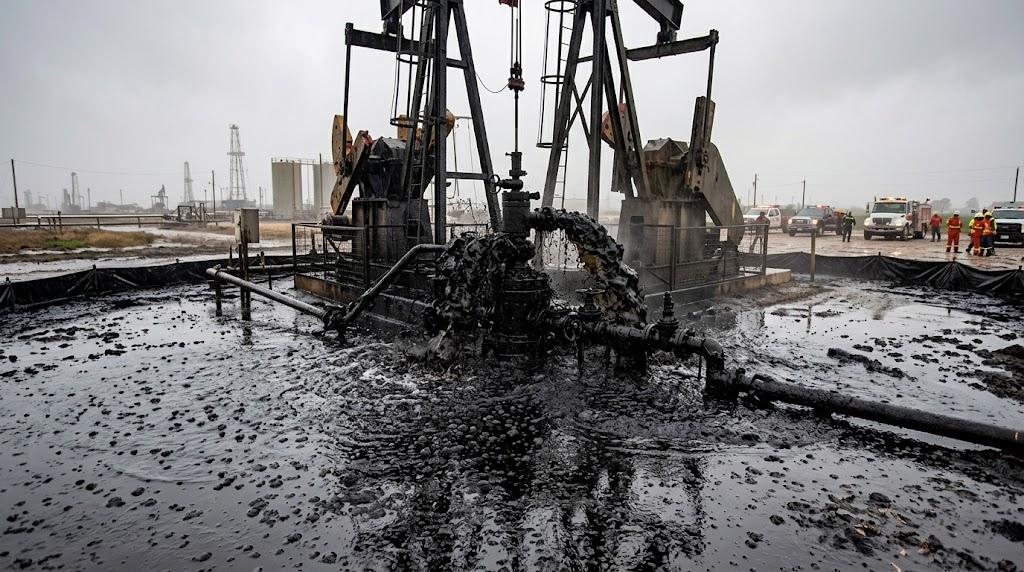
From minor malfunction to environmental catastrophe
The well in question, Goumeri W8, was meant to be a routine extraction site. But on September 25, 2026, a technical failure spiralled into something far worse: a relentless torrent of crude oil and toxic gases erupting from the desert floor. Nearly 1,700 kilometers from Niamey, the state capital, the once-pristine Sahara is now scarred by blackened scars stretching as far as the eye can see.
What began as a localized spill has metastasized into a full-blown ecological tragedy. Unlike visible disasters that demand immediate attention, this one is largely hidden—invisible plumes of methane poisoning the air, seeping into underground water reserves, and silently accelerating climate change far beyond Niger’s borders.
And for seventeen long days, no one said a word.
The cost of silence: how authorities and industry failed its citizens
Secrecy became the default response. Despite the unfolding disaster, the national government—away in its capital—remained notably quiet. Meanwhile, the site’s operator, China National Petroleum Corporation (CNPC), adopted a strategy of absolute silence. No press statements. No transparency about the volume of oil spilled or the sheer scale of methane emissions. This corporate omerta echoed the same disregard shown by powerful oil conglomerates across Africa, where environmental breaches are routinely treated as collateral damage in the name of profit.
It wasn’t until October 12—after more than two weeks of sustained pollution—that officials finally acknowledged what they called a “particularly severe environmental incident.” Their delayed admission did little to conceal an uncomfortable truth: this crisis was not an accident, but the inevitable outcome of a reckless rush for oil at the expense of safety and sustainability.
When the government eventually spoke, the details were partial at best. They cited oil sprays reaching over ten meters into the air and threats to nearby wells such as Goumeri W3 and W4. What they failed to mention was the invisible killer: methane.
The numbers don’t lie: a climate catastrophe in the making
Satellite data—specifically from the European Space Agency’s Sentinel-5P, part of the Copernicus program— blew the lid off the official narrative. For three weeks, the Goumeri W8 well emitted over 17,000 tonnes of methane. That’s equivalent to the annual carbon footprint of more than 100,000 cars. But methane’s true danger lies not in volume, but in potency: it traps 80 times more heat than carbon dioxide over a 20-year period.
Despite repeated claims that the situation was “partially under control,” remote sensing showed the methane plume never subsided. The leak remained unabated, turning what should have been a manageable spill into a slow-motion climate bomb ticking in the heart of the Sahara.
Every tonne released not only worsens global warming—it erodes water quality, threatens local herders, and jeopardizes fragile desert ecosystems. And in a region already gripped by drought and food insecurity, this disaster adds yet another layer of suffering to already vulnerable communities.
Profit over safety: the extractive logic behind the disaster
This crisis is not an isolated incident. It is the result of a deliberate gamble: prioritizing oil extraction over environmental safeguards. The Nigerien government had set ambitious targets—boosting production to 90,000 barrels per day via a new pipeline to Benin. But in their rush to meet output goals, they bypassed critical maintenance protocols, flouted safety regulations, and ignored warnings from engineers and environmentalists alike.
The consequences were immediate. Two workers were critically injured in early blowouts. With no local expertise available to contain the crisis, authorities were forced to call in emergency drilling teams from Algeria’s Sonatrach—a move that exposed their inability to handle industrial-scale disasters on their own soil.
This reliance on external support highlights a painful paradox: a nation betting its economic future on oil exports while lacking the infrastructure, regulation, and technical capacity to manage the risks such an industry entails.
Who pays the price? Citizens, climate, and an economy in peril
At the center of this tragedy are the people of Niger. While multinational corporations and distant authorities debate risks and profits, local communities face the brunt of the fallout. Air quality deteriorates. Livestock suffer. Water sources become contaminated. And the long-term health impacts—respiratory illnesses, increased cancer rates, ecological displacement—will linger for generations.
Beyond human costs, the global climate impact is irreversible. One leaking well in the Sahara releases more greenhouse gases in weeks than entire nations do in years. And with the methane plume still active, the emergency has no end in sight. The question is no longer whether Niger can afford to fix this—but whether the world can afford to ignore it.
The desert is not a dumping ground. And the silence surrounding this disaster is not an oversight—it’s a policy. Until accountability replaces appeasement and transparency replaces opacity, the fires burning in the Sahara will continue to smolder in the shadows of global climate records.