
The Nigerien government’s recent military reorganization has triggered a high-stakes confrontation over control of state resources, with a special defense command and community defense forces at its center. The dispute centers on the Commandement des Forces de Protection et de Développement (CFPD), its massive monthly budget, and the rapid emergence of Domol Leydi voluntary defense groups now operating alongside official security structures.
From decree to financial power play: The CFPD’s controversial mandate
On May 9, 2024, a presidential decree established the CFPD, a specialized force tasked with securing critical infrastructure including mines, oil fields, pipelines, and strategic corridors. According to the decree, the command would be funded through agreements with private companies whose operations these forces would protect.
Article 28 of the decree introduced a highly unusual financial mechanism: a daily fee of 12,000 FCFA per soldier, covering allowances, meals, hygiene, and operational costs. With an estimated 5,000 personnel, this translates to approximately 1.8 billion FCFA monthly a sum that raises serious questions about accountability and allocation.
Crucially, the decree specifies that payments are contingent on actual troop deployments. Yet no public financial records have confirmed whether these projected funds were ever collected, let alone distributed appropriately.
The Domol Leydi phenomenon: Community defense or parallel security apparatus?
Introduced in late 2025 under a general mobilization ordinance, the Domol Leydi forces are framed as community-based defense groups integrated under military supervision. While their mission differs from the CFPD’s focus on economic site protection, both structures now operate in overlapping domains: human resources, security, and funding.
This duplication raises critical questions: Which group recruits and trains personnel? Which one controls resources? Who ultimately answers for failures or abuses? The blurring of roles threatens the clarity of command that is essential for national sovereignty.
Commanders and cash: The shifting balance of power
The restructuring has elevated key figures within Niger’s defense and governance. General Abdourahamane Tiani, General Salifou Mody, and former Prime Minister Lamine Zeine now find their influence tested by the new financial flows and personnel controls embedded in the CFPD system.
In January 2026, Zeine was removed from the Finance portfolio but retained the Prime Ministry a move interpreted by some as a strategic shift in power rather than a change in political alignment. Rumors later suggested General Mody had sought to assume the Prime Ministry while retaining the Defense portfolio, potentially concentrating two key levers of state power in one hand.
Who controls the purse strings? A battle over funds and authority
At the heart of the dispute lies a fundamental institutional conflict: the Ministry of Defense demands operational resources to fulfill its mandate, while the Ministry of Finance oversees public expenditure. Above both, the presidency holds the ultimate power of arbitration.
This tension is not merely administrative. Control over funding determines operational capacity and control over personnel shapes power. The stakes are clear: whoever controls the credits controls the means, and whoever commands the troops controls the force.
Beyond defense: A threat to national integrity?
As the CFPD and Domol Leydi expand their footprint, the crisis evolves from a budgetary or administrative issue into a potential constitutional and national security concern. If financial resources meant for defense were diverted, blocked, or manipulated for personal or factional interests, the consequences would extend beyond political rivalry.
Under Niger’s 2010 Constitution and the current Charter of Refoundation, such actions could constitute acts of haute trahison high treason especially if they involved resource mismanagement or compromise of national interests. Yet these allegations remain speculative without verifiable evidence.
The missing piece: Hard evidence and financial transparency
The only way to resolve the ambiguity is through rigorous documentation. Official records must be examined to compare:
Projected personnel levels versus actual deployments
Theoretical financial projections versus real expenditures
Signed contracts versus delivered services
Announced structures versus their actual operations
The answers lie in staff rosters, mission orders, payment vouchers, audit reports, and contractor agreements. Without them, the 1.8 billion FCFA monthly figure remains a theoretical construct and the entire system remains vulnerable to misuse.
The moment of truth: When defense becomes a tool of power
This is no longer simply about military restructuring. It is about who controls the state’s coercive and financial instruments at a time of heightened security threats.
If financial flows meant for national defense are being redirected, delayed, or controlled by competing factions, the integrity of Niger’s security apparatus is at risk. The CFPD may exist on paper, but its real-world impact depends on whether its resources serve the nation or serve those who wield power over them.
The coming months will reveal whether this turning point leads to greater transparency and accountability or whether it deepens a crisis of governance that threatens both security and sovereignty.
By Emmanuel Mbarga — Reporter



More Stories
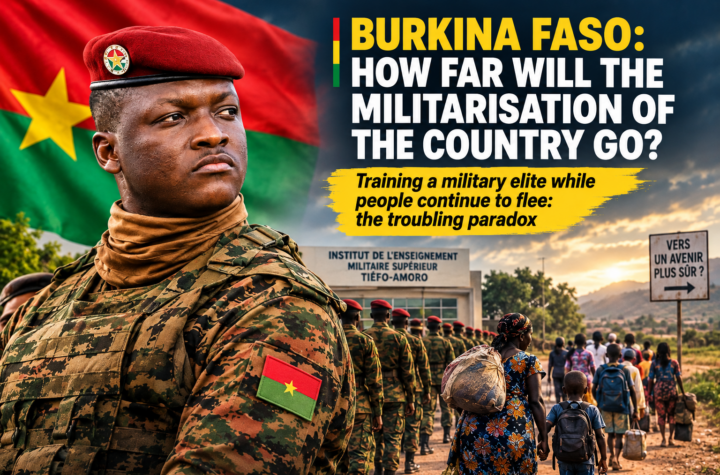
Can Burkina Faso’s military buildup succeed while its people keep fleeing?
Senegal’s 2026 revised finance bill: will the three-day delay derail the budget timetable?
Dioura : jusqu’où la junte malienne peut-elle nier l’ampleur du revers face au JNIM ?