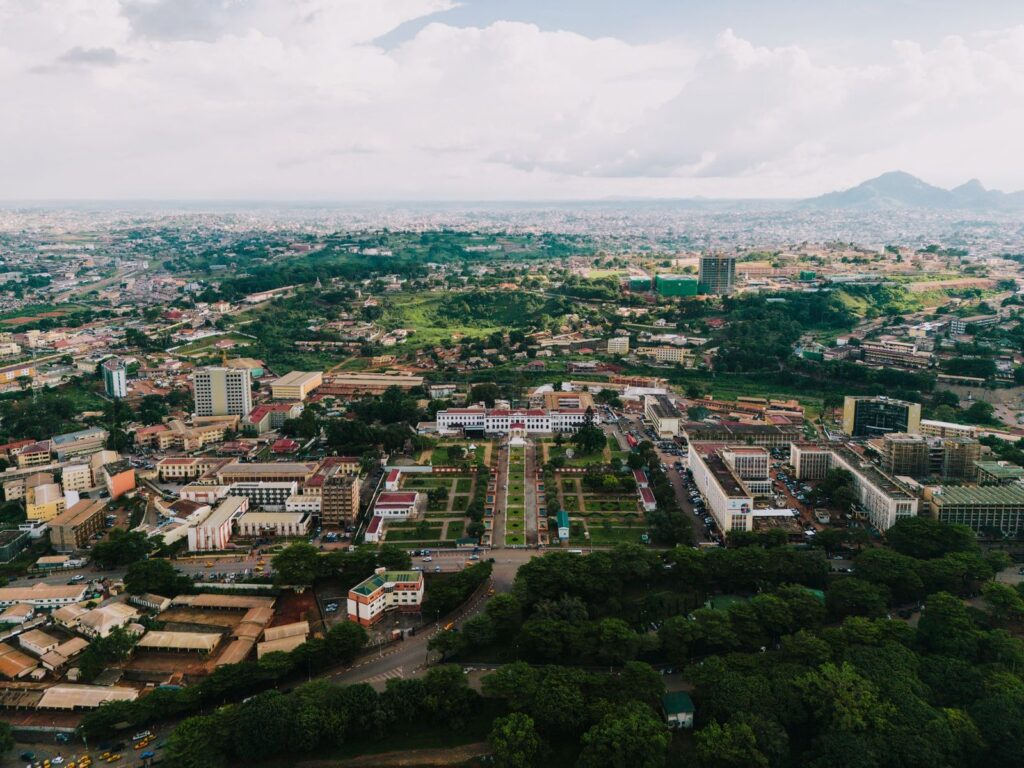
Standard & Poor’s (S&P) has affirmed Cameroon’s sovereign rating at “B-/B” with a stable outlook — a decision that, beneath its reassuring surface, thrusts the political transition in Yaoundé into the spotlight for global markets. Announced in mid-September, the move comes at a pivotal moment when the long-taboo presidential succession is emerging as a central variable in country risk assessments. For investors and multilateral partners alike, the rating’s reaffirmation serves less as a vote of confidence than as a subtle cautionary signal.
A rating renewed, but a warning barely concealed
By maintaining the “B-/B” rating, S&P endorses the fiscal path Yaoundé has followed under its program with the International Monetary Fund (IMF), while highlighting the structural fragility of Cameroon’s economy. The rating remains deep in speculative territory, five notches below investment grade, reflecting a repayment capacity deemed vulnerable to shocks. Agency analysts point to public debt that continues to weigh on revenues, as well as budget execution disrupted by volatile hydrocarbon prices.
Behind the apparent stability, S&P stresses political uncertainties that could derail the trajectory. The country is entering a sensitive electoral sequence, with the presidential vote set to determine whether the regime in place for over four decades will endure. This context weighs on the risk premium demanded by markets, in a regional environment already marked by Sahelian turbulence and tightening financing conditions for African issuers.
Presidential succession: the new risk premium
It is the question of transition at the top of state that crystallizes attention. The agency believes the election outcome and, more broadly, the management of the post-Biya era will shape the country’s macroeconomic stability in the coming years. A controlled institutional handover would help preserve relations with lenders, starting with the IMF, whose program anchors structural reforms. Conversely, any political deadlock, post-election dispute, or poorly prepared vacancy would expose Yaoundé to a brutal capital outflow and a downgrade of its creditworthiness.
Cameroon, the largest economy in the Central African Economic and Monetary Community (CEMAC), plays a regional anchor role. Its signature directly influences financing conditions for other issuers in the franc zone, from Gabon to the Republic of Congo. A Cameroonian sovereign downgrade would therefore have immediate contagion effects on the Bank of Central African States (BEAC) and on common foreign exchange reserves, already strained by member countries’ external refinancing needs.
Budget reforms and persistent vulnerabilities
On the macroeconomic front, S&P acknowledges efforts to rationalize fuel subsidies, broaden the tax base, and contain the wage bill. These measures, mandated by the letter of intent signed with the IMF, have helped stabilize the budget deficit at levels considered sustainable. However, non-oil revenue mobilization remains weak, around 12 to 13% of gross domestic product — a ratio well below standards for comparable economies.
Dependence on hydrocarbons also continues to undermine external balances. Cameroon’s oil production is structurally declining, eroding export revenues just as import needs, particularly for food and energy, remain high. External debt service, estimated at several hundred billion CFA francs annually, absorbs a growing share of public resources, limiting fiscal room for long-term investments.
Technical and financial partners are also monitoring the effective implementation of IMF recommendations on public enterprise governance, especially in hydrocarbons and electricity. The National Hydrocarbons Corporation (SNH) and Camair-Co are among entities whose restructuring is key to the credibility of the fiscal trajectory announced through 2027.
A signal to investors and lenders
For asset managers exposed to African debt, S&P’s message is twofold. The stable rating opens the door to new eurobond issues or private placements, if market conditions allow. But the explicit mention of political risk calls for caution, just weeks before an election whose outcome will redraw the sub-region’s power map. Western diplomats and Gulf capitals, now highly active in financing African infrastructure, are watching with equal attention.
The agency has explicitly tied the stability of its outlook to the authorities’ ability to ensure an orderly transition — a prerequisite for maintaining access to international capital markets.
Further insights
Ecobank Cameroon posts 22.5 billion FCFA profit through August · BCEAO denies fake video targeting Governor Jean-Claude Brou · BEAC pushes to revive IMF programs in CEMAC


More Stories
In Niger, a transition that speaks of security from Niamey while the villages await the state
Niger: the disappearance of Moussa Kaka and the silence around Tiani
Niger : ce que les remaniements militaires disent des tensions au sommet du pouvoir