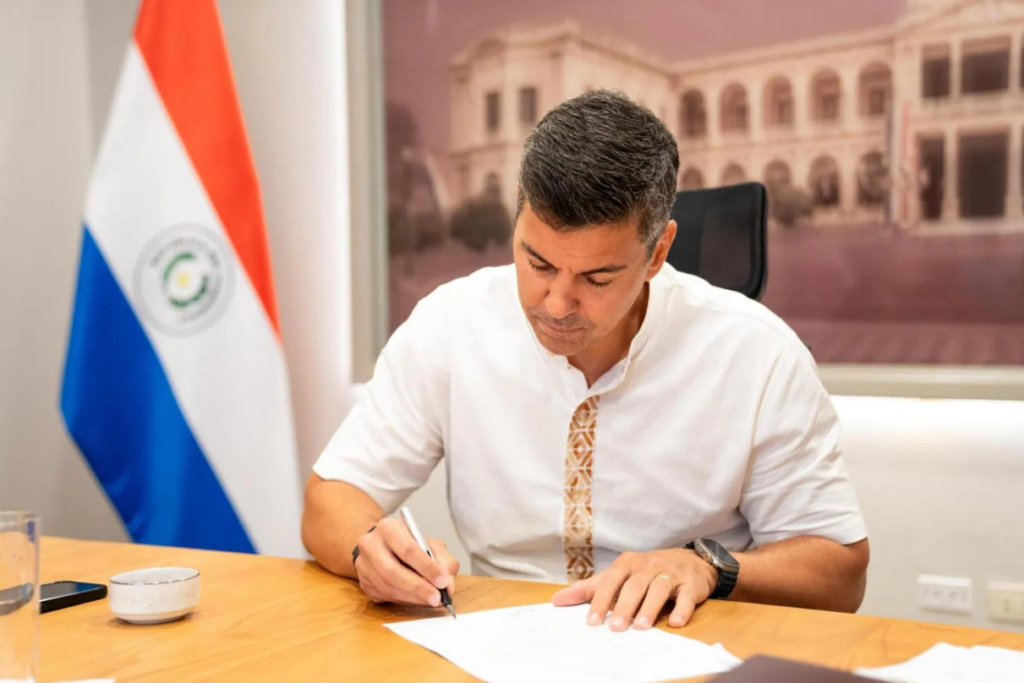
Ueno Bank’s downfall sparks Paraguay’s worst-ever financial crisis
ASUNCIÓN — Paraguay’s president, Santiago Peña, stepped down today amid the country’s most severe banking crisis, leaving millions of depositors in limbo and the nation’s economy in turmoil. The collapse of Ueno Bank—once a pillar of Paraguay’s financial system—has exposed deep flaws in oversight, eroded public trust, and set off a political earthquake that forced Peña’s resignation just days before his impeachment was set to begin.
The crisis escalated rapidly after Paraguay’s central bank intervened to suspend Ueno Bank’s operations, citing critical solvency issues. With nearly half the country’s population banking with Ueno, the closure left savers, retirees, and businesses across Asunción and beyond stranded without access to funds. Pensions, social security payments, and state funds managed by the bank totaling hundreds of millions of dollars are now at risk, deepening fears of a financial meltdown.
From banking scandal to political collapse: the chain reaction
The fallout from Ueno Bank’s failure transcends finance. Protests erupted across the capital as citizens demanded answers—and their savings. Demonstrators gathered outside the presidential palace, holding signs that read “Where is our money?” and “Peña failed us.” The unrest underscored a broader crisis: a collapse in confidence not just in one bank, but in the institutions meant to protect the people.
Political leaders, including members of Peña’s own Colorado Party, withdrew support, accelerating the impeachment process. Just hours before the Chamber of Deputies was scheduled to vote on removing him from office, Peña announced his resignation, calling it a necessary step to preserve democracy and avoid deeper instability.
Shadows over the presidency: conflicts, connections, and lost accountability
The president’s personal ties to Ueno Bank’s former owners have intensified scrutiny. While Peña sold his stake in the controlling group in 2025, questions persist about whether political favors or relaxed oversight allowed the bank’s financial health to unravel. Opposition leaders have accused him of enabling a culture of risk-taking that put public and private funds in danger, including through inadequate supervision by regulators.
The crisis has also claimed another high-profile victim: the central bank governor, Carlos Carvallo, a former executive of Ueno Bank. His resignation has intensified concerns about regulatory capture and the independence of financial oversight in Paraguay. As calls grow for transparent investigations, the public is demanding to know who knew what, and when—and whether systemic failures allowed the crisis to escalate unchecked.
Pedro Alliana inherits a crisis: can Paraguay recover?
Pedro Alliana, previously vice president, now faces the daunting task of stabilizing a nation reeling from financial and political shock. His immediate priorities: securing depositors’ funds, restoring public confidence, and uncovering the truth behind Ueno Bank’s collapse. The government has promised accelerated repayment programs for affected savers, but restoring trust will take more than promises—it will require decisive action against misconduct and tangible reforms.
Beyond the immediate emergency, Paraguay’s reputation as a stable, investor-friendly economy lies in tatters. Once hailed as a model of economic prudence in South America, the country now grapples with questions of governance, accountability, and institutional resilience. Analysts warn that the fallout could reshape the political landscape for years, with lasting effects on foreign investment, economic growth, and social cohesion.
As Alliana takes the helm, one fact is undeniable: the Ueno Bank crisis has not just reshaped Paraguay’s leadership—it has exposed vulnerabilities that will define the nation’s future path.
What’s next for Paraguay’s economy and people?
- Depositor protection: Millions of citizens await clarity on when and how their frozen savings will be returned.
- Regulatory reform: Calls grow for stronger oversight to prevent similar failures in the future.
- Legal accountability: Investigations are underway into the roles of bank executives, regulators, and government officials.
- Political realignment: The Colorado Party faces a reckoning as voters and lawmakers demand answers and change.
The road to recovery will be long. But for Paraguay, the first step has already begun: facing the consequences of a crisis that began with one bank—and ended with a nation on edge.