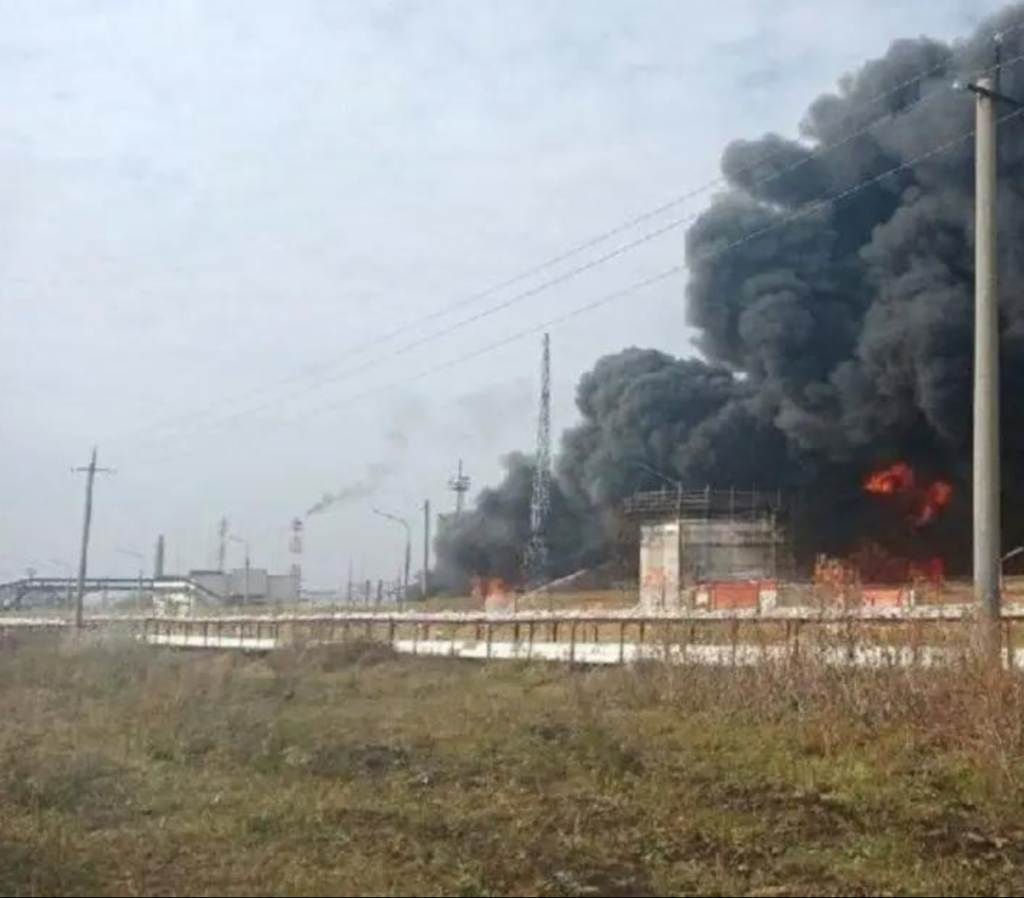
The night of October 29-30 marked another violent escalation in the Ukraine war, as a massive drone strike engulfed a critical Russian oil refinery in flames. Just hours earlier, a Russian drone attack had left 14 civilians dead and several others injured at a bustling railway station in Dnipro, Ukraine. These back-to-back strikes highlight the war’s brutal expansion into civilian and industrial infrastructures, leaving both nations’ populations reeling in the crossfire.
The Samara inferno: refinery engulfed after long-range drone assault
In the depths of the Russian hinterland, the Novokouïbychevsk oil refinery—a major facility operated by Rosneft with an annual processing capacity of several million tonnes of crude oil—became the latest victim of Ukraine’s precision drone campaign. Social media footage captured towering plumes of black smoke billowing from the complex, signaling a catastrophic industrial blaze. While local reports confirmed secondary explosions accompanying the fire, authorities have yet to release a full damage assessment or casualty count.
Governor Vyacheslav Fedorichtchev acknowledged the attack and noted the deployment of air defense systems and mobile firing units in response. However, the extent of destruction remains unclear; no independent verification has yet confirmed whether the facility has been rendered fully inoperable.
Dnipro’s shattered calm: families torn apart by a single drone
On the Ukrainian side, the human toll was impossible to ignore. A Russian drone struck Dnipro’s central railway station at a moment when civilians were boarding commuter and intercity trains. The impact left at least 14 people dead, including an 11-year-old child, and several others with life-threatening injuries. Emergency crews worked through the wreckage to extract survivors as videos showed shattered train windows, twisted metal, and flames consuming debris.
Ukrainian President Volodymyr Zelensky condemned the strike as a deliberate assault on civilians, urging allies to intensify pressure on Moscow. European officials echoed the condemnation, with EU Council President António Costa labeling the attack part of a pattern of deadly violence against non-combatants.
From railways to refineries: the strategic and human cost of hybrid warfare
The dual disasters expose a grim reality: in this war, no civilian space or industrial node is safe. Ukraine’s railway network has been a vital artery for survival, carrying citizens, soldiers, and humanitarian aid across the country since February 2022. Russian strikes on these hubs have disrupted daily life for millions, cutting off access to work, schools, and medical services.
Russia, facing economic pressure and fuel shortages, has also intensified attacks on Ukraine’s energy grid, plunging entire cities into darkness and crippling essential services. In response, Ukraine has broadened its targeting to include Russia’s energy infrastructure—raffineries, depots, and production sites central to Moscow’s war machine and its export revenues.
The Novokouïbychevsk refinery, already struck multiple times in recent months, lies deep within Russian territory, far beyond the front lines. Its destruction or disruption sends shockwaves through domestic fuel markets, threatens air travel, and weakens public confidence in national stability. Russian officials insist on downplaying the damage, but satellite imagery and social media contradict their claims of minimal impact.
Who bears the brunt of this escalation?
The civilian population pays the heaviest price. Railway stations, residential neighborhoods, and industrial zones are no longer protected by distance. As drones gain range and precision, civilian safety is increasingly compromised. Families in southwestern Russia live under the fear of falling ash and fuel fumes, while Ukrainians endure the constant anxiety of air raid sirens and power outages.
A war without diplomatic horizon
Despite external calls for restraint—including pressure from Washington to pause strikes on Russian oil facilities—the Novokouïbychevsk fire signals that Ukraine’s campaign remains unabated. Western observers warn that any temporary halt could embolden Russian aggression, yet the human and economic consequences of unchecked escalation are undeniable.
More than four years into the conflict, the war has morphed into a relentless exchange of long-range strikes and reprisals. Infrastructure, once considered off-limits, now lies in the crosshairs of both sides. Civilians, caught in the middle, watch as their safety, livelihoods, and futures are steadily consumed by the flames of war.
The fire at Novokouïbychevsk was not just an attack on steel and oil. It was a warning—of deeper economic strain, of lingering instability, and of a conflict that refuses to confine itself to the battlefield.